


Who’s Visiting Indonesia after Covid-19?
EDA : A closer look by Top 20 and Top 5 at where the world’s travelers come from on post pandemic period 2023–2025.
When the borders reopened, the planes didn’t just bring back travelers they brought back stories, accents, and energy from every corner of the world. Indonesia, one of Asia’s most diverse travel destinations, quickly became a stage for that comeback. From 2023 to 2025, international arrivals have grown not just in numbers, but in variety showing how global tourism has reshaped itself in the post-pandemic era. Using official data that tracks monthly visitor counts by nationality from BPS ( Badan Pusat Statistik) Indonesian Statistic Center, we can see exactly who is returning, when they’re coming, and how the world’s travel patterns have shifted. Behind every statistic lies a bigger picture one of recovery, curiosity, and a rediscovered love for exploring the islands of Indonesia.
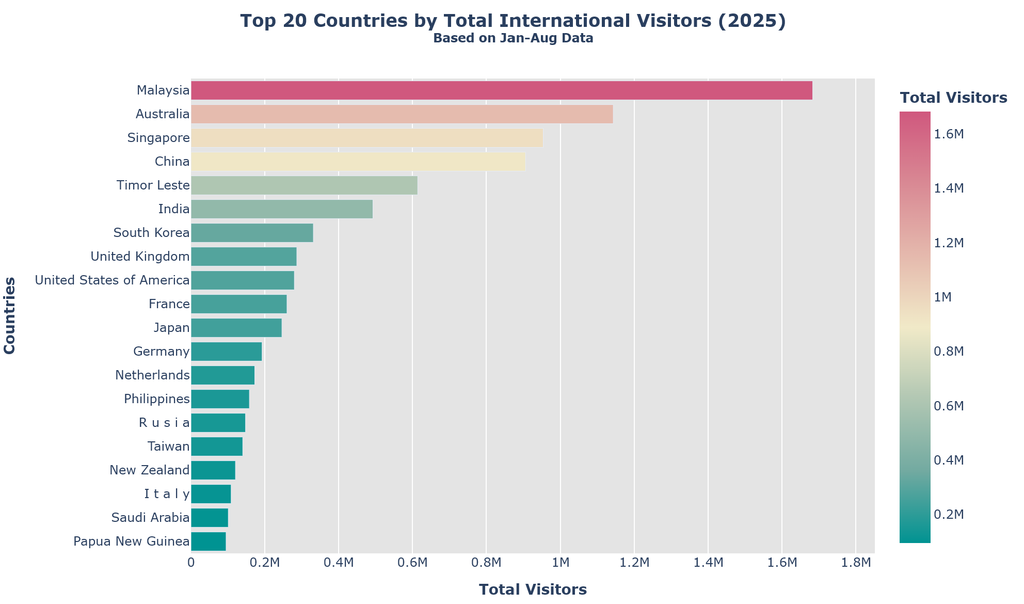
Since the dataset includes arrivals from more than 230 countries, analyzing every single one would feel like trying to count every wave that touches Indonesia’s shores. To keep things focused and meaningful, I narrowed the scope down to the Top 20 nationalities the countries that consistently contribute the highest number of visitors between 2023 and 2025. These nations represent the majority of Indonesia’s inbound tourism and give us a clear snapshot of global travel behavior who’s flying in the most, which regions are recovering fastest, and how travel preferences have shifted in the post-pandemic world. By focusing on these top contributors, we can uncover not just raw visitor counts, but the deeper story behind them the return of familiar travelers, the rise of new ones, and how Indonesia’s place in the world’s travel map has evolved over time.
Who’s been traveling to Indonesia the most in 2025 ? at least up to August. And unsurprisingly, our closest neighbors are leading the way. Malaysia tops the list by a huge margin, with over 1.7 million visitors, showing just how strong cross-border tourism has become again. The convenience of short flights, visa-free travel, and cultural familiarity keeps Malaysia at the top of Indonesia’s tourism market. Following behind, Australia and Singapore continue to play their long-standing roles as consistent inbound markets, driven by both leisure and frequent business travel. Together, these three countries alone already represent a large share of total international arrivals this year proof that proximity still plays a major role in post-pandemic travel decisions.
Beyond the top three, we see a fascinating mix of visitors from China, Timor Leste, India, and South Korea, each reflecting different kinds of travel demand. China’s return marks the slow but steady comeback of large group tourism, while India and South Korea are showing strong year-over-year growth fueled by new flight connections and lifestyle travel segments like weddings, surfing, and digital nomadism. What’s also refreshing is the diversity further down the list travelers from the United States, France, Japan, Germany, and Papua New Guinea are making their way back to Indonesia in significant numbers. These aren’t just tourists; they’re a reflection of how Indonesia has regained its global visibility. And since the data only covers up to August 2025, we can expect these numbers to climb even higher as the year-end holiday wave approaches the period when international flights, especially to Bali and Jakarta, are typically at their busiest.
Let’s step back a little to the ‘Covid-19 Recovery Year’ of 2023 and 2024, to compare with year 2025.
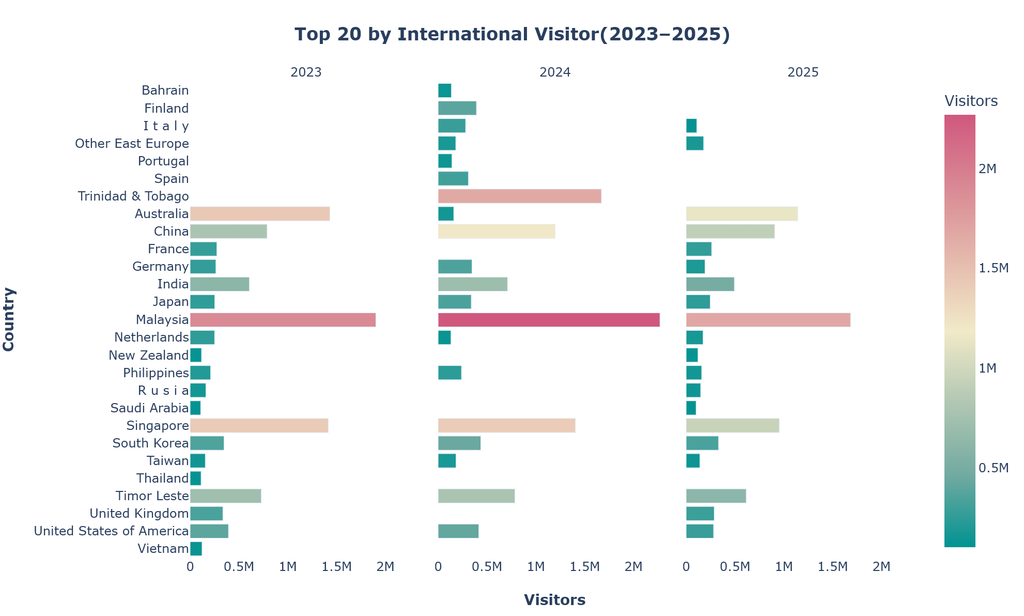
This plot gives a much clearer story of how Indonesia’s inbound tourism evolved from 2023 to 2025, and it shows just how dynamic the recovery really was. Starting in 2023, we can see the clear dominance of nearby countries like Malaysia, Singapore, and Australia all within short flight distances leading the post-pandemic rebound. These countries were the first to return in strong numbers, thanks to open travel corridors, geographic proximity, and pent-up leisure demand. Meanwhile, a few unexpected names such as Trinidad & Tobago and Timor Leste appear in the list, reflecting how even smaller or less traditional markets contributed during the early recovery phase when international travel was still rebuilding.
As we move to 2024, the chart highlights how the tourism flow began to stabilize. China made a solid comeback, moving higher in the rankings as outbound travel resumed, while European countries like Germany, France, and the UK showed consistent growth. The presence of Middle Eastern countries such as Bahrain and Saudi Arabia starts to become more visible, likely influenced by new flight routes and rising interest in both religious and luxury tourism experiences.
Then comes 2025, where we see a more diverse mix than ever. Malaysia still leads the way, but countries like China,Spain, and Saudi Arabia now feature more prominently marking a shift in the tourism landscape. What’s especially interesting is how some countries that didn’t even appear in earlier years, like Portugal and Finland, are now part of the top 20. This shows that as global travel confidence fully returned, more long-haul and high-spending travelers began exploring Indonesia.
Overall, the trend tells a story of global synchronization where not only Indonesia but many other countries regained their tourism rhythm. Nations with stronger post-pandemic economies and travel infrastructures recovered faster, allowing their citizens to travel again. By 2025, Indonesia isn’t just depending on its neighboring markets anymore; it’s once again welcoming the world in full color.
I tried to break this visit by continent of the country of origin:
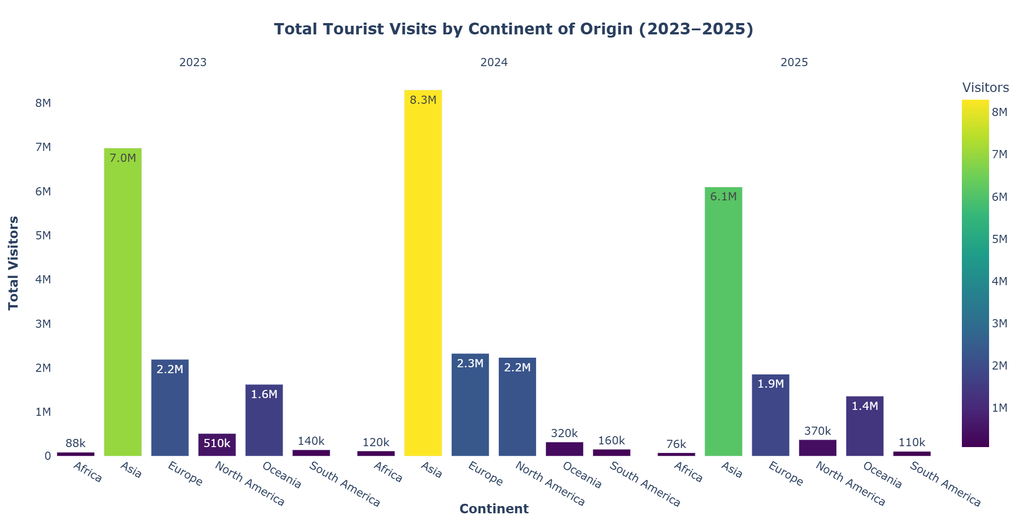
A big-picture view of where Indonesia’s international visitors actually come from, and it clearly shows that Asia has been the backbone of Indonesia’s tourism recovery between 2023 and 2025. In 2023, Asia contributed the majority share around 7 million visitors, which makes sense given Indonesia’s strong regional connectivity with neighboring countries like Malaysia, Singapore, China, and Australia, New Zealand (Oceania). As pandemic restrictions eased, short-haul travel rebounded first, so regional tourists were the earliest and fastest to return.
By 2024, we can see the tourism engine running even stronger Asia’s visitor count jumped to 8.3 million, showing that regional travel confidence had fully recovered. What’s equally interesting is how Europe and North America began catching up that year, reflecting long-haul travelers returning to destinations like Bali and Jakarta as flight capacity and global routes normalized. The Oceania market (mainly Australia and New Zealand) remained consistently high, sustaining Indonesia’s beach and adventure tourism segment.
Then in 2025, even though the total number from Asia slightly dropped to around 6.1 million, it’s not necessarily a decline rather a sign of stabilization as tourism flows spread more evenly across regions. Europe and North America kept steady momentum, showing that the rebound was now truly global, not just regional. Even smaller contributors like Africa and South America began showing small but steady numbers a good sign that Indonesia’s tourism appeal is diversifying beyond its traditional Asian and Oceanic base.
Overall, this continental view tells us that while Asia remains Indonesia’s tourism anchor, the post-pandemic years have brought a broader, more balanced visitor mix. The world is reconnecting with Indonesia again from regional neighbors looking for quick getaways to long-haul travelers seeking new, immersive experiences.
Let me narrow it to TOP 5 countries by accumulated year 2023–2025.
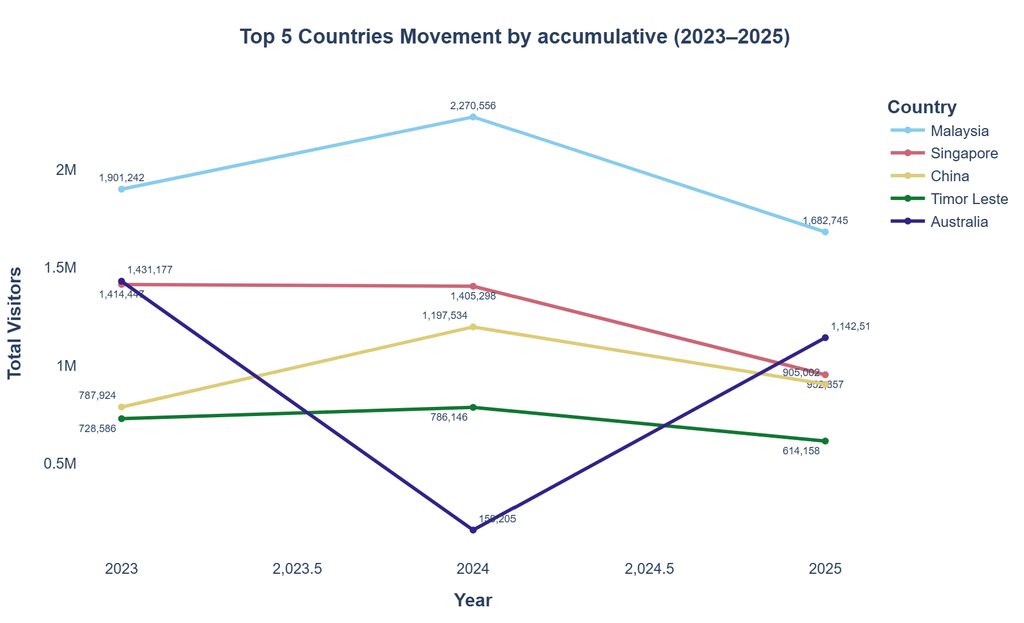
Showing how the top five visitor countries moved dynamically between 2023 and 2025( data up to August). If we look closely, starting with Malaysia, it’s clear why it remains Indonesia’s strongest tourism partner. The proximity, shared culture, and numerous daily flights made it the anchor market through the recovery years. Its visitor count rose from 1.9 million in 2023 to a peak of 2.27 million in 2024, before slightly cooling off in 2025 as regional travel normalized still, it’s far above any other country.
Singapore, though smaller geographically, has been another steady player. It hovered around the 1.4 million mark in both 2023 and 2024 but saw a dip to 900k in 2025, likely due to competition from new routes and shifting travel preferences within ASEAN. Meanwhile, China’s curve is fascinating a strong rise from 780k in 2023 to 1.19 million in 2024, reflecting its long-awaited tourism rebound, before easing again in 2025 as outbound travel patterns diversified.
Timor Leste maintained a modest but steady presence, reflecting the stability of cross-border visits rather than leisure tourism spikes an important regional connection. The most interesting comeback story, though, belongs to Australia. After a steep drop to just 150k in 2024 (possibly due to economic and airfare pressures), it shot back up to 1.14 million in 2025. This rebound likely mirrors Bali’s rising appeal and Australia’s growing middle-class appetite for regional travel.
In short, this chart shows that post-pandemic tourism isn’t linear it’s shaped by accessibility, affordability, and probably timing. Malaysia’s consistency, China’s quick rebound, and Australia’s big comeback paint a picture of a tourism landscape that’s both resilient and constantly evolving.
What if i try to make a forecast for the movement of this top 5.
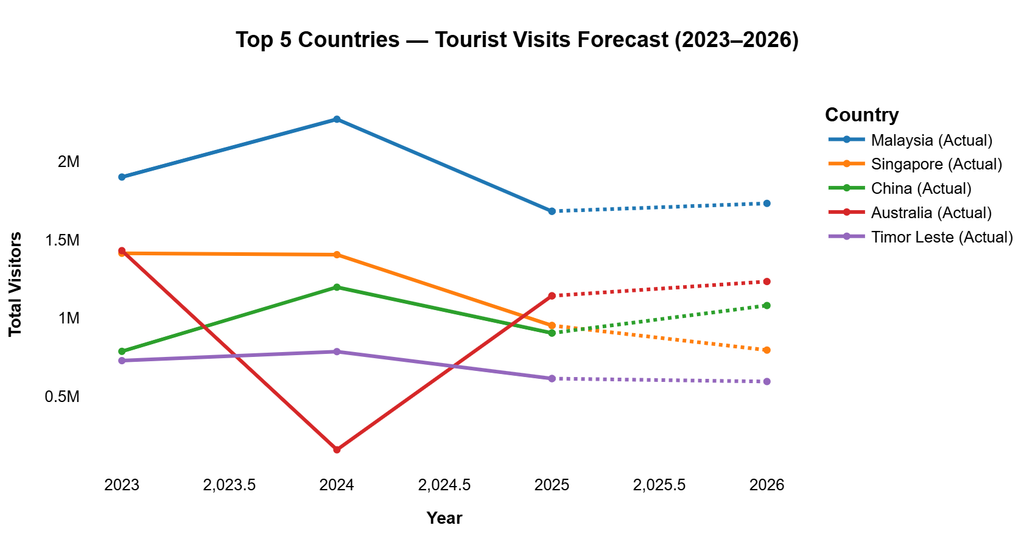
Let me try to forecast the movement and the outlook for 2026 looks quite optimistic. From this projection, Malaysia continues to hold its lead, showing signs of steady recovery momentum after the slight dip in 2025, while Australia’s line tells the most inspiring comeback story, rising sharply and predicted to sustain its upward trend through 2026. China also shows a healthy climb, signaling stronger outbound travel confidence as more flight connections and group tours resume. Singapore, though showing a small slowdown, remains one of Indonesia’s most consistent markets with stable regional flows. Meanwhile, Timor Leste stays steady, representing a loyal, close-border visitor base. Altogether, the pattern suggests that Indonesia’s tourism growth is entering a stabilization phase one marked by sustainable regional travel, stronger long-haul recovery, and a more diversified mix of visitors heading into 2026.
Since the 2025 data is only up to month august, let me try to make the prediction forecast till the end of the year as well.
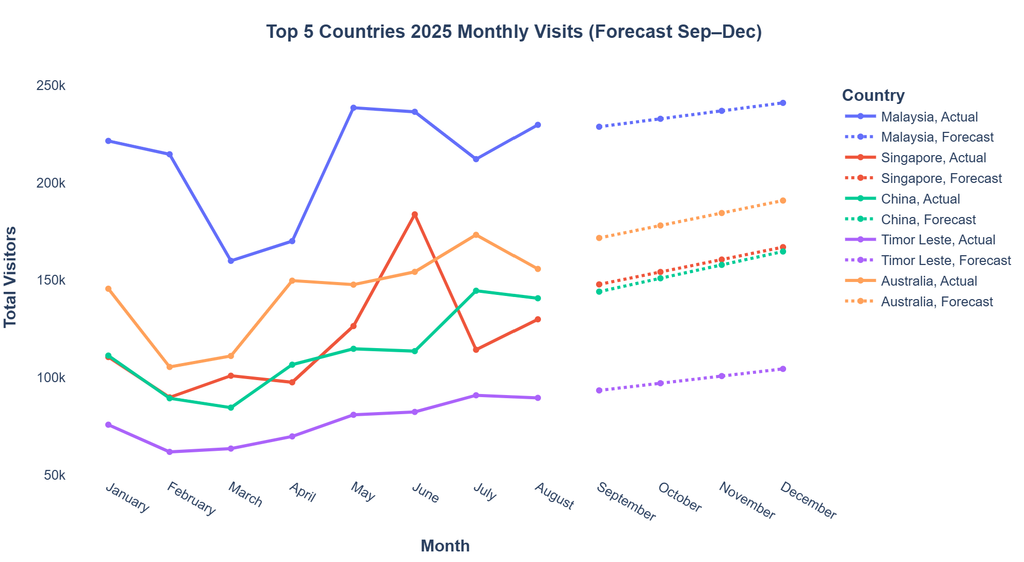
Continuing the forecast, here we take a closer look at the month-to-month movement from September to December 2025, filling in the months that haven’t been recorded yet. What’s interesting is how the forecast lines extend the already visible momentum showing a tourism scene that’s still lively even after the peak summer season.
Malaysia remains the consistent frontrunner, predicted to keep growing steadily toward the end of the year as short-haul travel and business trips maintain strong frequency. Australia shows a promising late-year surge, likely boosted by long holidays and the traditional end-of-year escape to tropical destinations like Bali. Singapore and China both follow an upward curve too, a sign that short-term leisure travel and shopping tourism continue to thrive in the final quarter. Even Timor Leste, though smaller in volume, maintains a subtle climb, hinting at the stability of regional border movements.
Altogether, this monthly projection paints an optimistic finish for 2025 a season where Indonesia’s inbound tourism keeps humming along, fueled by regional travelers and returning long-haul visitors preparing for another strong year ahead.
Data Source
The dataset used in this analysis was sourced from BPS ( Badan Pusat Statistic), Indonesian Statistic Center. Data Link : BPS dataset for visitor counts based on country to Indonesia 2028–2025
Author’s Notes:
The analysis presented here is purely for educational and exploratory purposes. This article is not a scientific study but a data analytics learning project based on publicly available datasets. Any statements should be understood within the context of the samples analyzed, not as universal conclusions.
The data analysis and visualization in this article i created by using Python, Plotly Express, Numpy Libraries & Pandas Libraries, and i utilized Chat GPT-5 Codex for code refinement ( make my coding short and tidy). Image (airport hustle) generated by Gemini : Nano Banana.