

From Lockdown Silence to Lobby Buzz, Indonesia’s Hotel Industry Post Covid.
EDA : Hospitality performance after uncertainty of covid-19
So far as we know in the beginning of year 2023, Indonesia’s hotel industry began to wake up again. After years of uncertainty, quiet lobbies, and half-empty rooms, the numbers finally started to move in the right direction. The hum of check-ins and suitcases rolling across marble floors returned slowly, but surely. Yet behind that sense of revival lies a more complex story. Some provinces bounced back faster than others, while a few are still catching their breath. By tracing hotel occupancy data from 2023 to 2025 based on Stars Hotels occupancy, we can see the rhythm of Indonesia’s hospitality comeback where it started, how fast it’s grown after 3 years of journey to pass the pandemic, and what it might tell us about the changing face of travel in the country.
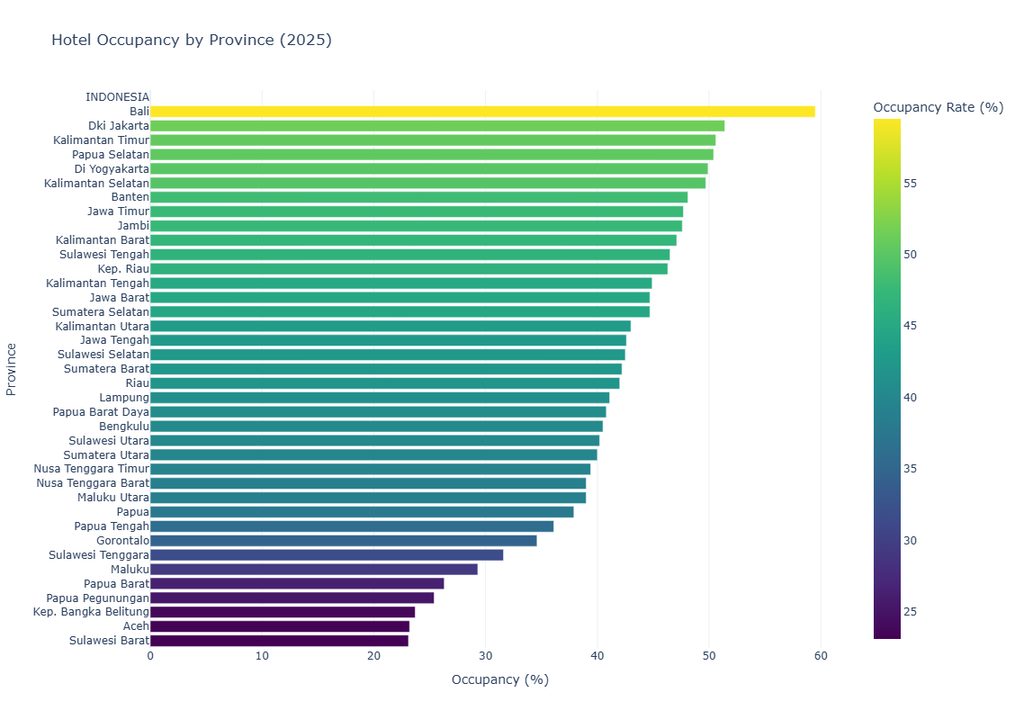
When we look at hotel occupancy by province for 2025 ( Dataset taken from BPS (Badan Pusat Statistik) / Statistic Center of Indonesia’s Government, the picture of Indonesia’s hospitality recovery becomes much clearer. It’s worth noting that this dataset only covers data up to August 2025, so the year isn’t fully complete yet. Even so, the numbers already tell a powerful story about how the country’s hotel industry is performing in its third year of recovery.
At the national level, the average occupancy rate hovers around 49–50%, but the differences between provinces are striking. Bali stands far above the rest, once again confirming its role as Indonesia’s tourism powerhouse. Despite years of disruption, the island has maintained its global appeal and now leads the nation’s hotel recovery with strong and consistent demand.
Just below Bali are Jakarta and East Kalimantan two regions that show solid resilience, but for different reasons. Jakarta’s rebound is driven by the return of business trips, conferences, and events, while East Kalimantan’s growth is boosted probably by the development boom around the new capital city project (IKN Nusantara). Interestingly, Papua Selatan and Yogyakarta also perform well, proving that local tourism and cultural destinations have become important anchors of domestic travel.
However, the story isn’t uniform across the country. Many provinces remain in the mid-30% to low-40% occupancy range, suggesting that recovery is still uneven. Regions such as Aceh, Sulawesi Barat, and Papua continue to face slower rebounds likely due to weaker infrastructure, fewer flight connections, and less reliance on mass tourism.
What’s most encouraging is the growing diversity of strong performers. Beyond Bali, we now see emerging hubs across Java, Kalimantan, and Papua starting to pick up pace. If 2023 was the year Indonesia’s hotels began to wake up, then 2025 even with only eight months of data shows a confident rhythm of recovery, one that’s expanding beyond traditional tourist centers and redefining the geography of hospitality in Indonesia.
To understand how far Indonesia’s hotel industry has come, we need to look back at where the recovery really began.
The years 2023 and 2024 tell an important part of this story the first wave of revival after the pandemic’s long shadow. By comparing these two years, we can see which provinces took the lead early and which ones struggled to keep up. 2023 was a year of reopening, where demand started to return but uncertainty still lingered. By 2024, travel confidence had grown stronger, local tourism picked up momentum, and hotel bookings began to show a more stable pattern. The difference between the two years reveals not just rising occupancy numbers, but also how Indonesia’s hospitality industry found its rhythm again after years of turbulence.
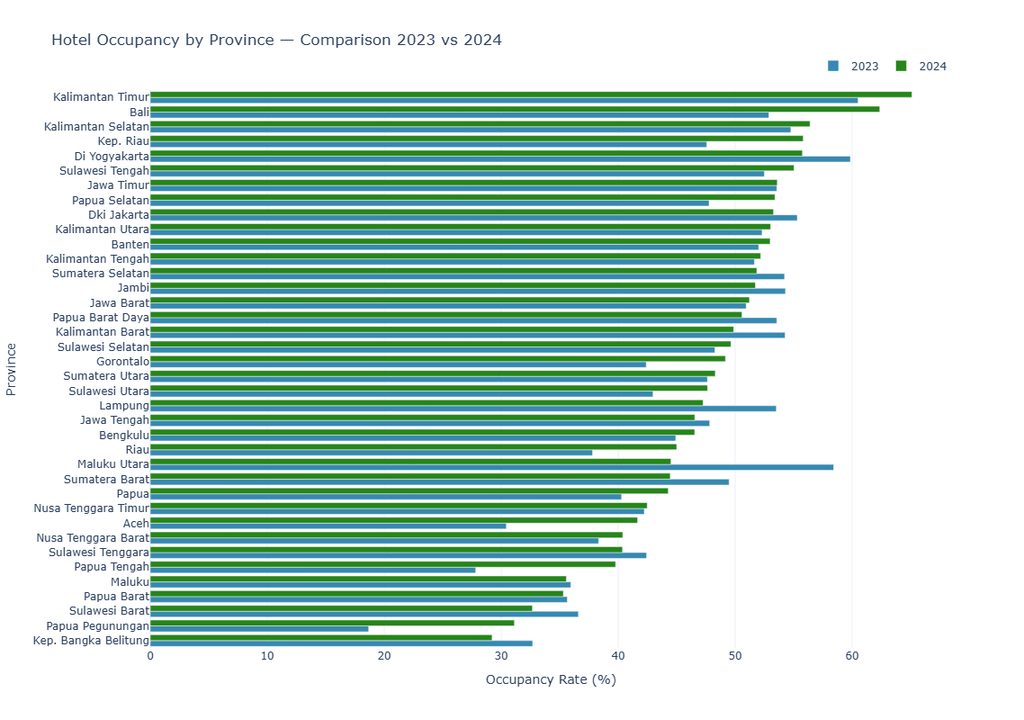
When comparing 2023 and 2024, the first thing that stands out is how much stronger and more even the recovery became across the country. Almost every province shows a noticeable rise in hotel occupancy, signaling that by 2024, Indonesia’s hospitality industry had moved from early rebound to real stabilization.
At the top of the list, East Kalimantan overtakes Bali with the highest occupancy growth. This is a major shift from the usual tourism pattern a clear sign of how the IKN Nusantara project ( started on July 2022-) has turned the region into one of Indonesia’s busiest hubs that time. Government staff relocations, infrastructure development, and an influx of business travelers have pushed hotel demand to new heights. Meanwhile, Bali remains incredibly strong, showing that leisure tourism continues to be the backbone of national hospitality, especially as international flights and festivals returned in full swing during 2024.
Other consistently high performers include South Kalimantan, Yogyakarta, and Central Sulawesi. Each represents a different strength: South Kalimantan’s mix of industrial and local business travel, Yogyakarta’s cultural and academic tourism, and Central Sulawesi’s rising domestic mobility. These provinces highlight how Indonesia’s recovery isn’t just about popular holiday spots it’s also powered by local economies and domestic travelers rediscovering regional destinations.
Looking more broadly, the overall spread between provinces has tightened fewer regions are stuck below 30%, showing that even slower-moving markets like Papua, Aceh, and Bangka Belitung have begun catching up. That’s important because it suggests the recovery is no longer limited to major urban or leisure destinations. Domestic tourism, regional conferences, and easier inter-island travel are helping smaller provinces find their footing again.
In short, 2023 was the year of reopening, while 2024 became the year of normalization. The hospitality pulse strengthened not only in Bali and Jakarta but across the entire archipelago. The data tells a hopeful story that Indonesia’s hotel industry is no longer surviving the aftermath of COVID-19, but steadily learning how to thrive again in a new era of travel.
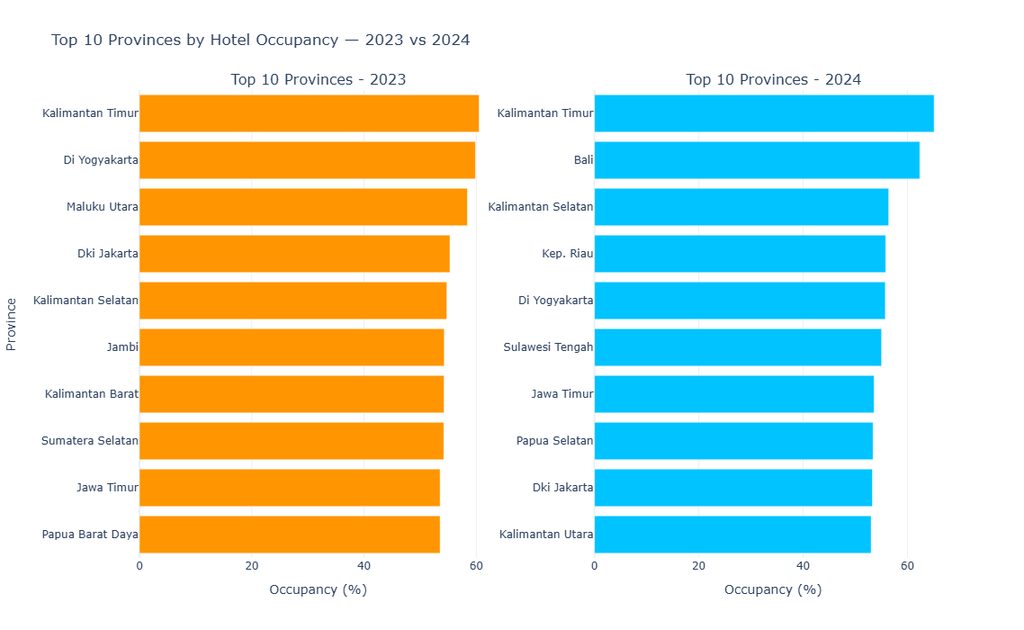
In 2023, Bali was notably absent from the top ten. That’s almost unthinkable for a province that once symbolized Indonesian tourism itself. Its absence reflects how deeply the island’s hotel sector was affected by the pandemic’s lingering effects. International travel was still limited, many foreign markets hadn’t fully reopened, and the local tourism ecosystem was still rebuilding its confidence. The top spots in 2023 were instead dominated by regions with strong domestic or business-driven travel, such as East Kalimantan, Yogyakarta, North Maluku, and Jakarta all areas that benefited from internal mobility rather than international tourism.
But by 2024, everything began to shift. Bali made a powerful comeback, climbing straight into second place, just behind East Kalimantan. This dramatic return signals that international arrivals had finally recovered, airlines had restored routes, and confidence among global travelers was back. The revival of major events, cultural festivals, and digital nomad communities also helped accelerate Bali’s rebound.
At the same time, East Kalimantan maintained its lead, showing how strong the economic impact of the new capital city project (IKN Nusantara) has been for hotel performance. Other provinces like South Kalimantan, Riau Islands, and Central Sulawesi also entered the 2024 top 10 evidence that Indonesia’s hospitality growth is spreading beyond traditional destinations.
The difference between these two charts tells an optimistic story. 2023 was a year defined by local strength, when domestic and business travel led the way. 2024, on the other hand, marks the return of international momentum. The combination of steady local demand and revived global tourism finally brought balance to the country’s hotel industry. And the fact that Bali once missing from the list now stands near the top is perhaps the clearest sign that Indonesia’s tourism heartbeat is fully alive again.
To see the full picture of Indonesia’s hotel recovery, we need to zoom out and look at the bigger timeline. The real story doesn’t happen in a single year it unfolds over time. By comparing the top 20 provinces from 2023 to 2025, we can trace how each region moved through its own recovery path. Some climbed steadily year after year, while others surged suddenly after a slow start. Together, they form a clear map of progress showing which provinces are leading the nation’s hospitality revival, and which are still finding their footing in a rapidly changing tourism landscape.
How is those 3 years post pandemic journey? let’s break it down to top 20, to get even more valuable insight!
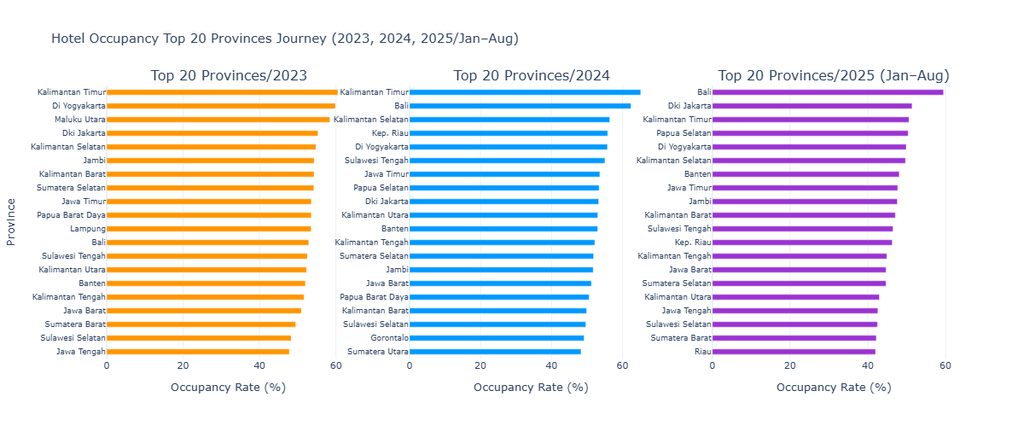
When the three years are lined up side by side, the journey of Indonesia’s hotel recovery becomes crystal clear a story not just of growth, but of shifting momentum across the archipelago. Each year tells a different phase of the comeback, 2023 was a cautious reopening, 2024 marked acceleration and stabilization, and 2025 (up to August) shows a confident stride toward normalcy.
Several provinces stand out for their remarkable consistency and upward progress. East Kalimantan is one of the strongest examples, maintaining a top position in all three years. What began as a localized business surge in 2023, fueled by the IKN Nusantara development, evolved into sustained demand through 2024 and 2025. Its hotels continue to benefit from government relocation programs, contractors, and long-term project workers turning the province into an unlikely but steady hospitality powerhouse.
Then there’s Bali, the emotional centerpiece of Indonesia’s tourism story. Absent from the top rankings in 2023, it reemerged spectacularly in 2024 and rose to the number one spot in 2025, even though data for that year only covers until August. This comeback captures the full revival of international tourism the return of global flights, packed beaches, digital nomads, and events that restored Bali’s identity as Indonesia’s hospitality heartbeat.
Yogyakarta also deserves recognition for its steady presence throughout all three years. Its mix of cultural, educational, and domestic travel continues to provide reliable demand. Similarly, South Kalimantan and Central Sulawesi show consistent improvement, proving that strong domestic tourism and regional business travel can keep performance rising even without heavy international traffic.
Another standout performer is Papua Selatan, which entered the top 20 in 2024 and climbed even higher in 2025. Its progress reflects how development and better connectivity in eastern Indonesia are beginning to translate into tangible hotel demand. On the other hand, traditional business hubs like Jakarta show stability not explosive growth, but a reliable base driven by conferences, events, and corporate travel.
Taken together, this three-year comparison paints a picture of Indonesia’s evolving hotel landscape. Recovery is no longer centered on a single destination like Bali or Jakarta it’s spreading outward. New regions are finding their rhythm, infrastructure investments are paying off, and domestic tourism has proven to be the silent force keeping the industry alive. If 2023 was the year of reopening and 2024 the year of balance, then 2025 marks the year of regional maturity when Indonesia’s hospitality story becomes not just about recovery, but resilience and reinvention.
How can we forecasting the rest of the year 2025? Here it the predictive model to tell about it.
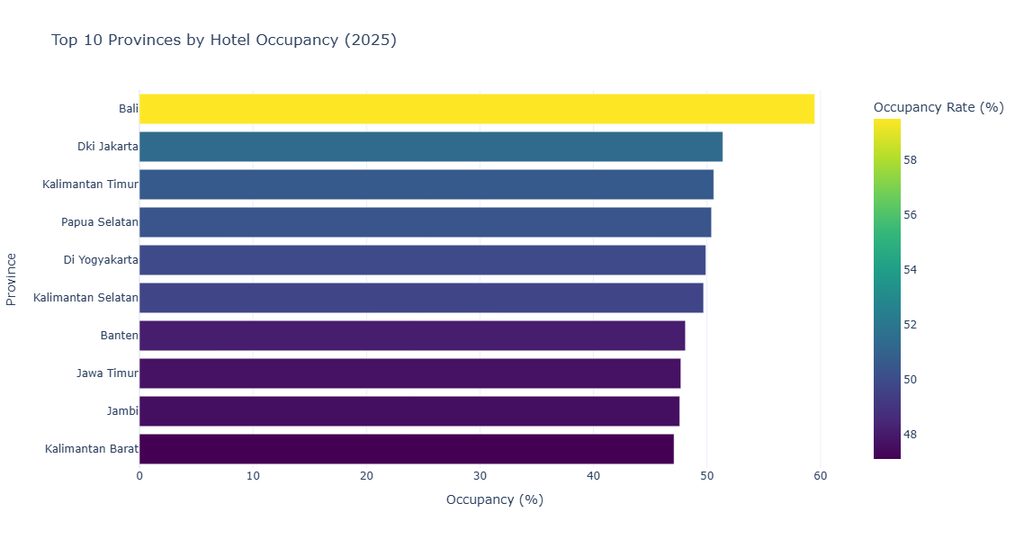
After seeing how far the recovery has come, it’s natural to wonder what’s next. With data already showing strong performance up to August 2025, we can make a reasonable forecast for how the year might close by December. This final stretch the last four months is often a decisive period for Indonesia’s hospitality industry, boosted by year-end holidays, local events, and the return of international travelers escaping winter from abroad. By projecting the trends forward, we can estimate which provinces are likely to hold their lead and which ones might rise unexpectedly. The next chart focuses on the top 10 provinces the ones setting the pace for Indonesia’s post-pandemic hotel boom and looks at how their performance might unfold as 2025 comes to an end.
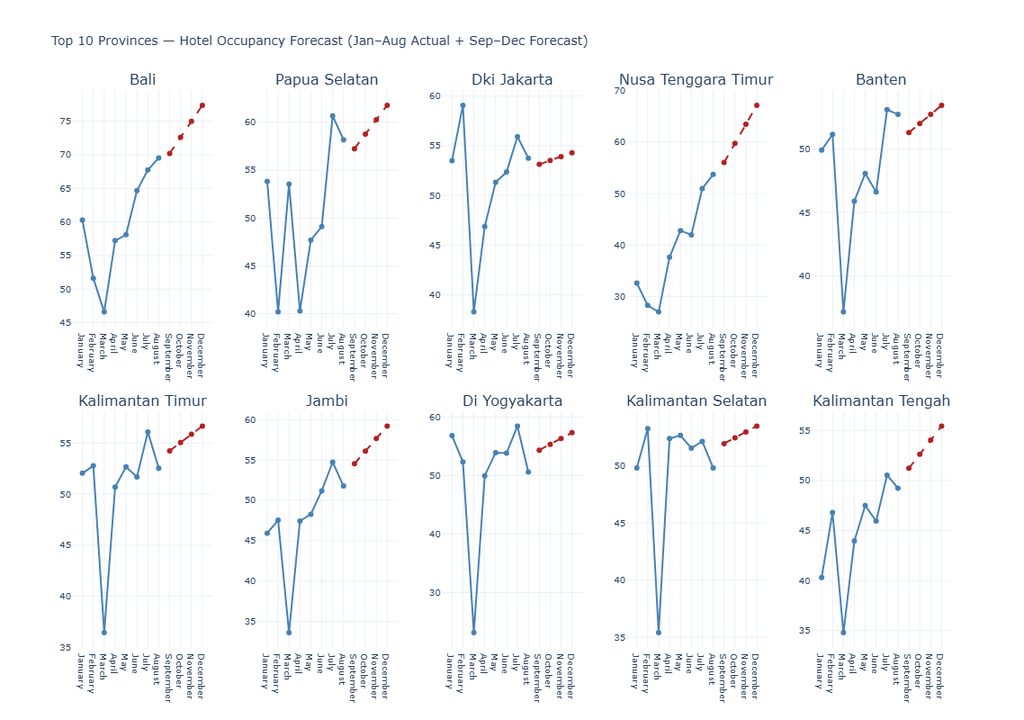
The forecast for the top 10 provinces paints an optimistic picture for the remainder of 2025. Using the data collected up to August, the projection suggests that hotel occupancy will continue to climb steadily through the final quarter, driven by year-end holidays, domestic travel surges, and returning international arrivals.
Among the leaders, Bali is expected to maintain its strong momentum and close the year as Indonesia’s top-performing province potentially reaching occupancy rates above 75% by December. The island’s mix of leisure tourism, international events, and digital nomad arrivals has made it resilient against mid-year slowdowns. Following closely behind is East Kalimantan, which continues to benefit from sustained business activity linked to the development. Even without relying on tourism, its consistent demand base gives it one of the most stable growth lines in the forecast.
Another standout is Papua Selatan, which shows an impressive upward trend through the year, marking it as one of the most improved regions in Indonesia’s post-pandemic recovery. Yogyakarta and Jakarta also display steady climbs Yogyakarta sustained by its strong domestic tourism and cultural pull, while Jakarta’s growth reflects the rebound of conferences and corporate travel. Jambi, Banten, and Central Kalimantan also continue to rise at a healthy pace, each demonstrating how regional tourism and local business travel are reinforcing the national recovery.
If this trajectory holds, by the end of 2025, the top performers are projected to be Bali, East Kalimantan, and Papua Selatan, followed by Jakarta, Yogyakarta, and South Kalimantan. Together, they represent a balance of leisure, business, and regional travel a sign that Indonesia’s hospitality sector is now more diversified and less dependent on any single destination.
However, it’s important to remember that this forecast is not an absolute prediction. It’s based on existing trends and assumes stable external conditions that i take from the dataset. Global events such as economic shifts, new travel restrictions, or natural disruptions could still influence outcomes in unpredictable ways. But if current momentum continues, Indonesia’s hotel industry will likely close 2025 with its strongest performance since before the pandemic, marking the completion of a three-year recovery journey that reshaped the landscape of tourism across the nation.
Conclusion in my point of view, Indonesia’s Hospitality Has Found Its Pulse Again
Looking back at the data from 2023 to 2025, it’s clear that Indonesia’s hotel industry has gone through more than just recovery it has gone through transformation. What began in 2023 as a slow, uncertain restart has now turned into a nationwide momentum that feels confident and diverse. Every chart tells the same underlying story: the hospitality sector didn’t simply bounce back; it adapted, evolved, and learned to stand on a broader foundation.
From my point of view, this three-year journey shows how resilience in hospitality is deeply connected to diversity. Bali’s comeback proved that international tourism still has a powerful heartbeat. East Kalimantan’s steady rise showed the growing strength of business-driven travel linked to national development. Regions like Yogyakarta, South Kalimantan, and Papua Selatan revealed how domestic tourism and regional economies can build sustainable demand even in times of uncertainty.
The data also reminds us that recovery doesn’t move in a straight line. Some provinces took off quickly, others needed time to find their rhythm. But together, they form a picture of an industry that now stands more balanced than before no longer defined by one island or one market.
By the end of 2025, Indonesia’s hotel occupancy is projected ( in my projection) to close stronger than any year since before the pandemic. And while these forecasts are not absolute as external factors like global economics, weather events, or travel policies can still shift the outcome the direction is clear. The country’s hospitality sector has regained its pulse, its confidence, and its identity.
In the end, this journey isn’t just about numbers or occupancy rates. It’s about the people who kept the lights on, the travelers who returned, and the renewed belief that Indonesia’s strength lies in its ability to adapt. The hotel industry is not just recovering it’s redefining what resilience looks like in the heart of the world’s largest archipelago.
Data Source
The dataset used in this analysis was sourced from BPS ( Badan Pusat Statistic), Indonesian Statistic Center.
Dataset i used : Occupancy Rates on Stars hotel. and Occupancy Rates on Stars Hotel Based On provinces.
Author’s Notes:
The analysis presented here is purely for educational and exploratory purposes. This article is not a scientific study but a data analytics learning project based on publicly available datasets. Any statements should be understood within the context of the samples analyzed, not as universal conclusions.
The data analysis and visualization in this article i created by using Python, Plotly Express & Pandas Libraries, and i utilized Chat GPT-5 Codex for code refinement ( make my coding short and tidy). Image ( Balinese Stye Hotel Lobby) is AI generated by Gemini Nano Banana.