


Why Some Workout Feel Stressful?
EDA: How intensity, frequency, duration, supplementation and hydration stack into training stress.
Training hard, drinking the shake, ticking the boxes, yet some sessions still feel oddly heavy. Maybe it is the day, or maybe there is a pattern hiding in plain sight. In this dataset of ten thousand routines we line up the usual suspects, intensity, how many days you train, how long you stay in the session, and the quiet helpers like water and fueling. The goal is simple, find where stress sneaks in and where it lets go. You will see which combinations push stress up, where a middle duration feels better than extremes, and how small habits change the feel of a hard day. No lab coat here, just clear patterns derive from a fitness habit dataset.
Before that as usual let’s get some info about this set of data.
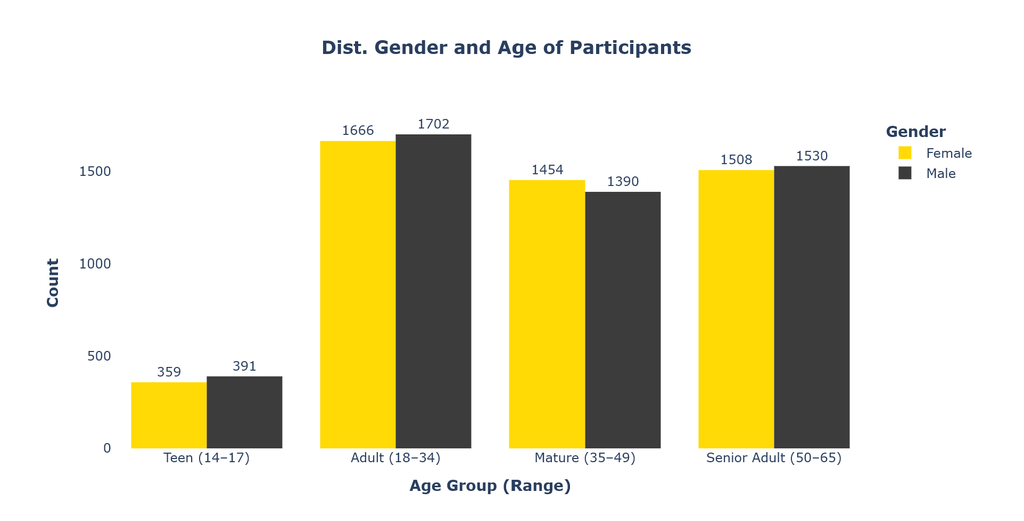
Visual gives a quick sense of who’s actually in the dataset and it turns out the fitness crowd here is mostly made up of adults between 18 and 34 years old. They’re the heartbeat of this data, training often and shaping most of the overall trends we’ll see later. The next biggest groups are the 35–49 and 50–65 brackets, which together make up almost as many people as the younger adults. That’s a good thing it means this isn’t just a “young gym bro” dataset; it captures how people at different life stages train and manage stress. Teens, on the other hand, are only a small slice, just a few hundred people, so any pattern in that group won’t really drive the bigger picture.
The gender balance is nicely even across all age ranges. Men edge slightly higher in the youngest and oldest brackets, while women lead a little in the 35–49 range. Nothing extreme, which is perfect for fair comparisons later. This balance means if we spot differences in training stress or recovery patterns between men and women, it’s likely due to lifestyle or training habits not because one gender is overrepresented.
So before we even touch the stress metrics, this snapshot already sets the tone: we’re looking at a dataset that feels broad, balanced, and real the kind of mix you’d find in a busy local gym on a weekday evening.
And What’s Up next?
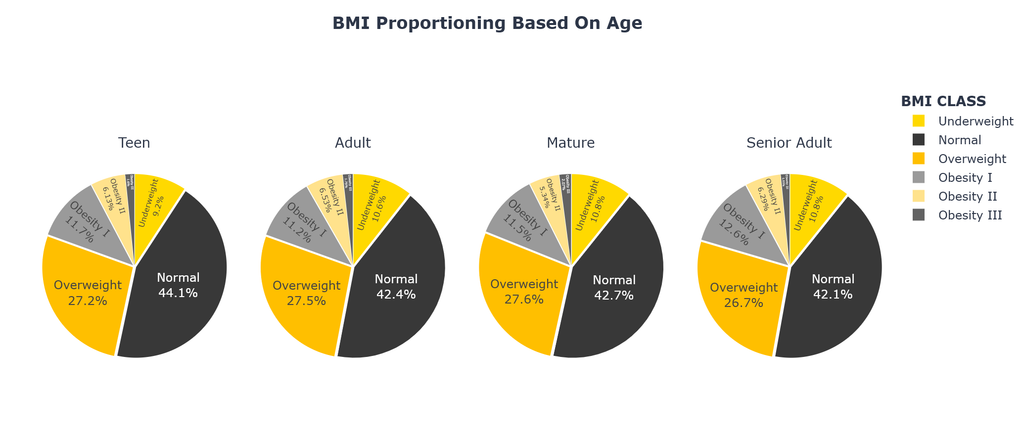
From the chart, most people in this dataset fall into the Normal BMI category, making up about 42–44% of each age group. The Overweight group comes next, sitting around 26–28%, showing that roughly one in four participants carry a bit more weight but not into the obesity range. The Underweight population is smaller, only about 9–11%, and it’s fairly even across all ages. Then come the Obesity I and II classes, together covering around 16–18%, while Obesity III the most severe level is only a tiny slice, less than 1% overall. In simple terms, out of the 10,000 people in this dataset, around 4,300 have a normal BMI, 2,700 are slightly overweight, about 1,000 are underweight, and roughly 1,700 fall into the obesity range. The proportions stay almost identical from teens to senior adults, showing that body composition doesn’t shift dramatically with age most people, regardless of how old they are, sit within a fairly balanced weight range.
Now that we’ve seen how BMI stays fairly stable across age, the next logical question is: does that also mean people handle their workouts the same way?
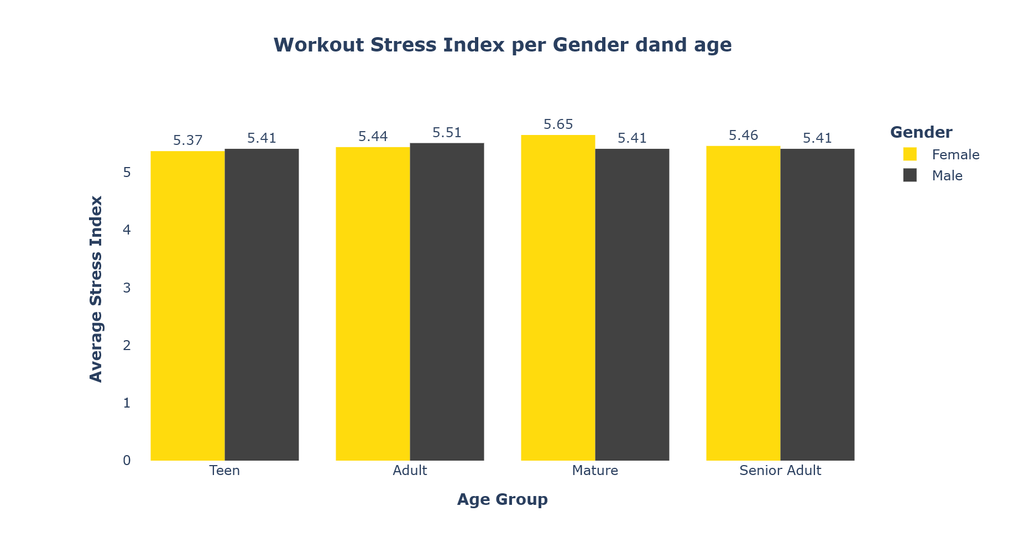
This chart answers that by showing the average workout stress index across different age groups, split by gender. The result is surprisingly steady the bars are almost identical from teens to senior adults. Both men and women sit around the same range, roughly 5.3 to 5.6, with only tiny bumps here and there.
For example, female participants in the mature group (ages 35–49) record a slightly higher average stress level at 5.65, while males peak a bit earlier, in the adult range (18–34), at 5.51. But these differences are too small to call real gaps they’re more like ripples than waves. What stands out most is how balanced the overall stress levels are across both age and gender. That means no specific group not the older ones, not the younger ones, not men, not women seems to carry a noticeably heavier training load on average.
This balance might suggests that stress during workouts may depend less on age or gender, and more on how people train: how often, how long, and how intense their sessions are, and what’s supplemented their workout. In other words, while the body’s age or gender might set the stage, the real story of workout stress unfolds in the habits behind the numbers and that’s exactly what we’ll explore next.
Will that duration, times of training or something else connected to stressful workout?
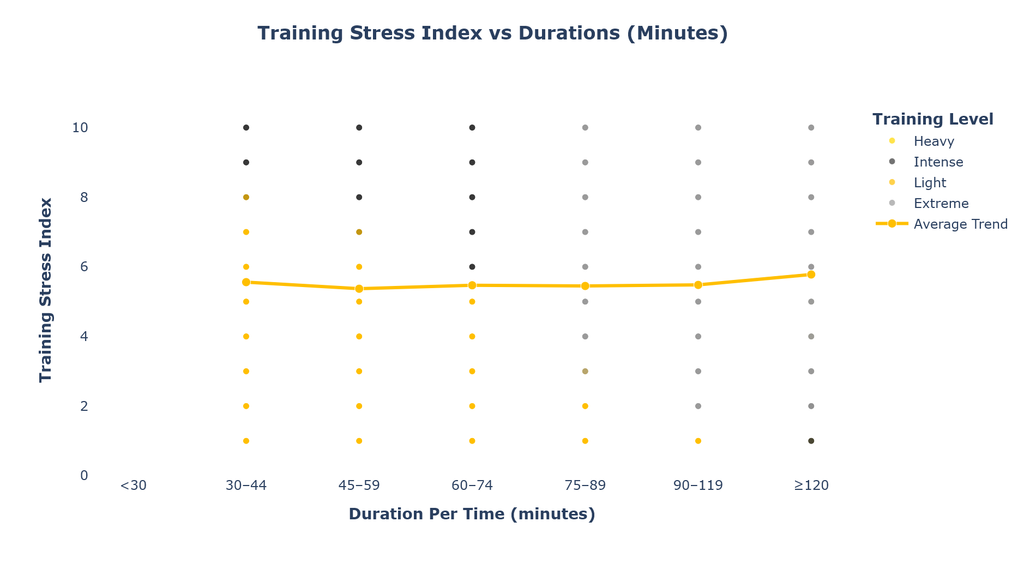
In this dataset, training level represents how demanding a workout is. Light means simple movements or light loads done at an easy pace. Heavy involves more advanced exercises or heavier resistance. Intense combines faster tempo and shorter rest, creating higher cardiovascular demand. And Extreme is the toughest blend high load, fast pace, and minimal recovery, merging the effort of both Heavy and Intense levels.
Then from this lens, this chart is where the story starts to get interesting. The yellow line our average trend stays almost flat between 30 and 119 minutes, sitting around 5.4 to 5.6 on the training stress index. It only begins to rise noticeably once session length crosses the 120-minute mark, climbing closer to 6.0. That means stress doesn’t increase linearly with time. The body handles workouts quite well up to roughly an hour and a half, but once sessions go long enough to count as a “marathon day,” stress starts to stack up faster.
The dots behind the line tell an even clearer story. Each dot color represents training intensity Light, Heavy, Intense, or Extreme and you can see that most of the higher stress values come from Intense and Extreme levels, regardless of duration. Light sessions, even when long, mostly stay below stress level 4. In other words, intensity trumps duration. A 60-minute Extreme session can feel tougher than a 90-minute Heavy one.
There’s also no smooth climb across each duration bin. The stress curve barely moves between 30–44, 45–59, and 75–89 minutes. The jump only happens once workouts stretch beyond two hours. That gives us a practical takeaway: the sweet spot for efficient, sustainable training lies between 45 and 90 minutes per session long enough to build progress, short enough to avoid heavy accumulated stress.
Beyond that mark (≥120 minutes), stress levels rise fast and recovery needs grow too. Anyone training that long should balance it with proper hydration, extra sleep, and at least one reload or recovery day per week.
If you’re programming workouts, think of it like this: lowering your training level from “Intense” to “Heavy” reduces stress far more effectively than just trimming 15 minutes off your session. For most people, a smart plan would be 3–5 sessions per week, each lasting 45–75 minutes in a controlled Heavy or Intense zone. For endurance sessions that must exceed two hours like a long run or long ride keep them to once a week, fuel properly during the session, and schedule a recovery block afterward.
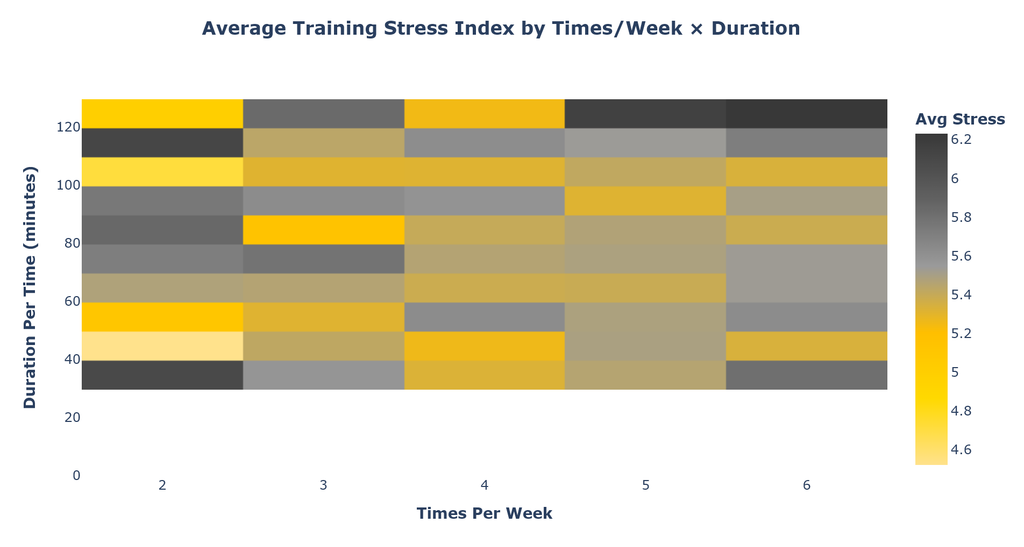
This heatmap shows how training stress shifts when we combine how long people train with how often they do it each week. The middle range roughly 3 to 5 sessions per week lasting 60 to 100 minutes each stays in a steady moderate zone around 5.4 to 5.6 on the stress scale. That area represents the most efficient balance: enough work to make progress without overloading the body. What’s interesting is that stress doesn’t rise evenly with more sessions; it depends on the total training load. You can train often and stay fine, or go long a few times a week and still be fine but pushing both at once tips the scale quickly.
The darker spots in the heatmap tell that story clearly. Stress spikes above 6.0 when sessions last two hours or more and happen five to six times a week, meaning that long duration plus high frequency drives fatigue fast, and fast fatigue end up with stress in the brain. But even short daily sessions can start to pile up stress if recovery days are missing. On the other hand, lighter zones show that moderate scheduling gives space for recovery while keeping performance consistent. In simple terms, this chart confirms that total stress isn’t about how hard one workout feels, but how many times you ask your body to repeat it. Balancing duration and frequency remains the key to sustainable, stress-free progress.
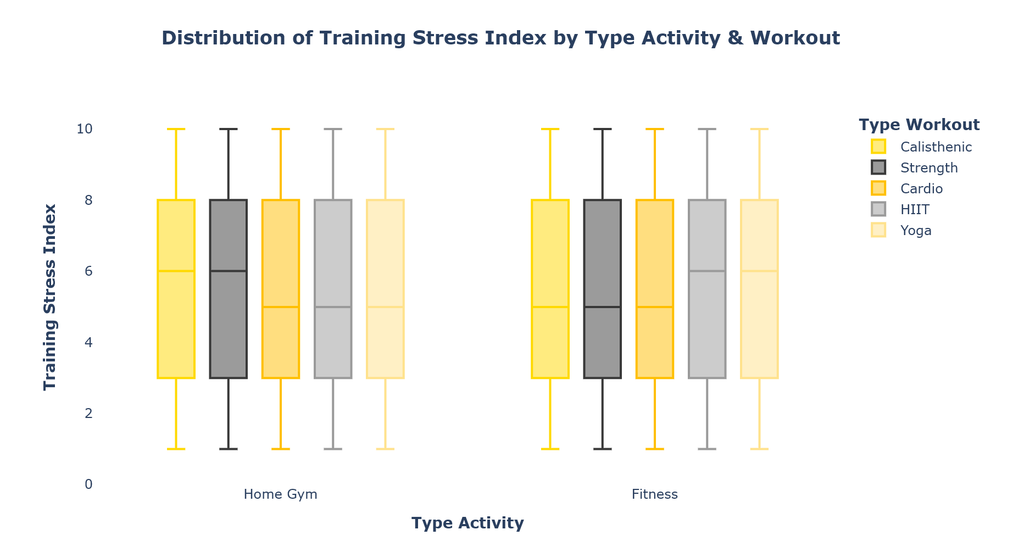
Now here’s where the data gets fun comparing where people train with what they actually do. This chart stacks the Training Stress Index for different workout types (Calisthenic, Strength, Cardio, HIIT, and Yoga) across two environments: Home Gym and Fitness Center. And right away, you can see something surprising the stress levels are remarkably similar no matter where people work out.
Whether someone trains at home or at a gym, the stress range sits roughly between 3 and 8, with medians hovering around 5 to 6. That means location alone doesn’t change how tough the session feels. Instead, the workout type itself drives the difference. HIIT and Strength sessions often reach the upper end of the stress scale, touching 7 to 9, while Cardio and Calisthenics hover in the middle range. Yoga, as expected, has the widest comfort zone some sessions are very light, others surprisingly intense, depending on how long or dynamic they are.
What’s cool here is that the environment doesn’t define the effort mindset and method do. A person doing structured HIIT at home can rack up the same stress as someone pushing weights in a gym. On the flip side, someone at a fancy fitness center can still stay in a low-stress zone if they focus on balance or mobility work.
The takeaway? Stress follows intention, not location. Your workout setup whether a full gym or a living room mat doesn’t decide how hard your body works; your choices do. It’s a great reminder that recovery and progress depend less on the space you train in and more on how you manage load, rest, and variation inside that space.
When you piece all three findings together, the message becomes pretty clear workout stress isn’t about a single factor, but how everything stacks up: how long you train, how often you do it, and how you choose to train.
From the duration analysis, we saw that stress barely moves until sessions go beyond the 120-minute mark; up to around 90 minutes, the body handles the load smoothly. Then, when we combined duration with weekly frequency, the data showed a predictable tipping point: stress only starts to climb fast when both duration and frequency go high together. And finally, when comparing training locations and workout types, it turned out that the space home gym or fitness center makes almost no difference. What matters is the intensity and structure of the session itself. In my view, this paints a practical truth that often gets overlooked: your body doesn’t care where you train; it cares about balance. Keeping sessions in the 45–90-minute range, capping total training at 3–5 times per week, and mixing load types (for example, alternating Strength or HIIT with lighter recovery days like Yoga or Cardio) forms a sustainable rhythm that builds consistency without burnout. The sweet spot isn’t about going harder, longer, or in a fancier place it’s about finding a pattern that feels tough enough to grow yet calm enough to repeat for years.
What you drink or eat before, during, and after you train, will that help with the workout stress?
Beyond how long or how often you train, what you take before and during your workout might quietly drive how stressful that session feels. A well-timed pre-workout formula usually combining caffeine and carbohydrates helps sustain energy, focus, and endurance while lowering perceived effort. During training, proper hydration and basic gym supplements like electrolytes or BCAAs or even just some bottle still water play a key role in keeping your body balanced and preventing stress hormones from spiking. In short, managing workout stress isn’t only about pacing your sets, it’s about fueling smartly so your body performs hard without feeling drained.
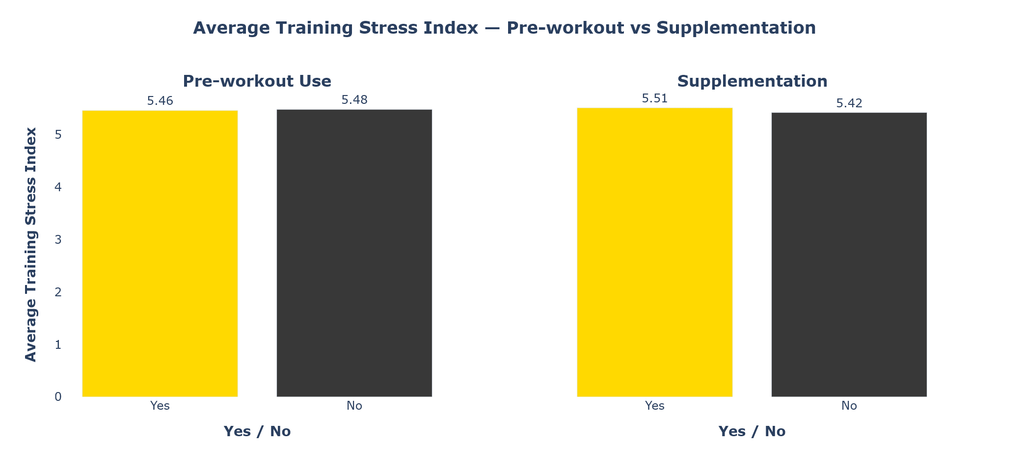
The average training stress index between people who use pre-workout or general supplements and those who don’t and the results are surprisingly even. The bars are nearly identical ( this scale on 0–10), with pre-workout users averaging 5.46, non-users at 5.48, and supplement users around 5.51 versus 5.42 for those who skip them. In other words, neither pre-workout nor supplements directly reduce workout stress in a measurable way. What they seem to do instead is shift how that stress feels.
This makes sense; pre-workouts, often powered by caffeine and nitric oxide boosters, improve focus and endurance, so you can push harder, but they don’t necessarily lower physiological stress. Similarly, basic gym supplements like protein powder or creatine help recover faster after training, not during it. The stress load stays about the same your body still works just as hard but perception and recovery improve. That’s why these tools should be viewed as performance enhancers, not stress reducers, because performed more doesn’t mean less stress. The real control lever remains the same as we saw earlier: how you balance intensity, duration, and frequency. Supplements can make that balance more comfortable, but they can’t replace it.
But since the stress scale ranges from 0 to 10, and both groups average around 5 to 6 points (balance), it suggests that using pre-workout or supplements has only a minimal effect on actual stress levels.
Most likely, the key factor lies in our psychological state before and during the workout how focused, motivated, or mentally prepared we are plays a bigger role in shaping how stressful the session feels, for example pushing our self to go for workout when out brain lazy due to many physical reasons.
Does Your Diet Make Your Workout Feel More Stressful?
Ever felt like your workout suddenly feels heavier than usual, even though nothing about your routine has changed? Sometimes, the difference isn’t in your training it’s on your plate. What you eat, and how you eat, can quietly shift how your body reacts to exercise. A diet that’s too strict, too low in calories, or missing key nutrients can make the same workout feel twice as hard. On the other hand, when your body is properly fueled, stress levels during training might drop, on the spot recovery improves, and effort starts to feel smoother. So before blaming your routine, it’s also worth asking could your diet be making your workout feel more stressful than it really is?
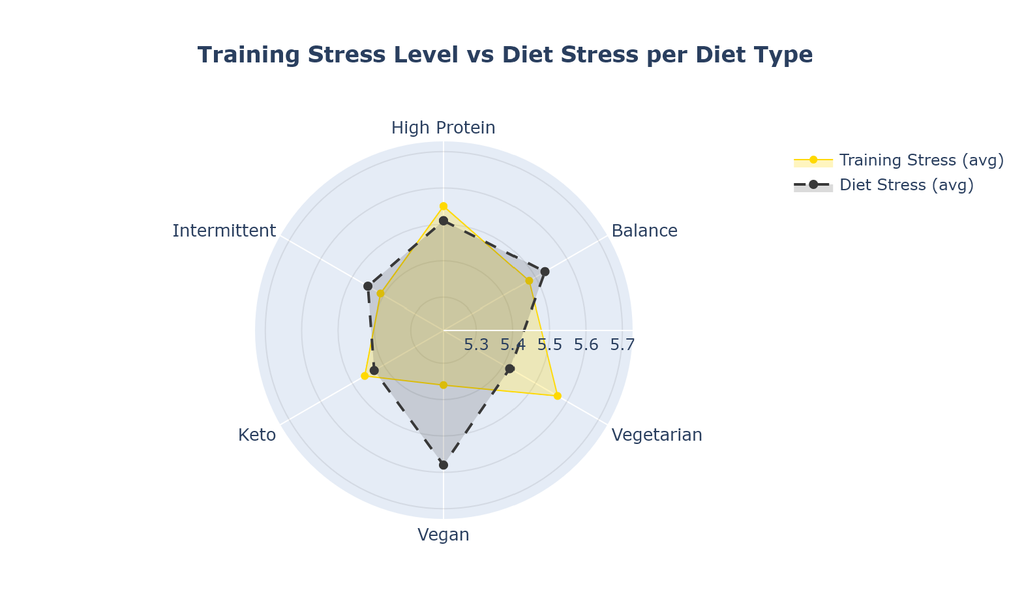
Here’s where things get interesting and a bit surprising. This radar chart compares training stress (the yellow line) and diet stress (the black dashed line) across different diet styles. You’d expect them to rise and fall together, right? Not quite. People following a balanced or high-protein diet seem to handle training stress better their stress levels stay around the middle range, showing that consistent fueling pays off. But take a look at the vegan group: their diet stress spikes the highest of all, even though their training stress isn’t extreme. That probably means they’re working hard to maintain energy and recovery under tighter nutritional limits a classic case of the body doing fine or been well adjusted, but the mind doing extra math at every meal.
Meanwhile, those on intermittent fasting or keto show the opposite pattern their diet stress is relatively low (they’re used to structure), but their training stress doesn’t drop much either. It’s a reminder that skipping meals may simplify your eating window, but it doesn’t necessarily make your workouts feel easier.
So, the fun thing here is this: the more rules your diet has, the more stress your body quietly keeps score of. Whether it’s counting macros, fasting hours, or plant-based protein sources, the best “diet” for performance seems to be the one that leaves your body fueled and your mind calm enough to enjoy the workout and the food itself.
Does body composition (in this case, BMI class) make workouts feel more stressful at different training levels?
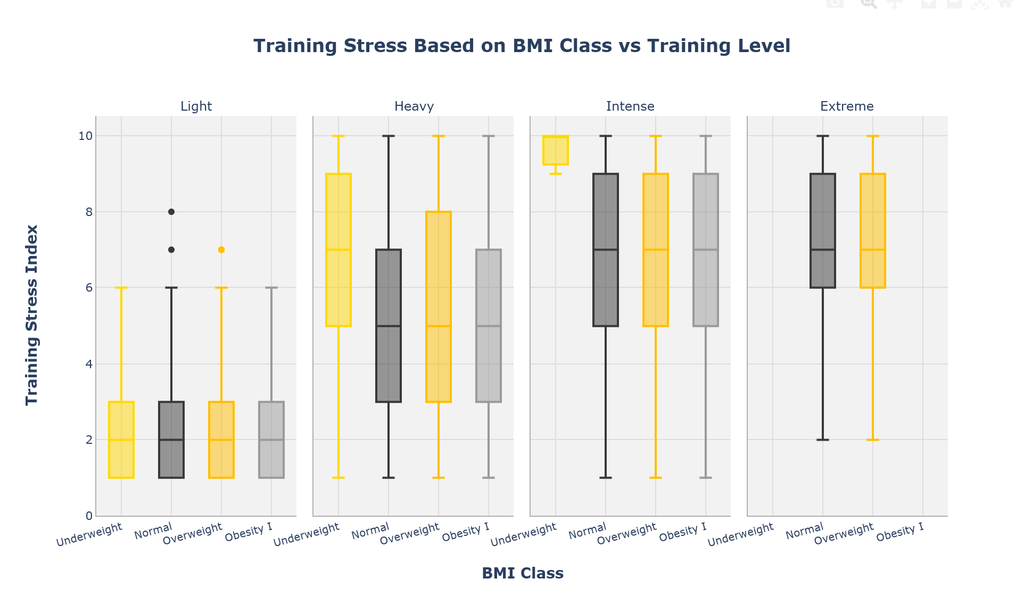
The data gives a pretty balanced but insightful answer: not really at the light level, but the difference starts to show as intensity climbs.
In the Light category, stress levels are low across all BMI groups whether someone is underweight, normal, overweight, or mildly obese, their training stress hovers near the same range. It’s gentle, manageable, and not heavily affected by body type. Once we move to the Heavy and Intense levels, though, stress spreads wider.
People in the underweight and obese I groups begin to show more variation likely because their energy capacity and endurance differ from those in the normal or slightly overweight range. At these stages, the body’s physical efficiency starts to matter; moving heavier weight or sustaining faster pace naturally feels tougher if body composition isn’t optimized for it.
The pattern becomes clearest in the Extreme level training, stress shoots up for almost everyone who given that extreme level, underweight and obesity absent may be because they will not be given such an extreme training session. It’s a great reminder that extreme routines demand a well-prepared body: proper fueling, consistent conditioning, and gradual progression. So, while BMI alone doesn’t dictate your stress in lighter training, it does become a stronger variable when the workout reaches the upper edge of intensity. The higher the level, the more your body’s balance between weight, muscle, and endurance starts to decide how much stress you can truly handle.
Conclusion:
Looking back at everything, it’s clear that workout stress is not defined by one single thing. It’s the sum of how long you train, how often you move, how you fuel, and how you recover. Supplements and pre-workouts can boost performance, but they don’t replace smart planning; diet choices influence your energy and mindset as much as they shape your body; and BMI or body type only start to matter when intensity reaches the extremes. What truly defines a sustainable training lifestyle is balance enough structure to grow stronger, but enough flexibility to stay consistent and enjoy the process. This data reminds us that stress in training is not the enemy; it’s the feedback loop or alarm that tells us when to push and when to pause. The goal isn’t to eliminate stress, but to understand it so every workout feels less like a battle, and more like a rhythm your body and mind can dance to.
The real sweet spot lies in balance, good motivation to start, enough challenge to grow, enough rest to recover, and enough fuel and time to stay consistent. Whether you train at home or in a fitness center, vegan or not, using supplements or just plain water the data shows that sustainable performance comes from awareness, not extremes.
Fitness, at its core, is a dialogue between your body, your habits, ambition, and your mindset. The more in tune they are, the less stress might feels like pressure and the more it becomes momentum of happiness treating your body in a good way you have wanted.
Data Source
This dataset was synthetically generated to mirror real-world workout and lifestyle patterns. It combines general knowledge about fitness behavior and nutrition to explore how factors like training intensity, diet, and body composition interact. The goal is to highlight data-driven insights in an educational context, not to present clinical or population-level findings.
Author’s Notes:
The analysis presented here is purely for educational and Exploratory Data Analysis purposes. This article is not a scientific study but a data analytics learning project based on synthetic datasets. Any statements should be understood and commented within the context of the samples analyzed, not as universal real conclusions. Results do not represent the global population, as cultural, environmental, and health factors may vary across groups.
Parts of the data analysis and visualization in this article i created by using Phyton, Pandas & NumPy Libraries, Scikit Learn, Plotly express. And i utilized Chat GPT.5 Codex to streamline and refine the code for better workflow. Hero Images was generated using Gemini: Nano Banana.