

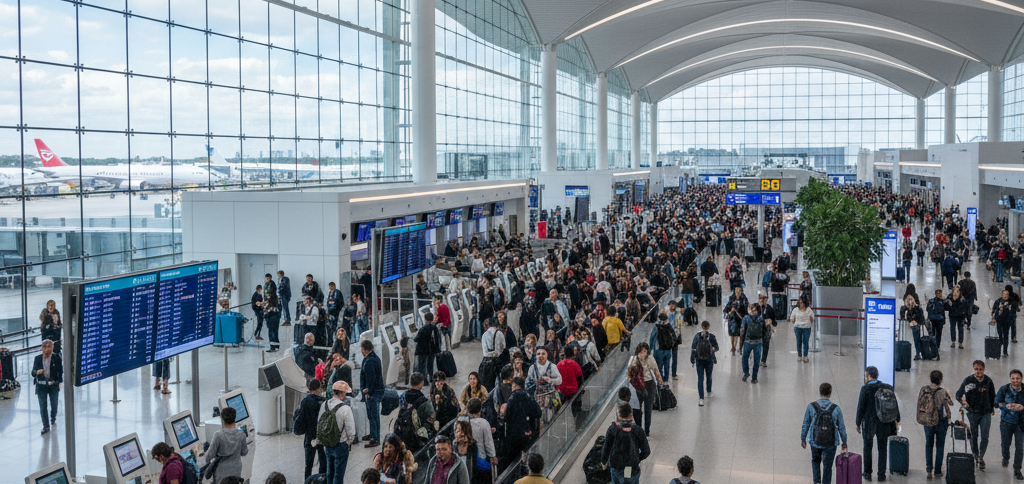
Tracing Bali’s Tourism Comeback in Post Pandemic.
EDA to analyze From International Tourist Arrivals by Air travel port.
When the world began to travel again, Indonesia was among the destinations that waited patiently for its visitors to return. After years of global restrictions and empty terminals, 2023 became the first true year of revival a turning point when international arrivals finally began to climb back. Each airport and other borders post tells a small part of that story, revealing how travelers from across the world reconnected with the archipelago. By tracing the arrival data from BPS ( Badan Pusat Statistik) and Indonesian Statistic Center through various entry points, we can see the rhythm of Indonesia’s tourism comeback where it began, how it grew, and what it says about the nation’s new chapter in global travel. As i highlighting it for the post-pandemic event.
To understand how this recovery truly unfolded, I decided to focus on one specific gateway, air travel the front door of modern tourism. Indonesia has dozens of entry points by sea and land, but airports are where most international arrivals begin their journey. For this analysis, I narrowed it down to six key international airports that represent both national and regional travel patterns: Ngurah Rai (Bali), Soekarno-Hatta (Jakarta), Juanda (East Java), Kualanamu (North Sumatra), Adi Sucipto (Yogyakarta), and Lombok International Airport. Together, these six form a realistic snapshot of how visitors re-entered the country from the busy leisure gateways of Bali and Lombok to the urban and business-oriented corridors of Jakarta and Surabaya. By observing their arrival trends, we can see how Indonesia’s skies gradually filled again and which regions led the comeback.
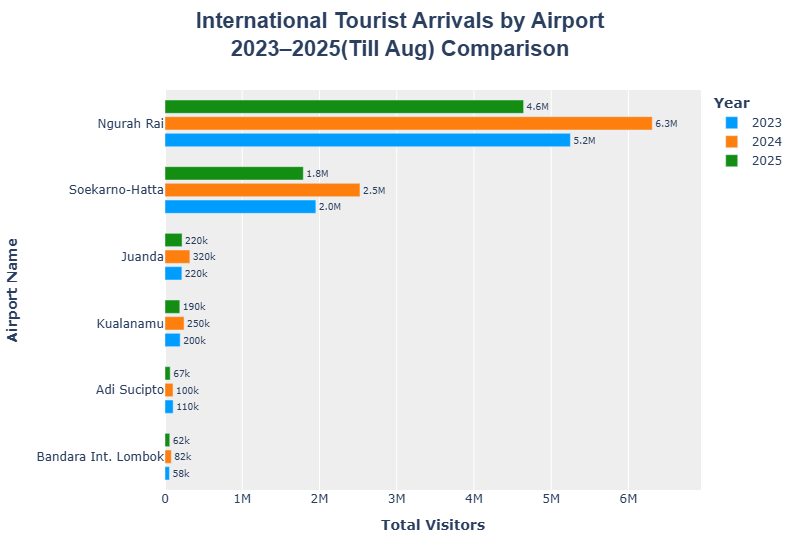
When we look at the numbers from 2023 to 2025, the comeback of Indonesia’s international airports almost feels like watching the country take a deep breath again after holding it in for too long. But before we jump into the celebration, it’s worth remembering that the 2025 data only covers arrivals up to August meaning there’s still a few months of travel left that could make the story even more exciting.
Starting with Ngurah Rai Airport in Bali, the trend is nothing short of spectacular. From 5.2 million visitors in 2023 to 6.3 million in 2024, the island didn’t just recover it roared back to life. Even with only eight months of data in 2025, Bali has already welcomed 4.6 million international tourists, setting it on track to easily match or even surpass last year’s total by December. This mirrors what we’ve seen on the ground packed beaches, crowded cafés, and an island that’s once again the face of Indonesia’s tourism heartbeat.
Next is Soekarno-Hatta International Airport in Jakarta, which plays a very different but equally important role. Unlike Bali’s leisure-driven traffic, Jakarta’s numbers rising from 2 million in 2023 to 2.5 million in 2024 reflect the recovery of business travel, international events, and transit passengers. The slight dip to 1.8 million by August 2025 doesn’t indicate a slowdown, but rather a typical mid-year fluctuation. With the city hosting major conventions and connecting flights through the end of the year, Jakarta’s annual total will likely stabilize around last year’s figure.
Meanwhile, Juanda Airport (East Java) and Kualanamu (North Sumatra) tell a quieter but equally meaningful story. Both have shown steady consistency, hovering between 200,000–320,000 arrivals per year. Their growth reflects regional travel visitors connecting from neighboring ASEAN countries or domestic hubs proof that recovery isn’t just happening in the country’s main gateways but also in its regional corridors.
Adi Sucipto (Yogyakarta) and Lombok International Airport may have smaller numbers, but their progress speaks volumes. From around 60,000 arrivals in 2023, both airports have grown notably, signaling a rising interest in cultural and nature-based tourism. Lombok, in particular, benefits from spillover visitors from Bali and events like international races and festivals. These smaller airports might not dominate in volume, but they represent the expanding geography of Indonesia’s tourism one that’s no longer defined by just one island.
After looking at the national picture, it’s impossible not to give special attention to Bali the island that has always been the face of Indonesia’s tourism heartbeat.
Beyond just big annual numbers, Bali’s tourism rhythm follows a fascinating seasonal pulse. To make things easier to understand, I defined the “high season” as any month when international arrivals surpassed 500,000 visitors. This threshold helps us visualize when the island truly hits its peak when airports are buzzing, hotels are full, and local streets transform into a melting pot of languages and cultures.
By tracking Bali’s high and low seasons over the past few years, we can see not only when visitors come, but also how fast the island’s tourism has bounced back to pre-pandemic energy. Each spike tells a story holidays, school breaks, surf seasons, or festival months moments when Bali becomes the world’s meeting point once again.
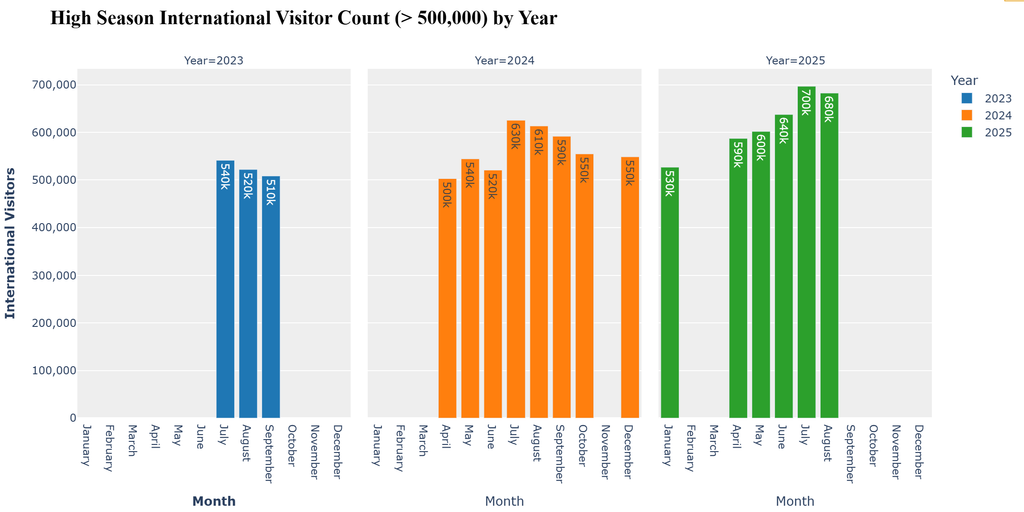
If there’s one thing Bali has always been famous for, it’s having a “peak season” that feels like a global festival. And this chart shows exactly how that rhythm came back to life after the pandemic.
In 2023, Bali’s high season was short but powerful starting around July and lasting through September, with arrivals just crossing the 500,000 mark each month. Those three months represented the island’s first real taste of normalcy after years of uncertainty. It was a cautious celebration the planes were back after the lockdown normalization, the hotels were shouting their service again, and the sound of rolling suitcases finally returned to Ngurah Rai Airport.
By 2024, things looked completely different. The high season stretched much longer from April all the way to October, with a clear peak in July (630,000 visitors). That’s seven consecutive months above half a million arrivals. It shows how Bali not only recovered but expanded its tourism cycle. Flights from Australia, Europe, and Asia were fully active again, and Bali was welcoming travelers almost non-stop. What used to be a mid-year boom became a nearly year-round phenomenon, a clear sign that the island’s tourism machine was running smoothly again.
Then comes 2025, which (even with data only up to August) shows record-breaking numbers. Starting from even the beginning of the year, every month smashed through the half-million mark and July even reached an impressive 700,000 international visitors, the highest in three years. What’s even more striking is the consistency, from April to August, Bali didn’t just recover; it achieved sustained, high-volume momentum.
This trend tells us something deeper: Bali’s appeal has become both seasonal and structural. It’s not just about summer vacations anymore the island has successfully positioned itself as an all-year destination. The growth of remote work tourism, digital nomad communities, and wellness travel has softened what used to be sharp seasonal dips.
In short, Bali’s tourism calendar has transformed. The “high season” is no longer a few golden months it’s evolving into a golden era, one where visitors come not only for the beaches and sunsets, but for a sense of reconnection that the island seems uniquely able to offer.
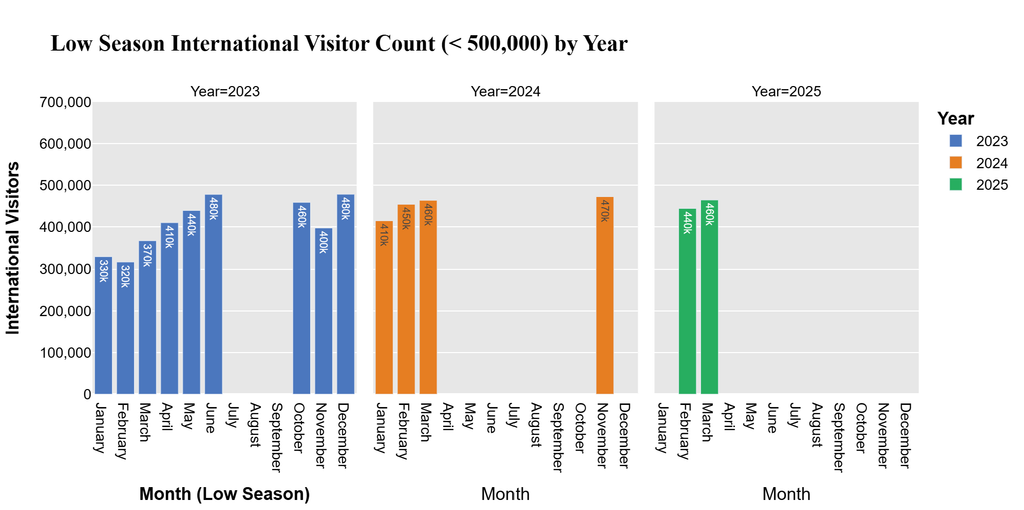
The low season reveals its quieter rhythm and it’s equally interesting. In 2023, the early months like January to May still showed the aftertaste of pandemic caution, with arrivals slowly climbing from 330,000 to around 480,000 by midyear. But what’s notable is that even during off-peak periods, Bali no longer dips below 300,000 visitors a solid sign of baseline demand returning. Moving to 2024, the low season softened further; visitor counts from January to April already hovered close to the 450,000 range, indicating that even the “quiet months” were getting busier. By 2025, this pattern becomes even clearer Bali’s so called low season (January to March) now attracts between 440,000 to 460,000 international visitors, nearly matching the early post-pandemic peaks of 2023. In other words, Bali’s off-season isn’t really “low” anymore.
Let me try to forecast the trend until the end of year 2025, base on fluctuated experience since the beginning of the year.
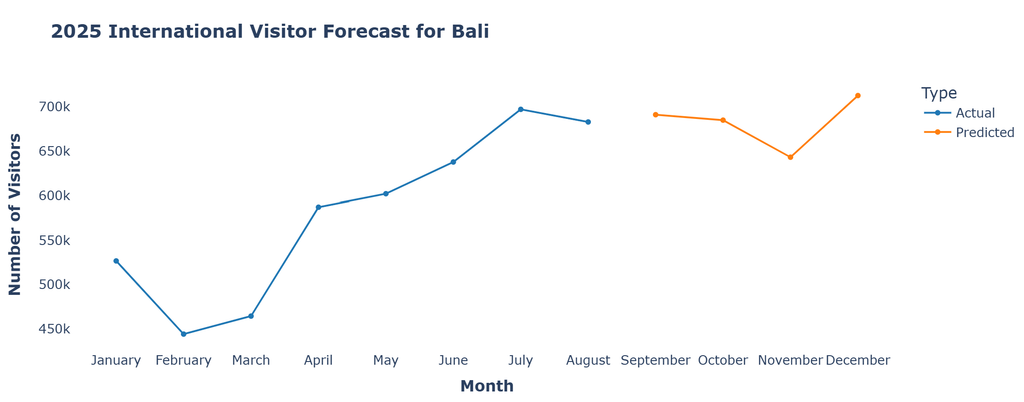
Looking ahead to the final months of 2025, the forecast suggests that Bali’s tourism rhythm will remain strong and steady. After reaching its mid-year peak in July with around 700,000 international visitors, the predicted data for September to November shows only a slight dip, averaging between 670,000 and 600,000 visitors per month. This kind of soft landing is typical for post-summer travel patterns when family vacations taper off but digital nomads, long-stay travelers, and event visitors keep the island’s flow alive. The projection for December, however, tells a more exciting story, a climb back toward 700,000 visitors, fueled by year-end holidays and winter escapes from the Northern Hemisphere. If this forecast holds true, Bali could close 2025 with its highest-ever annual total since before the pandemic a clear sign that the island’s tourism engine isn’t just back, it’s thriving. Of course, as with any forecast, these numbers may shift depending on global factors like travel policies, airline routes, and economic conditions.
But one thing seems certain, Bali has fully reclaimed its place as one of the world’s most resilient and magnetic travel destinations for post pandemic.
Data Source
The dataset used in this analysis was sourced from BPS ( Badan Pusat Statistic), Indonesian Statistic Center. Dataset Link : Visitors count based on entry port to Indonesia 2028–2025.
Author’s Notes:
The analysis presented here is purely for educational and exploratory purposes. This article is not a scientific study but a data analytics learning project based on publicly available datasets. Any statements should be understood within the context of the samples analyzed, not as universal conclusions.
The data analysis and visualization in this article i created by using Python, Plotly Express & Pandas Libraries, and i utilized Chat GPT-5 Codex for code refinement ( make my coding short and tidy). Image (Balinese Legong Dancer) generated by Gemini : Nano Banana.