


Hooked on Screens! Insights from Sample Data on Teen Phone Addiction
It’s almost impossible to walk through a school hallway or café without seeing a sea of glowing screens teenagers scrolling, typing, snapping, and streaming as if the world beyond their phones fades into the background. What started as a tool to stay connected has quietly become something much deeper a constant companion that teens check first thing in the morning and last before bed. But just how deep does this connection go? Are we watching the rise of a digital dependency that’s shaping an entire generation’s focus, sleep, and sense of self?
Behind every notification sound lies a hidden pattern one that data can finally make visible. When researchers began charting how long teens use their phones each day against how “addicted” they feel, some surprising stories emerged. Screen time doesn’t just measure hours; it maps emotion, habit, and even social pressure. As we unpack this data from differences between boys and girls to how long use links with stress and sleep we’ll see more than numbers. We’ll see a mirror reflecting how modern life and mental health intertwine in the palm of a teenage hand.
So, what about phone addiction levels when we look at teen gender and daily usage together?
Does spending more time on the screen affect boys and girls differently or is it something that catches everyone the same way? To find out, let’s take a look at how daily phone hours stack up against addiction levels across genders.
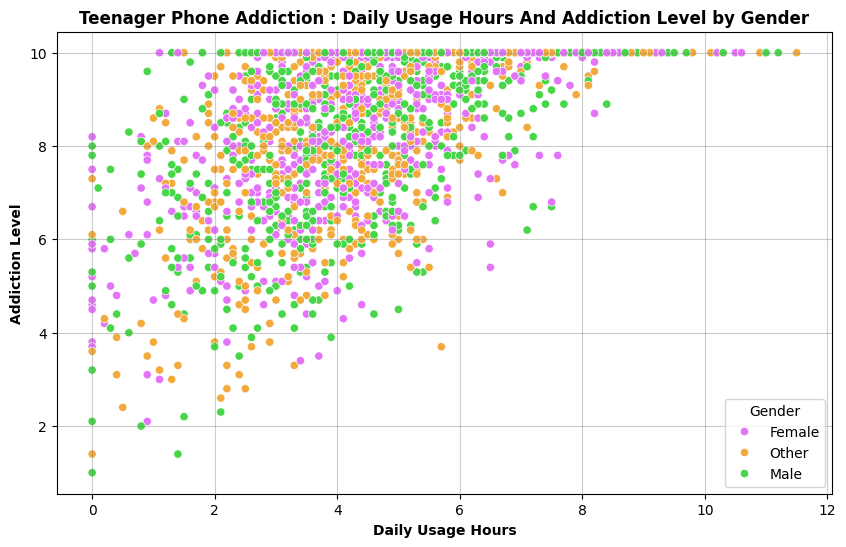
At first glance, we can clearly see a positive trend: as daily usage hours rise, the addiction level tends to climb too. Teens who spend 6–10 hours a day on their phones almost all report very high addiction scores, often hitting the maximum level of 10. On the other hand, those using their phones for less than 2 hours a day are scattered at lower addiction levels though even here, a few outliers show that short use doesn’t always mean low dependency (maybe due to emotional attachment rather than duration).
Looking at the gender colors, all groups male, female, and others (rater Not say) follow a similar pattern, meaning phone addiction cuts across everyone. However, the purple dots (female teens) seem a bit more concentrated near the top range, especially around 3–6 hours per day. This suggests that female teens might experience stronger or more frequent feelings of phone dependency even with moderate use, possibly linked to heavier social media engagement. Male teens (green dots), meanwhile, spread more widely across the chart, showing a more varied pattern some use phones a lot without feeling deeply “addicted,” while others hit high addiction even with mid-level usage.
The “other” gender group (orange) is smaller but mirrors the same upward trend as usage increases, addiction levels almost always follow.
Overall, this visual paints a clear story: more time on the phone generally equals stronger addiction, regardless of gender. The differences between groups are subtle, suggesting the real factor isn’t who you are, but how much time you spend and perhaps what you use it for. This reinforces one key takeaway: it’s not just about having a phone, but about how deeply it shapes daily habits and emotions.
In short, the data tells one clear story no one is completely safe from digital pull. Regardless of gender, once usage hours creep upward, phones start claiming more of a teen’s attention, energy, and even emotion.
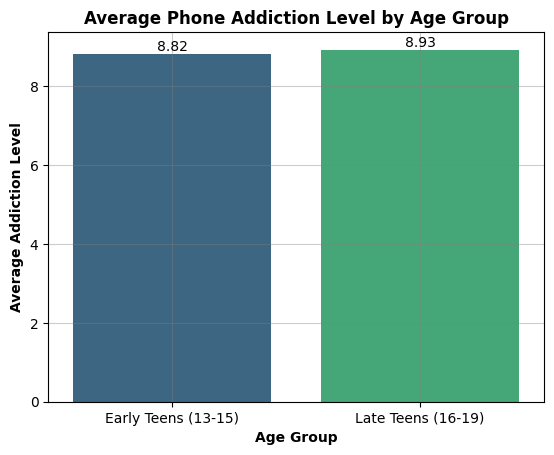
Addiction Levels Between Early and Late Teens
If we break it down by teen age categories, the story of phone addiction gets even more interesting to know. Early teens and late teens may both live in the same digital world, but how they connect to their phones can feel very different. The younger group, just stepping into high school life, often sees their phones as an exciting social gateway a place to belong, chat, and explore. Older teens, on the other hand, are already more embedded in online life, balancing messaging, entertainment, and even schoolwork through the same glowing screen. But which group shows stronger signs of dependency? Let’s dig deep how age plays into the addiction curve.
The numbers in the visual might look very close an average addiction level of 8.82 for early teens and 8.93 for late teens but those small decimals might tell a deeper story about how phone habits evolve as teenagers grow up. Both groups clearly sit at the higher end of the scale, meaning phone dependence is already strong across the board. However, the slightly higher score among late teens (16–19) hints that the connection between young people and their phones doesn’t fade with age growing.For early teens, phones often start as a form of excitement and social entry. This age group is discovering the digital world for the first time, and their sense of attachment comes from curiosity and belonging chatting with classmates, joining online trends, and exploring social platforms. Late teens, however, have a different relationship with their devices. For them, the phone isn’t just entertainment; it’s a lifeline a planner, study aid, communication hub, and emotional anchor all in one. That constant presence in their daily routine might explain the higher addiction level: it’s no longer just about wanting to check the phone, but needing to.
What’s striking here is that both bars are near the ceiling, showing how deeply phones have woven themselves into teenage life, regardless of age. The gap may be small, but it reflects a meaningful shift from playful curiosity to functional dependency. It’s a reminder that phone addiction doesn’t necessarily start big; it grows quietly as the phone becomes part of how teens think, feel, and connect with the world.
What Do Teens Actually Use Their Phones For? (By Gender)
Let’s be honest not all screen time is created equal. Some teens are glued to TikTok or Instagram, others can’t stop gaming, while a few swear they’re just “studying.” But behind every tap and scroll, there’s a story about why teens pick up their phones in the first place. When we break it down by gender, those stories get even more colorful. Do girls really spend more time on social media, or is that just a stereotype? Are boys truly the gaming kings, or have the trends started to blur? Let’s dive into the data and see what really keeps teens scrolling, swiping, and staying online.
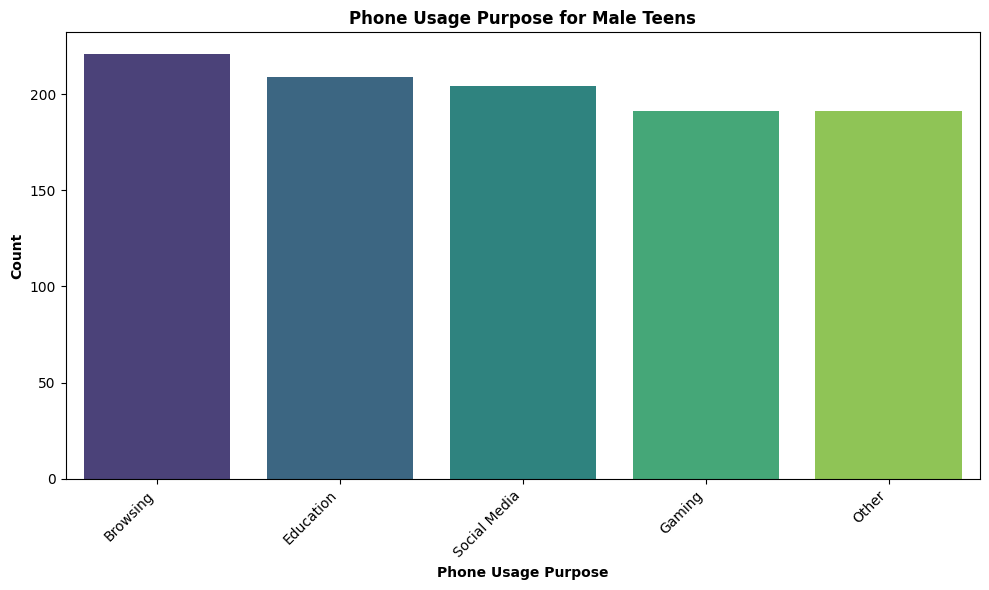
For male teens, the data shows a surprisingly balanced digital diet but with a clear favorite at the top. Browsing takes the lead as their most common activity, suggesting that boys spend plenty of time exploring the web, watching videos, or jumping between different types of content. Close behind are education and social media, proving that not all screen time is purely for fun; many also use their phones for schoolwork or staying connected online. Gaming, while often assumed to dominate male phone use, actually sits a bit lower than expected still significant, but not the main event. The “other” category rounds things off with nearly the same count, hinting that boys also dabble in various smaller activities like music, utilities, or creative apps. Overall, male teens seem to treat their phones as all-in-one devices tools for entertainment, connection, and even productivity, all mixed into one scrolling routine.
And let’s see how female teen use their phone for.
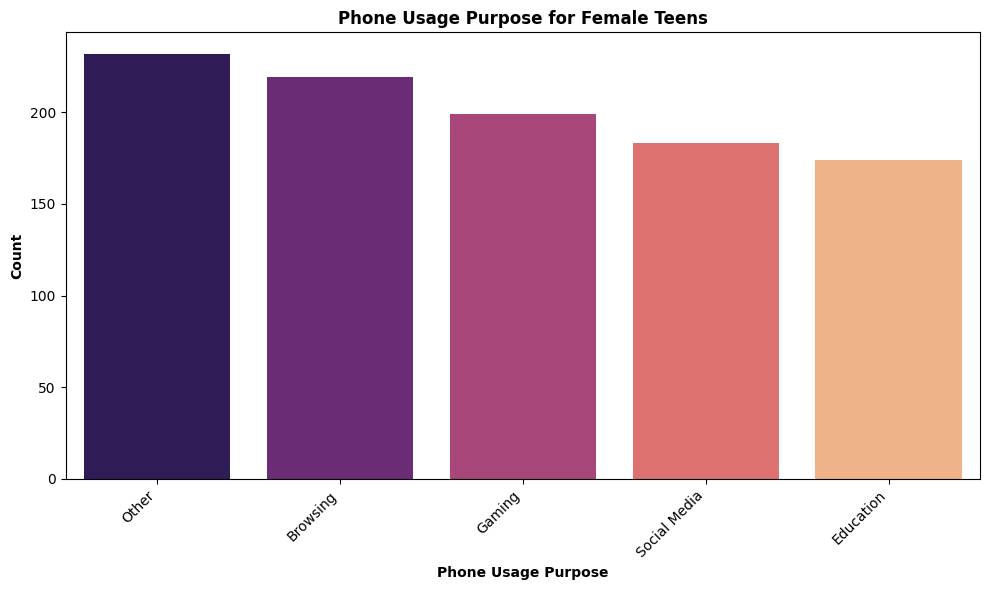
For female teens, phone use looks a bit more diverse, but still with clear favorites. The “Other” category tops the list, suggesting girls might spend plenty of time on lifestyle, creativity, or communication apps things like apps connect to their hobbies such photo editing, journaling, music, or messaging platforms that reflect more personal or expressive use. Browsing comes next, showing a strong interest in exploring online content, from shopping and trends to learning or inspiration. Interestingly, gaming takes the middle spot a sign that girls are just as active in the gaming space as boys, even if it’s not their main focus. Meanwhile, social media and education trail slightly behind, yet still remain major parts of daily phone life. Overall, female teens seem to use their phones as a blend of self-expression, discovery, and connection, balancing fun, creativity, and practicality in a way that feels uniquely personal.
How Long Do Teens Really Spend on Their Phones Each Day?
It’s one thing to know what teens do on their phones but the real question is, how long do they actually stay glued to those screens? We often hear numbers tossed around “just an hour” or “only for schoolwork” but data has a funny way of revealing the truth. When we look at the daily usage hours across genders, the picture becomes much clearer (and maybe a bit shocking). Are boys really the ones losing track of time gaming? Or do girls spend even longer scrolling through social feeds and chatting? Let’s find out how deep this digital routine goes in the day-to-day lives of today’s teens.
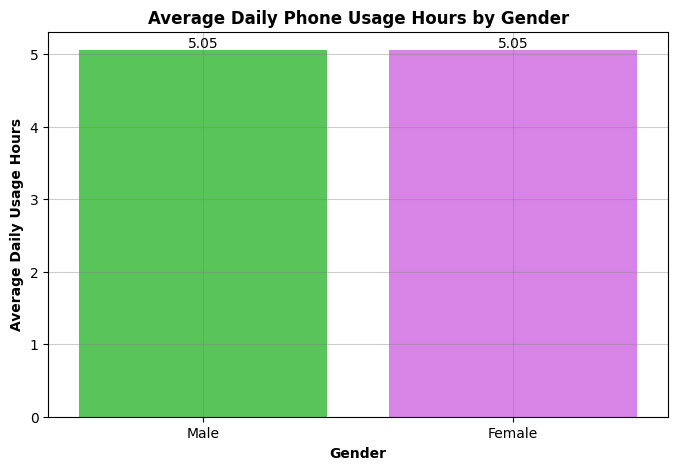
This might just end one of the oldest debates boys and girls spend almost the exact same amount of time on their phones every day. Both genders clock in at an average of 5.05 hours daily, showing that when it comes to screen time, the digital gap has practically disappeared. It’s not about who uses their phone more anymore, but how deeply both have woven it into their routines. From morning alarms and school chats to late-night scrolling, phones have become an all-day companion regardless of gender.
What’s fascinating here is the balance. For male teens, those hours might be divided between browsing, gaming, and learning apps a mix of curiosity, play, and productivity. For female teens, the same hours could be split across social interaction, creative content, and communication. Yet in the end, both are spending roughly a fifth of their day in front of a screen, which is a powerful reminder of just how central phones have become to teenage life. The takeaway? It’s no longer about who’s more addicted it’s about how both sides are equally living in a world that constantly fits in the palm of their hand.
Is that number five full hours a day really bringing bad effects into their lives? That’s the big question, and honestly, no one truly knows until we look beyond the numbers and observe their behavior. For some teens, those hours might be harmless time spent studying, learning, or connecting meaningfully with friends.
But for others, it could quietly reshape their habits, attention spans, and even emotions. The tricky part is that it doesn’t happen overnight; it creeps in slowly staying up a little later, checking messages a little more often, feeling uneasy when the phone isn’t nearby. Over time, these small shifts can snowball into something much larger, blurring the line between healthy use and quiet dependency.
Does More Screen Time Mean Less Sleep?
If there’s one thing most parents (and teachers) agree on, it’s that phones and sleep don’t always mix well. Late-night scrolling, endless chats, and “just one more video” moments have quietly turned bedtime into screen time for many teens. But how serious is it, really? When we look at the connection between daily phone usage hours and sleep duration, the data starts to tell a familiar but worrying story the more time spent on the screen, the fewer hours of rest teens seem to get. It’s as if their minds stay switched on long after the lights go out, caught between the comfort of connection and the cost of losing sleep.
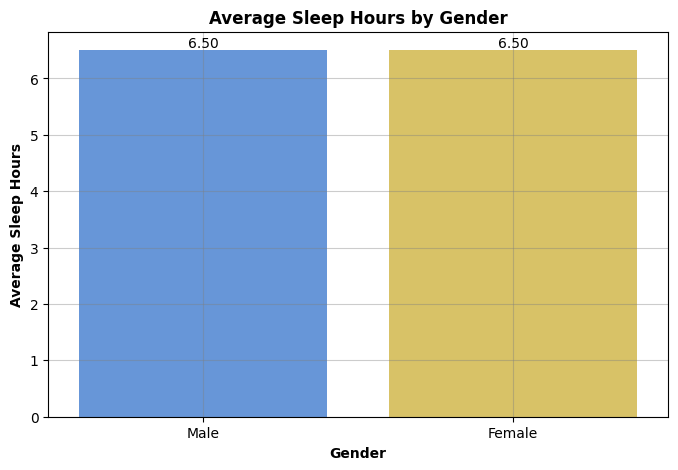
This might look surprisingly balanced both male and female teens average about 6.5 hours of sleep per night. But when you think about it, that number is actually below the recommended 8–9 hours for healthy adolescent sleep. It means that, on average, most teens are losing around two hours of rest every night, and the reason might just be glowing in their hands. The fact that both genders show identical averages hints that this isn’t a “boy vs girl” issue anymore it’s a shared lifestyle pattern.
For many teens, nighttime has quietly turned into bonus screen time. What used to be quiet hours for winding down is now filled with late scrolling, chatting, or binge-watching. Phones have become the last thing they see before sleeping and the first thing they check upon waking up. Over time, that habit chips away at both the quality and quantity of sleep, leaving them tired but still reaching for the screen the next day. So while 6.5 hours may not sound too alarming, it tells a deeper story: a generation trying to stay awake in a world that never stops blinking.
The Sleepless Cycle: How Phone Addiction and Sleep Loss Feed Each Other
Here’s where things get even more interesting and a little worrying. What if phone addiction isn’t just a result of long screen time, but also something that quietly grows when teens don’t get enough sleep? Think about it: the more tired they feel, the more they reach for their phones for comfort, distraction, or a quick hit of dopamine. But the more they scroll, the harder it becomes to rest. It’s a cycle that keeps spinning late-night scrolling leads to less sleep, and less sleep fuels even stronger phone dependency the next day. When we look at the data side by side, the pattern becomes hard to ignore: the less teens sleep, the higher their addiction levels climb.
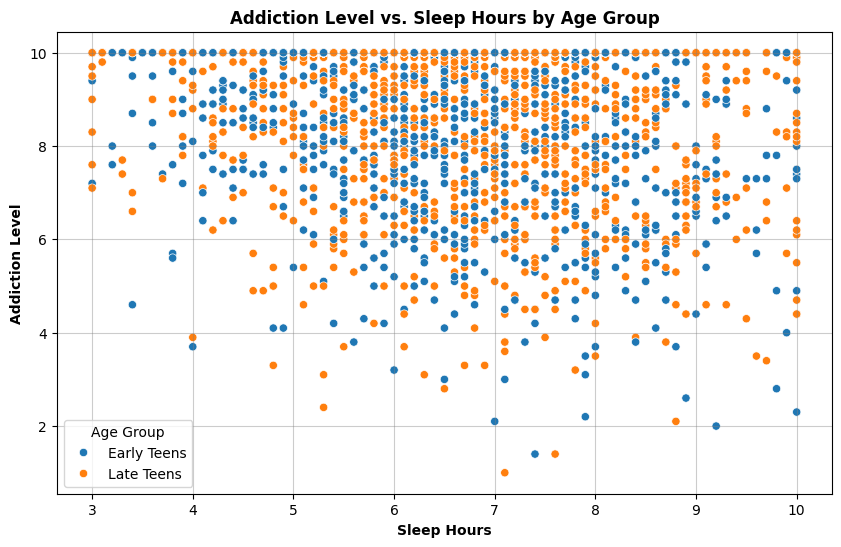
When we connects the dots literally between how much teens sleep and how addicted they feel to their phones. Each point represents a teen’s sleep hours against their addiction level, and together they draw a clear pattern: the less sleep they get, the higher their phone addiction tends to be. The cluster of points at the top of the chart, especially around 6 hours or less of sleep, shows just how strong this link is. Teens who stay up late scrolling or chatting seem to pay for it with both fewer hours of rest and higher dependency the next day.
Interestingly, both early teens (blue) and late teens (orange) follow almost the same trend, but late teens appear slightly more concentrated at the extreme high end of addiction despite longer sleep ranges. This might mean that as teens grow older, the emotional or habitual bond with their phones deepens, even if they’re technically getting a bit more rest. Early teens, meanwhile, show more variation some manage decent sleep with moderate addiction, while others already hit high dependency early on.
Visual tells a familiar but powerful story: less sleep doesn’t just make teens tired it strengthens their digital craving. The body might want rest, but the mind keeps scrolling, caught in a loop that blends fatigue with stimulation. Over time, that loop can quietly shape their moods, focus, and even how they start and end each day.
When the Screen Starts to Affect the Scores: Phone Addiction and Academic Performance
Now that we’ve seen how phone use can cut into sleep, it’s time to ask the next big question what happens when all that lost sleep and constant scrolling meet the classroom? For many teens, the phone isn’t just a distraction anymore; it’s part of their daily rhythm, even during study time. Messages, notifications, and late-night browsing slowly chip away at focus and motivation, often without them realizing it. When we put addiction levels side by side with academic performance, the trend becomes clearer: the more addicted teens feel to their phones, the harder it seems for them to stay sharp in school. It’s not about being lazy or unmotivated it’s about how constant connection quietly rewires attention, making it tougher to concentrate, remember, and perform at their best.
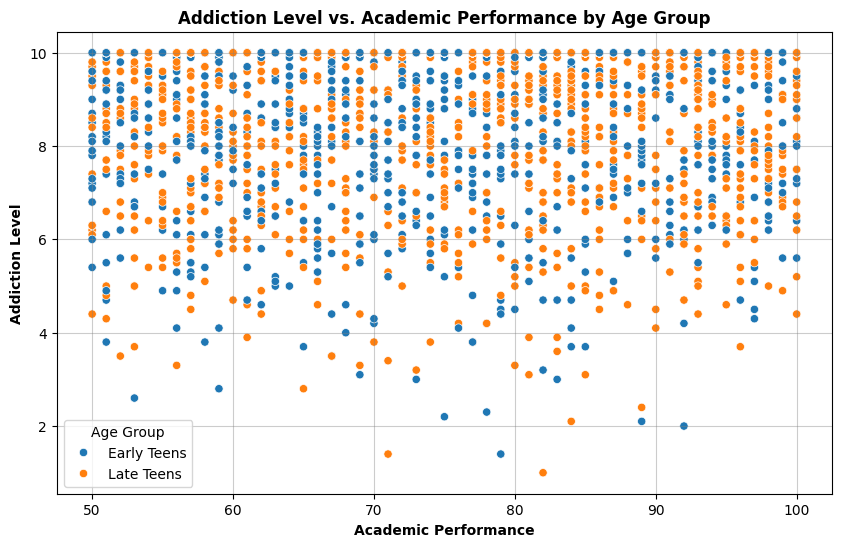
This pulls the story together showing how phone addiction levels connect to teens’ academic performance and the trend is hard to miss. While there are students who still manage good grades despite high phone use, the overall pattern leans one way: as addiction levels rise, academic performance tends to slip. The cluster of dots near the top (addiction scores between 8–10) spreads widely across all performance levels, but noticeably thins out near the highest academic scores. It’s as if the stronger the digital pull, the harder it becomes to stay consistent or focused in schoolwork.
Both early teens (blue) and late teens (orange) follow this same curve, though late teens show slightly more high-addiction cases paired with mid-range academic results. That could reflect how older students juggle more responsibilities exams, social life, and digital communication which makes distractions even more tempting. Early teens, meanwhile, show more scattered patterns, likely because their habits are still forming. Yet across both groups, the message is consistent: when the phone becomes the main source of stimulation, studying often takes the back seat.
In simple terms, this data visual reminds us of something every teacher and parent senses it’s not that teens can’t study; it’s that their attention is being quietly outcompeted. Every ping, scroll, or notification steals just a bit of focus, and over time, those small interruptions add up. The result isn’t an immediate drop in grades, but a slow erosion of concentration, motivation, and academic rhythm the very skills they need most in a hyperconnected world.
The Bigger Picture: When Phone Addiction Shapes More Than Just Habits
At this point, the story of teen phone addiction isn’t just about screen time it’s about everything that happens because of it. Behind every late-night scroll, every missed hour of sleep, and every drop in concentration lies something deeper: the emotional cost. When researchers connect the dots between phone addiction, sleep loss, academic struggles, anxiety, and depression, a powerful pattern begins to emerge. It’s not a straight line it’s a web. One behavior feeds another, until phone dependency becomes more than a habit it turns into a lifestyle that quietly reshapes how teens think, feel, and function.
This isn’t about blaming technology. It’s about recognizing how easily comfort turns into compulsion. Teens reach for their phones to relax, to belong, to escape stress but over time, that same habit can create the very stress they’re trying to avoid. The data shows that higher addiction levels often go hand in hand with shorter sleep, lower academic performance, and higher signs of anxiety and depression. It’s a digital loop that keeps the mind awake long after the body needs rest a modern cycle of connection that can, ironically, make young people feel more disconnected inside.
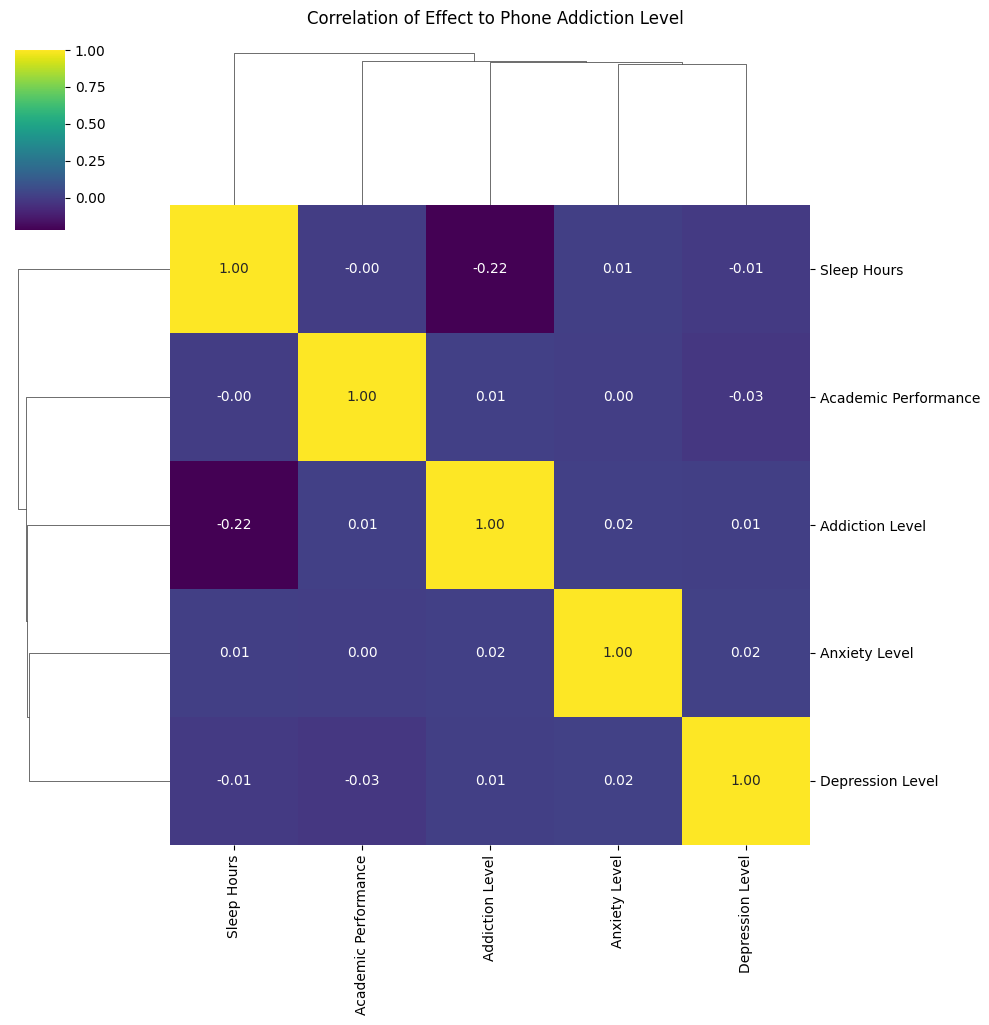
In a bird’s-eye view the correlation map that ties everything together. Each square tells how strongly one factor connects to another, and while most of the numbers look small, the relationships they represent are still meaningful. The clearest link here is the negative correlation between sleep hours and phone addiction (-0.22), showing that as phone addiction rises, sleep tends to shrink. It’s not a dramatic crash, but a steady trade-off: every extra hour spent on screens slowly eats away at rest.
Interestingly, the connection between phone addiction and academic performance hovers close to zero, suggesting that grades don’t always drop immediately some teens still manage to perform well despite their screen time. But this neutrality may hide a longer-term effect: the slow erosion of focus and consistency rather than an instant academic decline. The correlations with anxiety and depression are small yet telling hovering slightly above zero. This means that while not every addicted teen feels anxious or depressed, the emotional cost begins to appear subtly beneath the surface.
In short, this map doesn’t shout it whispers. It shows how modern teen life isn’t defined by one overwhelming factor but by the quiet combination of many small ones. A little less sleep, a little more scrolling, a bit of academic slip, and creeping emotional strain together, they form a pattern that mirrors the rhythm of digital overuse. The data reminds us that addiction’s power doesn’t always come from being extreme, but from being constant day after day, night after night, shaping habits that feel harmless until they’re hard to let go of.
If this pattern continues, the future doesn’t look like a sudden collapse it looks like a slow fade. A generation growing up always connected, yet quietly disconnected from rest, focus, and emotional balance. For parents, this isn’t just about limiting screen time; it’s about protecting something far more fragile attention, curiosity, and mental clarity. And for teens, it’s a reminder that the phone doesn’t just steal minutes; it reshapes mindsets. Left uncontrolled, phone addiction won’t just cut into sleep or study hours it can chip away at confidence, patience, and the ability to sit still with one’s own thoughts. The danger isn’t in using technology, but in letting it silently take charge of the rhythm of life.\

In the end, phone addiction among teens isn’t just a data story it’s a mirror held up to how modern life has changed. The same devices that keep us informed and connected can quietly drain the very things that make us human: focus, calm, and real connection. The challenge isn’t to abandon technology, but to reclaim balance to teach awareness, not fear. Whether you’re a parent watching from the sidelines or a teenager scrolling through the night, it starts with small, conscious choices: putting the phone down, taking a breath, and remembering that the world still exists beyond the screen. Create a world that ‘Phone life balance’.
Data Source
The dataset used in this analysis was sourced from Kaggle and is licensed under the Open Data Commons Public Domain Dedication and License (PDDL v1.0). Datasets published by Khushi Yadav : Teen Phone Addiction and Lifestyle Survey Dataset.
Author’s Notes:
The analysis presented here is purely for educational and exploratory purposes. This article is not a scientific study but a data analytics learning project based on publicly available datasets. Any statements should be understood within the context of the samples analyzed, not as universal conclusions. Results do not represent the global population, as cultural, environmental, and health factors may vary across groups.
The data analysis and visualization in this article i created by using Python, Matplotlib, Seaborn & Pandas Libraries, and i utilized MS. Copilot 365 to streamline and refine the code for better and shrinking a long workflow. Teen image was generated using Gemini: nano banana.