

Think Better, Live Smarter. How Lifestyle Explains the Way Our Minds Work.
EDA : Exploring how small daily choices keep the mind clear, focused, and full of energy..
We all have our morning rituals some start the day with coffee, others with an extra hour of sleep. But what if we could actually see how these habits influence our ability to think, focus, and remember? When we look at data from over 80,000 people tracking their sleep, caffeine intake, and daily routines, an interesting pattern starts to appear. It turns out mental energy isn’t just about how much coffee you drink or how long you sleep it’s about how these choices interact with your stress, exercise, and even screen time. The data paints a surprisingly human story: how small daily behaviors quietly shape the sharpness of our minds.
To dig deeper into this connection, I started by comparing several lifestyle factors to see how they collectively influence mental energy. Sleep duration, caffeine intake, stress level, exercise frequency, and even daily screen time all play a part in shaping how the brain performs. Instead of isolating just one variable, the goal was to understand the overall pattern how these daily habits overlap and interact. When we look at the data this way, it stops being about “what’s good or bad” and becomes more about balance. Each habit contributes something different to how alert, focused, and stable our minds feel throughout the day.
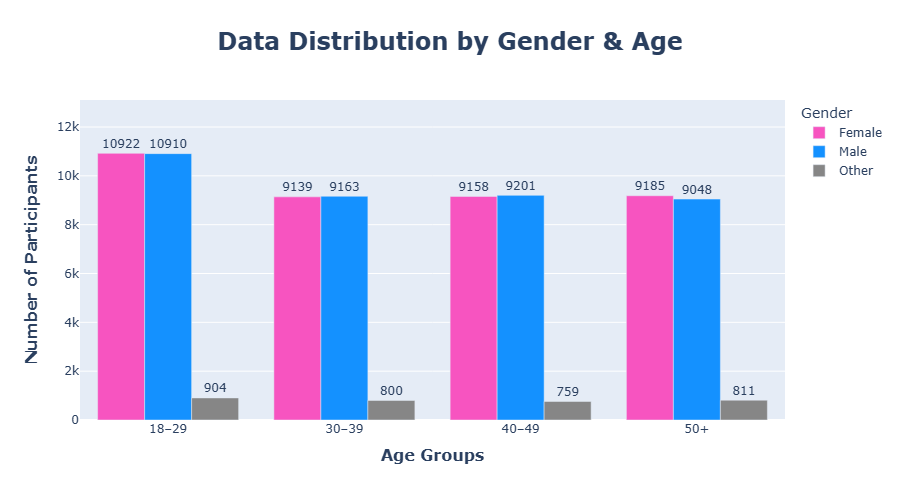
Before diving into the insights, let’s first look at who’s actually inside this dataset. With 80,000 participants, the sample gives a broad look at different lifestyles across age and gender. To make the analysis easier and more readable, I divided the participants into four age groups: 18–29, 30–39, 40–49, and 50+. As shown in the chart above, the distribution between men and women is fairly balanced in every group, while participants identifying as “other / rather not say” make up a much smaller portion. This balance helps ensure that any trends we find later like how sleep or caffeine affect cognition aren’t skewed by gender or age bias. In other words, the dataset gives us a good starting point to explore how different generations manage their mental energy in today’s fast-paced world.
Now that we know who the participants are, it’s time to see how their thinking performance looks across genders. In this part, I focused on the Cognitive Score, which represents how well a person performs in areas like attention, memory, and problem-solving. Looking at it through the lens of gender helps us see if there’s any consistent difference in how men, women, or other gender identities process information. This step isn’t about comparison or competition, but rather about understanding whether cognitive ability follows a certain pattern among different groups or if, in reality, the mind doesn’t really care about gender labels at all.
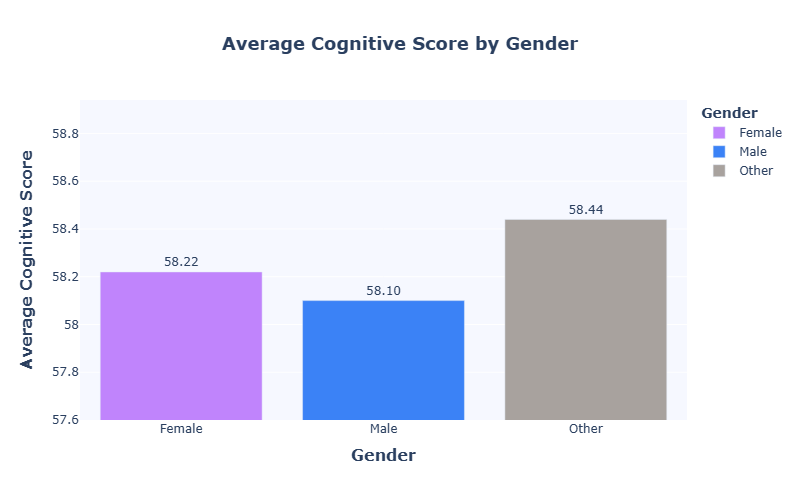
When looking at the chart, you might notice there’s a third category labeled “Other” with a slightly higher average score. However, this group only represents a small fraction of total participants, which makes the data less reliable for direct comparison. Because of the limited sample size and potential variations in how these responses were recorded, it’s better not to draw conclusions from it.
So let’s focus on the two main groups male and female participants. Here, the difference in cognitive scores is almost invisible. Females have an average score of 58.22, while males follow closely with 58.10. The gap is so narrow that it doesn’t suggest any real cognitive advantage for either gender. This reinforces the idea that thinking ability, memory, and focus aren’t strongly tied to gender identity. Instead, factors like sleep, stress, and daily routines likely play a much bigger role in shaping mental performance.
After seeing that gender doesn’t make much difference, the next thing to explore is whether age does. Since we’ve already grouped the participants into four age brackets made earlier , it’s interesting to see how thinking performance shifts across life stages. Does the mind really get slower as we grow older, or does experience balance it out? By looking at the average cognitive score in each group, we can get a sense of how mental sharpness evolves with age and whether lifestyle choices at different stages might help keep the brain in shape.
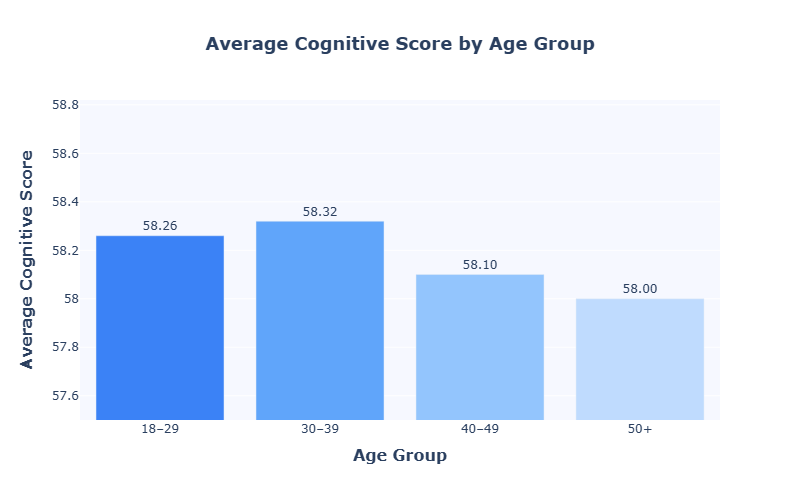
downward slope but not as steep as people might expect. The 30–39 age group records the highest average score at 58.32, slightly above the 18–29 group at 58.26. After that, there’s a small decline through the 40–49 group (58.10) and the 50+ group (58.00). In other words, the difference between the youngest and oldest participants is only about 0.3 points, which is barely noticeable in real terms.
This small change suggests that cognitive ability doesn’t simply “drop off” with age. It might fluctuate more based on lifestyle or mental engagement than age itself. People in their thirties, for instance, could be balancing active professional and personal lives keeping their minds busy and challenged while older participants might experience more routine, less stimulation, or higher stress. The key takeaway here is that mental sharpness seems to stay fairly consistent across adulthood, especially when people maintain healthy habits that keep their brains alert and active.
One of many base element to our cognitive : Yes, it’s our reaction time.
One of the basic elements that builds our cognitive performance is reaction time. It may sound simple how quickly we respond to something but it actually says a lot about how the brain processes information. Reaction time reflects mental sharpness, focus, and how efficiently the brain connects input to action. In other words, it’s like the brain’s speedometer. A faster reaction doesn’t just mean quick reflexes; it also hints at a well-rested mind, balanced stress level, and steady mental clarity. So before connecting this to other lifestyle factors, it’s worth taking a closer look at how reaction time varies across people in the dataset.
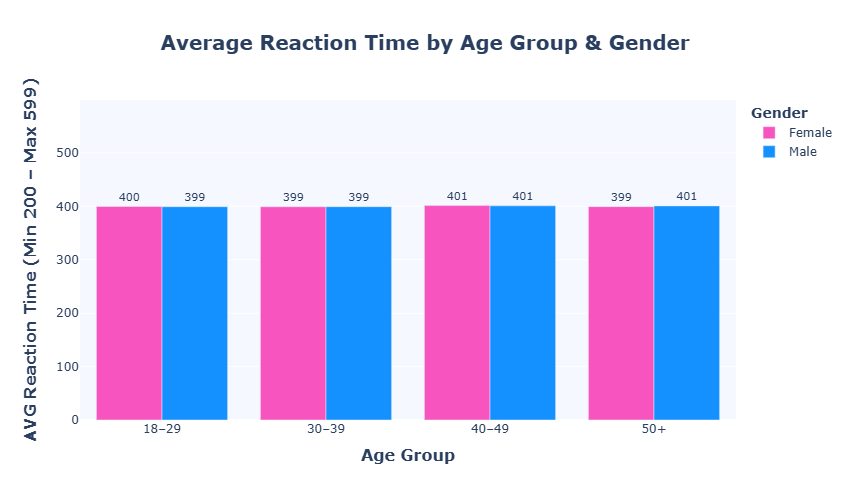
This chart might seem almost too calm to be interesting every bar sits nearly at the same height. Across all age groups, the average reaction time hovers tightly around 400 milliseconds for both men and women. It’s a surprisingly consistent pattern, showing that neither gender nor age seems to have a major advantage when it comes to mental speed.
For instance, participants aged 18–29 react male or female at about 400 ms (milliseconds), while those over 50 still respond at roughly the same pace. That’s quite impressive if you think about it even as we get older, our brain’s response doesn’t appear to slow down much. It’s almost as if reaction time is one of those stable features of the mind that resists the pull of age.
What’s also interesting is the near-identical result between males and females. It breaks the stereotype that one gender might be “quicker” or “sharper” by nature. The data tells a different story one that’s much more human and universal. It shows that our reaction speed might not be defined by who we are, but by how consistently we live, rest, and train our minds to stay alert.
Is a certain lifestyle matters?
So far, the data shows that age and gender don’t seem to make a big difference in how our brains perform. Which leads to a more personal question if it’s not about who we are, could it be about how we live? The little things we do every day how much we sleep, how often we move, how long we stare at screens, or even how many cups of coffee we drink might quietly shape the rhythm of our minds. Lifestyle isn’t just a background variable here; it’s the daily script that decides whether we feel mentally fresh or foggy. This is where the story starts to get interesting, because behind every number in the dataset lies a very human routine.
And that’s exactly what we’re about to explore, and let start with comparing Sleep hours VS Cognition score throughout the age group.
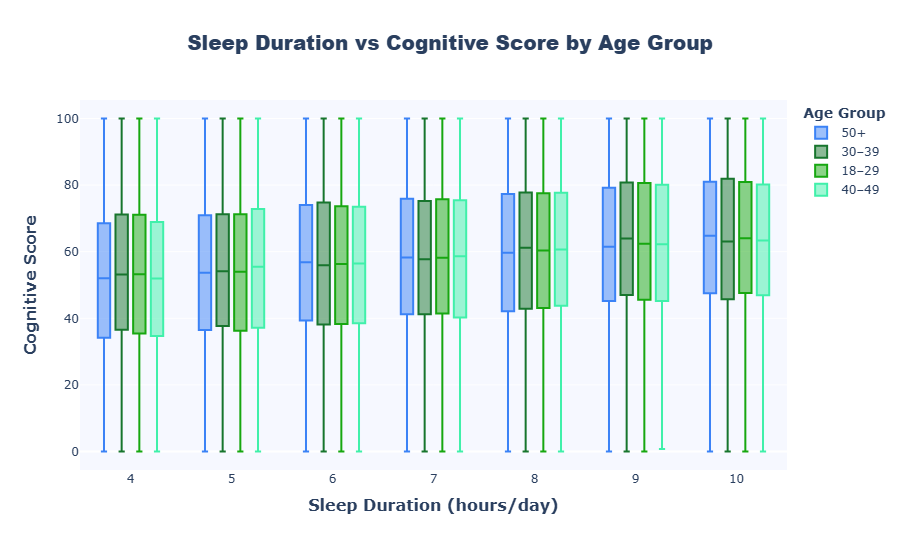
When it comes to mental sharpness, sleep is usually the first thing everyone points to and the data mostly agrees. From the chart above, we can see that people who sleep between 7 to 9 hours tend to have slightly higher and more stable cognitive scores across all age groups. It’s not a dramatic spike, but it’s consistent enough to matter. What’s fascinating is that both too little sleep (around 4–5 hours) and too much sleep (9–10 hours) show wider variations and lower medians, suggesting that both extremes might reduce mental balance.
Across age groups, the trend holds steady. Whether someone is in their twenties or fifties, the pattern looks almost the same moderate sleepers perform better. This shows that our brains appreciate regularity more than excess. Sleep seems to act like a mental reset button; too little, and the system runs on fumes, too much, and it drifts into sluggish mode. The takeaway here is simple but powerful: cognitive performance doesn’t come from sleeping more, but from sleeping right.
What about a personal dietary? here data only gives 3 type of dietary ( Vegan, Non-vegetarian and vegetarian) let’s break it down to gender and age group.
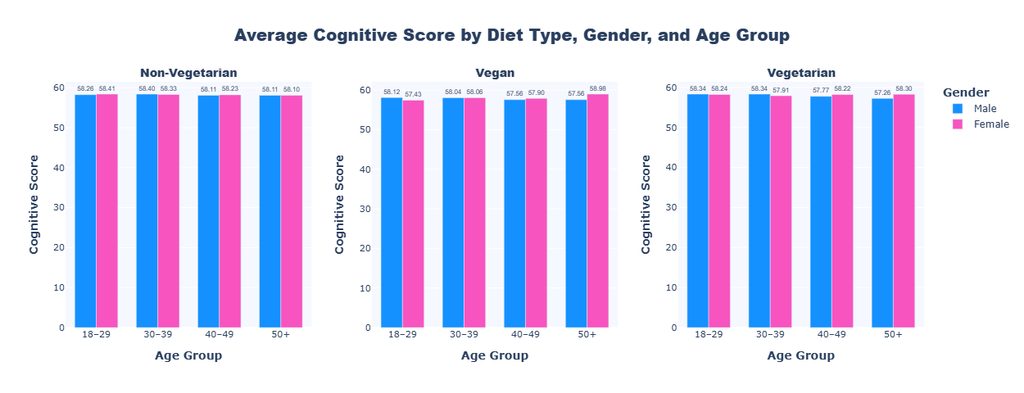
Food habits always spark debate when it comes to mental performance, but the data here paints a calm, balanced picture. Across all three diet types non-vegetarian, vegan, and vegetarian the average cognitive scores stay in a very close range, roughly between 57.5 and 58.5. In other words, no diet seems to make people dramatically smarter or slower.
But if we look closely, there’s a small pattern worth mentioning. Participants who follow a vegan diet tend to record slightly lower cognitive scores across almost every age group compared to vegetarians and non-vegetarians. The gap isn’t big, but it’s consistent enough to notice. It might not mean that vegan diets harm cognitive ability, but perhaps it reflects differences in nutrient intake for example, lower levels of vitamin B12, omega-3, or iron, which are important for brain health.
Meanwhile, vegetarians appear to hold the most stable line across ages, showing less fluctuation than the other two groups. Non-vegetarians sit right in between neither the highest nor the lowest but remain consistently strong. Altogether, this suggests that the quality and balance of nutrients matter more than the label of the diet itself. In simple terms, your brain doesn’t really care what you call your diet, as long as it’s getting everything it needs to stay fueled and focused.
Nowadays screens have quietly become our second home to admit. From work meetings to late-night scrolling, it’s almost impossible to escape them. But does all that screen exposure come with a cost to how well we think and remember things? When looking at the data, the answer leans toward yes.
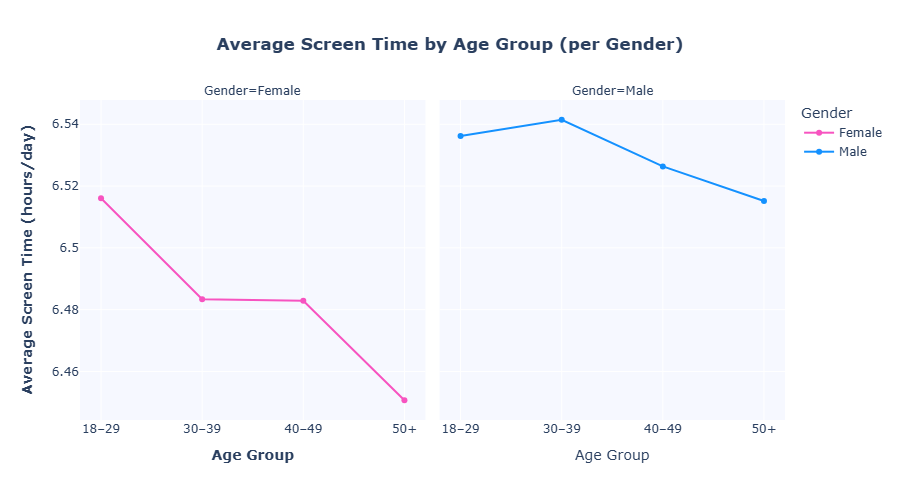
When we break screen time down by age and gender, a subtle yet interesting pattern appears. Younger adults clearly spend the most hours in front of screens, while older participants show a gradual decline. For both men and women, average daily screen use hovers around 6.5 hours for those aged 18–29 and slowly drops toward 6.4 hours or less among the 50+ group. It’s not a huge difference, but it reflects how daily routines shift as people move through different life stages.
For female participants, screen time shows a steady downward curve younger women spend the most time connected, and older women the least. Among males, the curve starts a bit higher and peaks slightly in the 30–39 range before easing down. This could reflect work patterns or lifestyle differences, such as higher digital engagement during mid-career years.
Even though the numbers seem close, what makes them meaningful is their link to mental balance. More time in front of screens can easily blend work, entertainment, and distraction into one endless stream, leaving less room for mental rest. This aligns with the earlier insight people spending over six hours daily with screens tend to have slightly lower cognitive and memory scores. The data reminds us that the real challenge isn’t avoiding screens, but finding balance in how we use them.
What about talking something that fuels millions of brains cells every morning “caffeine”!.
Whether it’s a cup of coffee, tea, or an energy drink, caffeine is often seen as the shortcut to focus and productivity. But how much does it really help our thinking performance? And is there a point where it starts doing more harm than good? Looking at the data, caffeine becomes one of the most fascinating variables because it’s both a mental booster and, at times, a silent saboteur. The challenge isn’t whether to drink it or not it’s about finding that sweet spot where caffeine keeps the brain alert without pushing it into overdrive.
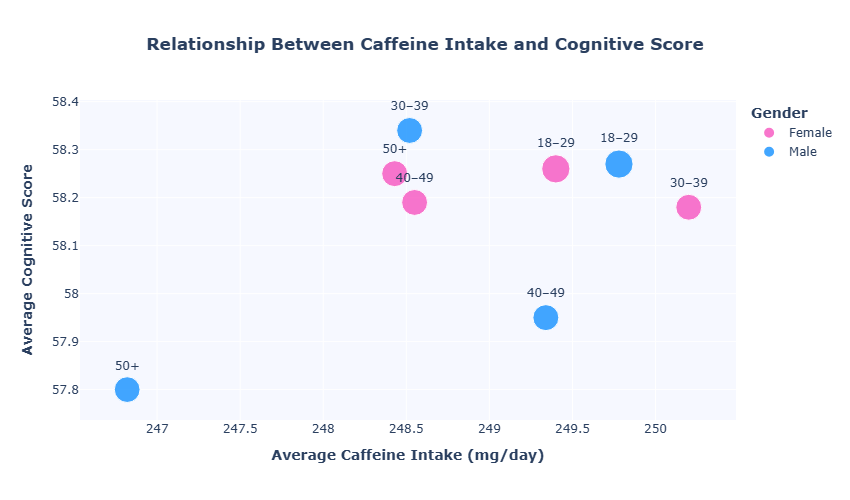
Looking at the relationship between caffeine intake and cognitive score, the data tells a story of moderation. People who consume a moderate amount of caffeine around 248 to 249 mg per day tend to show slightly higher cognitive scores compared to those with lower or higher intake. This sweet spot sits roughly around two small cups of coffee a day, which seems to keep the brain awake without crossing into overstimulation.
When broken down by gender and age, the pattern stays gentle but consistent. Both men and women in the 30–39 and 18–29 age groups show the best balance of caffeine use and mental performance. Meanwhile, cognitive scores dip just a little among older participants, particularly males aged 50+, even though their caffeine intake is slightly lower. This might suggest that with age, caffeine’s stimulating effect becomes less pronounced or that other lifestyle factors like sleep and stress start to play a bigger role.
Overall, the data hints that caffeine can indeed sharpen the mind, but only within limits. Too much and it tips into restlessness; too little and the spark fades. The secret, it seems, isn’t in quitting coffee, but in keeping it as a quiet ally a small ritual that helps the mind stay alert without burning out.
The last lifestyle factor in this exploration is exercise, a variable that often makes or breaks our mental freshness. In the dataset, exercise frequency was originally grouped into simple levels low, medium, and high. Now, the real question is does moving more actually lead to sharper thinking, or is it more about consistency than intensity?
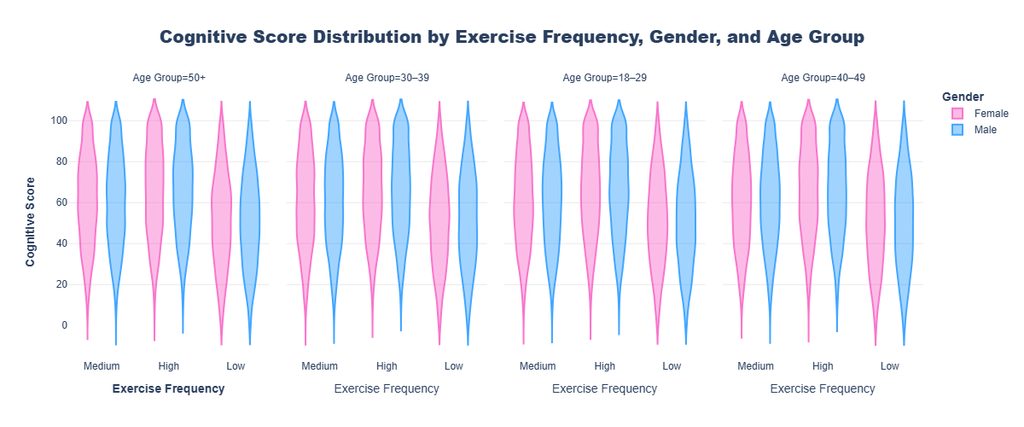
When it comes to exercise, the data makes one thing clear moving your body does something good for your mind, but not in a perfectly linear way. Across all age groups, people who exercise at a medium frequency roughly 3 to 5 hours per week tend to show the most balanced and stable cognitive scores. Their distributions are slightly tighter, suggesting more consistency in mental performance. It’s as if the brain responds best to regular, moderate movement rather than pushing too hard or doing too little.
Those in the low activity category show more spread in their scores, meaning mental performance fluctuates more widely from person to person. This could reflect varying energy levels, mood swings, or simply the mental fatigue that comes from a sedentary routine. Meanwhile, those in the high activity range don’t necessarily outperform everyone else in some cases, the curve even flattens a little, hinting that excessive training might not always equal sharper brain performance.
Across gender lines, the patterns remain nearly identical. Both men and women benefit equally from consistent exercise, especially within that moderate zone. And when you look at the four age groups, the story stays the same from young adults to those over 50, balance beats intensity. The key insight here is refreshingly simple: the mind doesn’t need an athlete’s schedule to stay sharp, just a body that keeps moving often enough to keep the system alive and awake.
Conclusion in my point of view after exploring the data.
After walking through thousands of data points and every corner of our daily routine, one truth quietly stands out our cognitive strength isn’t built by one single habit, but by the rhythm of all of them working together. Gender and age might set the background, but the real story comes from how we live day to day: how much we sleep, move, rest, and stimulate our minds.

Sleep shows us the value of balance too little or too much, and focus starts to drift. Diet reminds us that labels like “vegan” or “non-vegetarian” matter less than nutrient quality and consistency. Screen time exposes how our connected world can tire the mind if left unchecked. Exercise proves that steady, moderate movement can keep the mental engine running smoothly. And caffeine, everyone’s favorite brain fuel, teaches us that even good things have their limits moderation wins again.
In the end, mental performance isn’t about chasing perfection or living like a machine. It’s about building small, sustainable rhythms thru of our age phases that keep the brain clear, responsive, and energized. If this dataset shows anything, it’s that thinking well is less about willpower and more about maintenance a lifestyle that nourishes the body just enough for the mind to do what it does best.
Data Source
The dataset used in this analysis was sourced from Kaggle and is licensed under the Open Data Commons Public Domain Dedication and License (PDDL v1.0). Dataset published by Samharison : Human Cognitive Performance Analysis.
Author’s Notes:
The analysis presented here is purely for educational and exploratory purposes. This article is not a scientific study but a data analytics learning project based on publicly available datasets. Any statements should be understood within the context of the samples analyzed, not as universal conclusions. Results do not represent the global population, as cultural, environmental, and health factors may vary across groups.
The data analysis and visualization in this article i created by using Python, Plotly Express & Pandas Libraries, and i utilized Chat GPT-5 Codex for code refinement ( make my coding short and tidy). Images was generated using Gemini: nano banana.