
Daily Briefing and Debriefing Skills SOP
Daily Briefing and Debriefing Skills SOP
Short description
A leadership skills Standard Operating Procedure that turns the daily shift briefing from a formality into a managed practice, covering preparation, a timed four part briefing structure, a four part debriefing structure, documentation requirements, coaching technique, and eight named failure modes to avoid. Written for Front Office Supervisors and Managers, with timings specified at every stage.
Purpose
Almost every hotel holds briefings. Very few hold good ones. The common pattern is a supervisor reading arrivals from a printed sheet to a half attentive team, skipped entirely on the busiest days, with nothing recorded and nothing followed up. The shift then runs on assumption, and the handover carries whatever the outgoing supervisor happens to remember.
This SOP addresses that directly, and it does something the rest of your library does not:
- It teaches a skill rather than specifying a process. Where your Recruitment SOP documents a procedure, this one develops a capability, namely how to run a short meeting that actually changes how a shift performs.
- It makes the briefing a leadership instrument. The policy statement says so explicitly, stating that the briefing is not a formality but a leadership tool, and holding every supervisor and manager accountable for conducting one.
- It gives structure with timings. Ten to fifteen minutes for the briefing, five to ten for the debriefing, twenty minutes of preparation beforehand, and a minute allocation for each segment, which is what stops a briefing either rushing or sprawling.
- It closes the shift properly. The debriefing receives the same attention as the briefing, which is unusual and valuable, since most properties open the shift with structure and end it with nothing.
- It names the failure modes. Eight specific mistakes are listed, each one recognisable to anyone who has watched briefings in a real hotel.
It suits hotels standardising shift leadership across properties, management companies developing supervisory capability, operations where service quality varies by shift, properties preparing supervisors for promotion, and any department head who has sat through a weak briefing and struggled to explain exactly what was missing.
What is inside the document
A complete SOP in seven numbered sections, with document control, policy statement and corrective action provisions.
1. Document control and policy
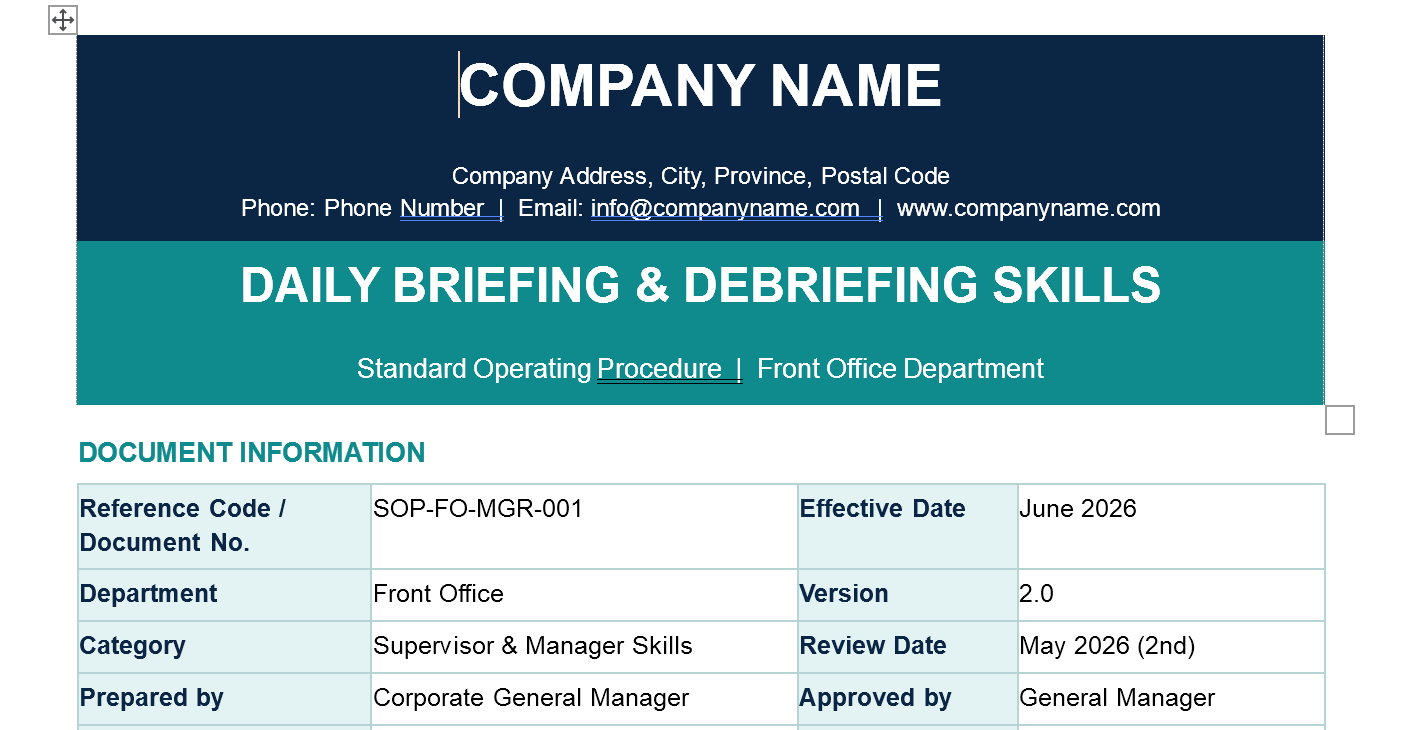
A letterhead block for company name, address, phone, email and website, followed by a five row control table recording the reference code SOP-FO-MGR-001, effective date, department, version, category identified as Supervisor and Manager Skills, review date, preparer, approver, distribution and classification.
Purpose and scope follow, confirming that the SOP applies to all Front Office Supervisors and Managers across all properties, and covering preparation, conduct and documentation of both sessions.
The policy statement is the strongest paragraph in the document and worth quoting in your sales material. It states that the daily briefing is not a formality but a leadership tool, that every supervisor and manager is responsible for a structured briefing at the start of each shift and a meaningful debriefing at the end, and that these sessions set the tone for service quality, staff accountability and operational excellence. That framing is what distinguishes this document from a meeting agenda.
2. Section 1, Pre Shift Briefing Preparation
Seven preparation steps beginning at least twenty minutes before the shift, covering review of the occupancy report, arrivals, departures and VIP list, checking pending guest requests, complaints and unresolved issues from the previous shift, reviewing management directives, special events and property wide notices, preparing a grooming and uniform inspection checklist, setting up the briefing space with all staff present, preparing the shift task assignment list with clear responsibilities per team member, and reviewing performance notes or coaching points for individuals.
Specifying twenty minutes of preparation is what makes the rest of the document work, since an unprepared briefing cannot be rescued by structure alone.
3. Section 2, Pre Shift Briefing Conduct
A four part sequence totalling ten to fifteen minutes, with a time allocation for each part:
- Opening, one to two minutes, covering greeting and attendance confirmation, grooming and uniform inspection, and acknowledgement of team achievements or positive feedback from the previous shift.
- Operational Update, five to seven minutes, covering occupancy figures with rooms occupied, expected arrivals and departures, VIP guests and their specific requirements, special events, group arrivals and property wide activities, pending guest requests carried over, and operational changes including system updates, room blocks and maintenance restrictions.
- Task Assignment, two to three minutes, covering workstation and responsibility allocation, break times and rotation, and cross training or coverage arrangements when staffing is short.
- Motivation and Close, one to two minutes, covering a short service reminder, an open floor for questions, and a clear positive closing statement, with suggested wording supplied.
Opening with recognition before moving to operations is a deliberate sequencing choice that most briefings get backwards, and the grooming inspection placed at the start rather than left informal means it actually happens.
4. Section 3, Post Shift Debriefing Preparation
Five preparation steps beginning ten minutes before the shift ends, covering review of completed tasks and pending items against the assignment list, collecting team feedback on service issues, noting complaints, compliments and unusual incidents, confirming guest requests have been resolved or properly handed over, and preparing the shift summary for the handover report.
5. Section 4, Post Shift Debriefing Conduct
A four part sequence of five to ten minutes, conducted before team members leave their workstation:
- Shift Review, summarising key activities and outcomes, acknowledging strong performance and service recovery, and discussing service challenges and how they were handled.
- Issue Identification, inviting the team to raise concerns, recurring issues and process gaps, recording items requiring management or interdepartmental follow up, and an explicit instruction to avoid blame and focus on problem solving.
- Handover Confirmation, confirming open items communicated to the incoming supervisor, verifying the handover report is complete and accurate, and ensuring no pending guest request is left without a clear action plan.
- Closing, thanking the team, sharing one positive takeaway or learning point, and dismissing the team in an orderly manner.
Requiring the debriefing to happen before staff leave their workstation is the operational detail that makes it possible, since a team that has already dispersed cannot be debriefed.
6. Section 5, Documentation and Records
Five requirements covering completion of the Daily Briefing Log recording date, shift, attending staff, topics covered and action items, recording of pending tasks, complaints and escalations in the Shift Handover Report, noting individual coaching points in the supervisor’s logbook, filing of briefing logs by the Department Head with a minimum thirty day retention, and escalation to the Front Office Manager of any issue recurring across multiple shifts.
The recurring issue escalation rule is the mechanism that turns daily briefings into operational improvement rather than daily repetition.
7. Section 6, Using Briefings as a Coaching Tool
Six coaching techniques covering a short service tip or brand standard reminder at every briefing capped at two minutes, using real guest feedback as a teaching moment without naming the guest, recognising strong performance publicly to reinforce behaviour, addressing individual performance issues privately and never in the group briefing, rotating the floor by asking a team member to share a guest interaction highlight, and keeping coaching to one or two key messages rather than a lecture.
The public praise and private correction rule is stated plainly rather than implied, which matters because the opposite practice is common and quietly corrosive.
8. Section 7, Common Mistakes, and corrective action
Eight named failure modes, covering skipping the briefing when busy with the pointed observation that this is when briefings matter most, reading from a sheet without engaging, covering too many topics, overrunning without an agenda, using the briefing to criticise an individual publicly, failing to follow up previous action items, briefing without first reviewing occupancy and VIP reports, and closing without confirming staff understood their tasks.
The document closes with a non compliance clause stating that supervisors or managers who consistently fail to conduct briefings, or conduct them without required preparation and documentation, are subject to corrective action under HR policy, followed by a document control block recording preparer, filer, approver, version and next review date.
What you gain
- Briefings that change shift performance rather than merely occupying ten minutes.
- Supervisory capability developed through a document rather than through trial and error.
- Shifts that close properly, through a debriefing given equal weight to the briefing.
- Continuity across shifts, through documented logs, handover confirmation and a thirty day retention rule.
- Operational improvement, through recurring issues escalated rather than repeated.
- Better coaching, through technique taught explicitly including what never to do in front of a team.
- Enforceability, through a corrective action clause that gives the standard weight.
Owner: Oka Witantra
© 2026 Oka Witantra. All rights reserved.
Website: www.okawitantra.com
This document, including its design, layout, wording, structure and documentation, is the intellectual property of Oka Witantra. The downloader is granted a single user licence to use and adapt this document for the internal operation of their own property or organisation. Reproduction, redistribution, resale, sublicensing or publication of this document, in whole or in part, is not permitted without prior written permission from the author.
All names, codes and figures shown in this document are sample data for illustration only.
Download link:
Daily Briefing and Debriefing Skills SOP