
Standard Recipe Card and Menu Costing
Standard Recipe Card and Menu Costing
Short description
A complete recipe costing workbook holding twenty standard recipe cards, all costed from a single ingredient price master and compiled into a menu profitability dashboard. Change one supplier price and every affected dish re costs instantly, with food cost percentage, gross profit and a suggested selling price recalculated against the target for that menu category.
Purpose
Menu pricing in most hotels is set once, by estimate, and then left alone while ingredient prices move underneath it. Twelve months later the kitchen is selling several dishes at a loss and nobody knows which ones, because re costing a menu by hand takes days that no Executive Chef has.
This workbook removes that obstacle entirely:
- One price list drives everything. Ingredient prices live in a single master. Update a supplier price once and every recipe using that ingredient re costs automatically, which turns an annual exercise into a two minute task.
- It costs the way a professional kitchen actually costs. Yield percentage is built into every ingredient line, so trimming, peeling and cooking loss are priced in rather than ignored. A Q factor covers seasoning, oil and garnish that nobody lists.
- It prices backwards as well as forwards. Alongside the current food cost percentage, the card calculates the selling price that would hit the target for that category, rounded to a sensible figure, so the question is not only whether a dish is profitable but what it should cost.
- It handles the guest facing price correctly. Service charge and government tax are applied in the right order, so the menu price and the price on the bill are both visible.
- It makes the card a working document, not only a costing. Allergen declarations, preparation method and plating standard sit on the same sheet, so one card serves costing, training and compliance.
It suits Executive Chefs costing or re costing a menu, F&B Managers and Directors reviewing menu profitability, Cost Controllers verifying theoretical food cost, pre opening teams building a menu from scratch, and any property that has not re costed its menu since supplier prices last moved.
What is inside the file
Twenty six sheets, organised as one dashboard, one settings sheet, one ingredient master, twenty recipe cards, a master template, a user guide and an ownership notice.
1. Summary sheet, the menu costing dashboard
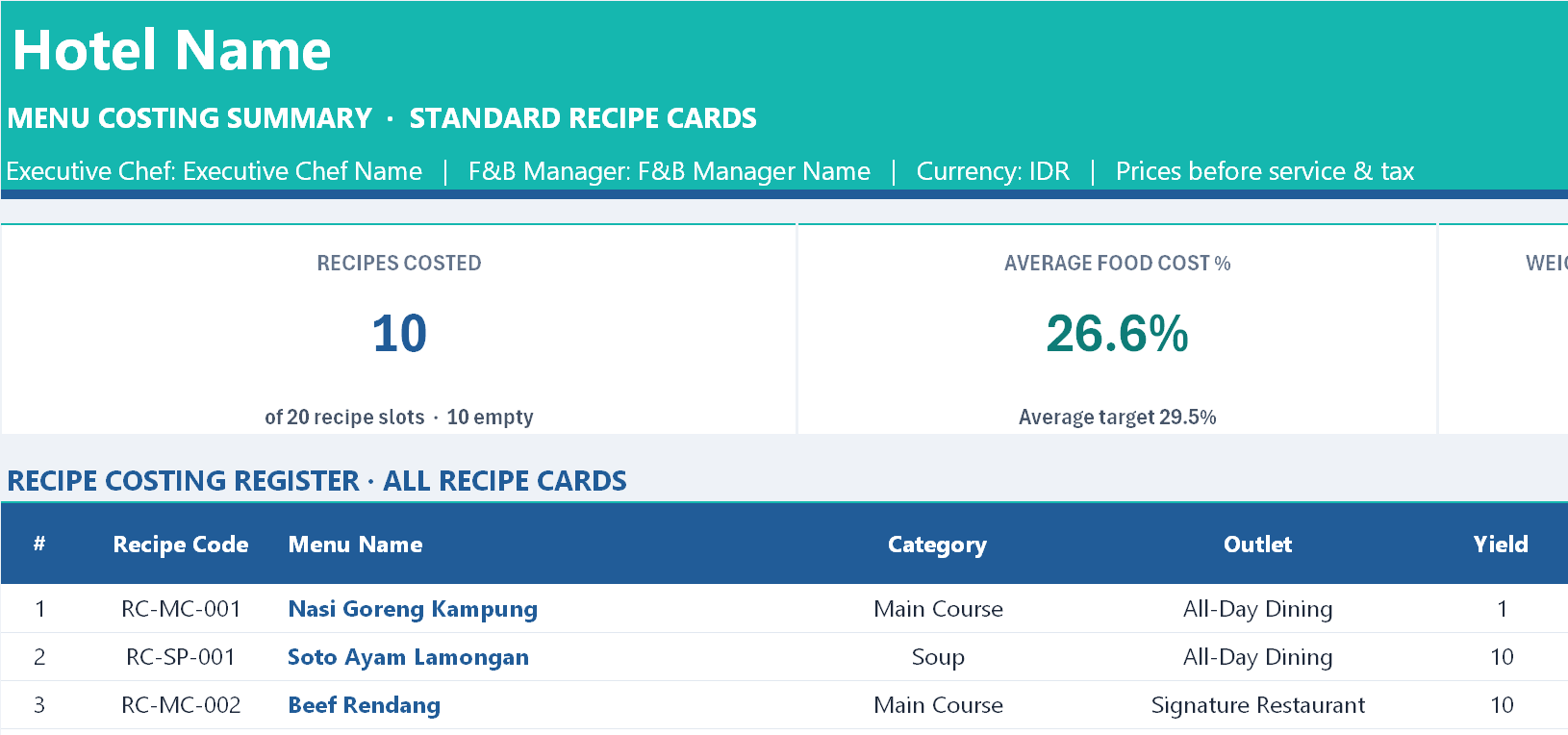
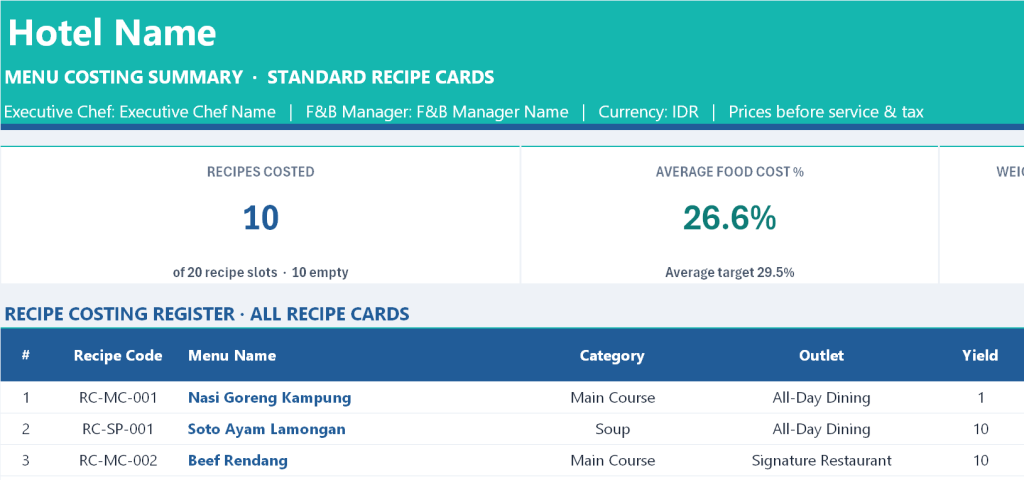
- Six headline cards covering recipes costed out of twenty slots, average food cost percentage against average target, weighted food cost percentage by sales mix, potential monthly food revenue, potential monthly gross profit, and a status mix showing how many dishes sit On Target, Watch and Action.
- A header reporting how many ingredients are in the price master and the date of the most recent recipe update.
- A Recipe Costing Register listing all twenty cards with recipe code, menu name, category, outlet, yield, cost per portion, selling price, food cost percentage, target percentage, variance in points, gross profit per portion, suggested price, monthly portions, monthly revenue, monthly food cost, monthly gross profit and status.
- A category view and a Top 10 review list identifying the dishes most in need of attention.
- Two charts.
The weighted food cost percentage by sales mix is the figure worth drawing attention to. A simple average across twenty dishes tells you very little, because a dish selling four hundred portions a month matters far more than one selling twelve. Weighting by actual sales mix produces the number that will reconcile with the kitchen’s real food cost.
2. Setup sheet, configured once
- Property settings covering hotel name, currency label, Executive Chef and F&B Manager names.
- Pricing rules covering service charge, government tax, the Q factor for seasoning, oil and garnish, a watch band in percentage points, a default target food cost percentage, and a rounding increment for suggested prices.
- Eight menu categories each with its own target food cost percentage, namely appetizer, soup, salad, main course, dessert, side dish, non alcoholic beverage and kids menu.
- Six outlets, editable to match the property.
- Dropdown lists for allergen answers and spicy level.
Setting a different target by category is the correct approach, since holding a soup and a main course to the same food cost percentage misprices both.
3. Ingredients sheet, the price master
Capacity for over one hundred ingredients, supplied with sixty one already entered, each recording an automatic code, ingredient name, category, purchase unit, purchase price, recipe unit, recipe units per purchase unit, calculated cost per recipe unit, yield percentage, supplier, last price update, and a count of how many recipes use it.
Two columns here carry most of the workbook’s value. The purchase unit to recipe unit conversion means a chef enters grams while purchasing enters kilograms, with no manual arithmetic. And the used in recipes count shows immediately how many dishes a supplier price increase will affect, which is exactly what you want to know before accepting one.
4. Recipe cards, twenty sheets
Ten sample cards are supplied complete, namely Nasi Goreng Kampung, Soto Ayam Lamongan, Beef Rendang, Grilled Salmon Lemon Butter, Caesar Salad, Club Sandwich, Mie Goreng Seafood, Pisang Goreng with Ice Cream, Chocolate Lava Cake and Sate Ayam Madura, alongside ten empty slots. Each card carries five headline figures and six sections:
- Headline cards for cost per portion, food cost percentage against target, selling price, gross profit per portion, and the suggested price at target, with a status marker reading On Target, Watch or Action, plus a prompt indicating whether a price increase is needed and by how much.
- Section 1, Recipe Information, covering menu name, recipe code, category, outlet, yield in portions, portion size, selling price before service and tax, preparation and cooking time, estimated monthly portions sold, creator, last updated and approver.
- Section 2, Ingredients and Costing, twenty lines where selecting an ingredient pulls its unit, cost per unit and yield percentage automatically. It produces an ingredient subtotal, the Q factor addition, total recipe cost, and cost per portion, with each line showing its share of the recipe and a preparation note.
- Section 3, Pricing and Profitability, covering selling price, cost per portion, food cost percentage, target percentage by category, variance in points, gross profit per portion, the suggested price at target rounded up, and the guest price including service charge and tax.
- Section 4, Allergen and Dietary Information, covering gluten, dairy, egg, seafood and shellfish, peanuts and tree nuts, soy, pork content, and spicy level.
- Section 5, Method of Preparation, ten numbered steps.
- Section 6, Plating, Garnish and Service Standard, covering serviceware, garnish, holding and serving temperature and a service note.
5. Template, How to Use and Copyright
A hidden master copy of a recipe card for creating new ones, a five part guide covering the workbook map, colour code, one time setup, how to create a recipe card and the key formulas, and an ownership notice.
What you gain
- A menu re costed in minutes when supplier prices move, rather than not at all.
- Costs that include waste, through yield percentage applied to every ingredient.
- A price recommendation, not only a cost, for every dish on the menu.
- Visibility of which dishes actually damage profitability, weighted by how often they sell.
- Advance warning of the impact of a supplier price increase, through the usage count.
- One card that serves costing, kitchen training, allergen compliance and plating standard.
- Ten Indonesian and international sample recipes already built, so the workbook can be understood before any data is entered.
Owner: Oka Witantra
© 2026 Oka Witantra. All rights reserved.
Website: www.okawitantra.com
This document, including its design, layout, wording, structure and documentation, is the intellectual property of Oka Witantra. The downloader is granted a single user licence to use and adapt this document for the internal operation of their own property or organisation. Reproduction, redistribution, resale, sublicensing or publication of this document, in whole or in part, is not permitted without prior written permission from the author.
All names, codes and figures shown in this document are sample data for illustration only.
Download link:
Standard Recipe Card and Menu Costing