
Revenue Analyst Job Description Template
Revenue Analyst Job Description Template
Short description
A ready to brand job description for the Revenue Analyst, covering 28 specific responsibilities across nine areas of accountability, together with qualifications, measurable performance indicators, and a three party signature block. Written at staff level for the analytical position that produces the data the entire commercial team depends on, with rate loading, parity monitoring, displacement analysis and data quality all written in as accountabilities.
Purpose
Revenue management produces decisions, but it runs on data, and somebody has to produce that data accurately and on time every single day. In most properties that work is spread across whoever has capacity, which is why the daily report arrives late, segment codes are wrong, rate parity breaches are noticed by the OTA before the hotel, and the forecast rests on numbers nobody has verified.
This template defines the position that fixes all of it:
- For recruitment, it sets an accessible bar at one year of experience while explicitly welcoming fresh graduates with strong analytical skills, which is realistic for an entry level analytical role and widens a narrow candidate pool.
- For execution, it assigns the operational work the Revenue Manager should not be doing, namely rate loading, parity checks, rate shopping, content verification and channel troubleshooting.
- For data integrity, it places rate codes, room types, packages and market segment codes in one named role, and requires daily statistics to be checked against the night audit.
- For commercial support, it includes displacement analysis preparation, which is the single most valuable analytical task in a hotel and the one most often skipped for lack of time.
- For audit readiness, it requires a clear log of rate changes, restrictions and system updates, and organised storage of revenue data.
It suits hotels establishing or expanding a revenue function, properties where the Revenue Manager is consumed by data production rather than strategy, operations with recurring parity or content errors across channels, and HR departments completing the Sales and Marketing library at staff level.
What is inside the document
A clean portrait layout in five parts.
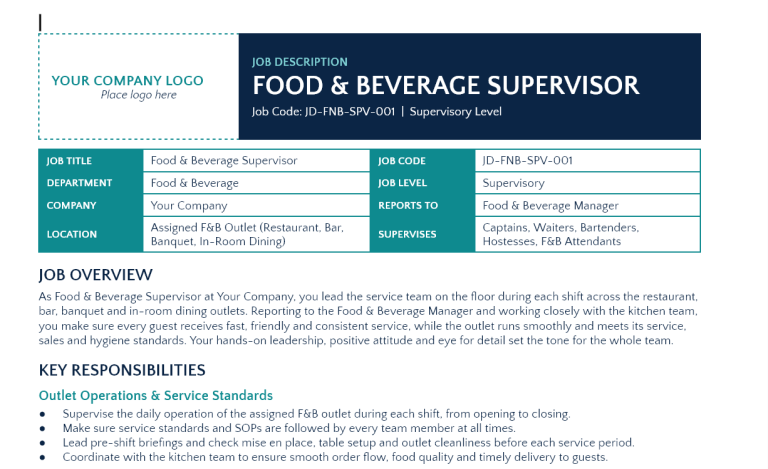
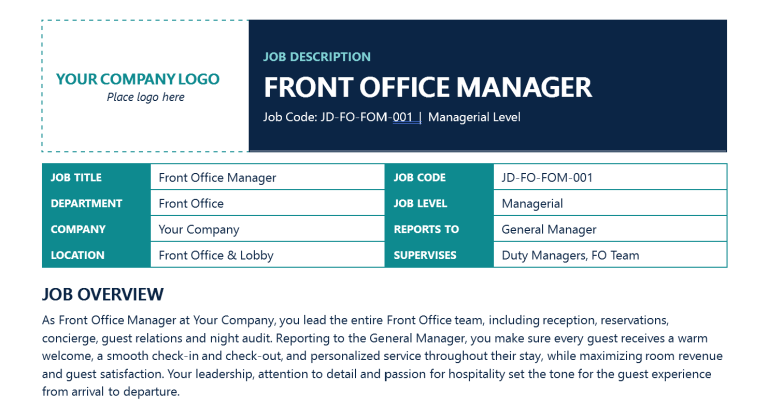
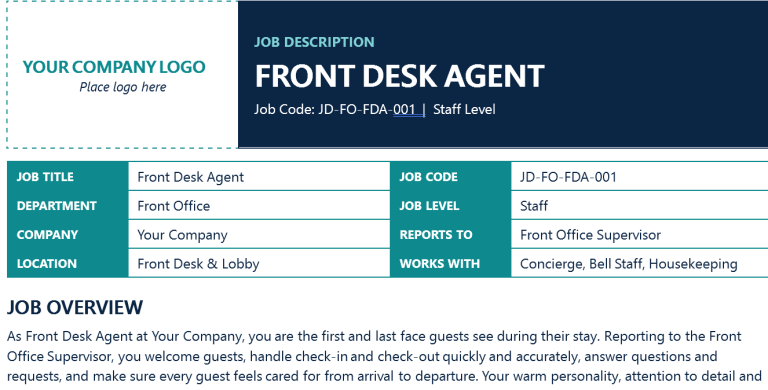
1. Branded header
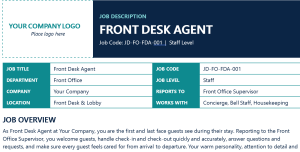
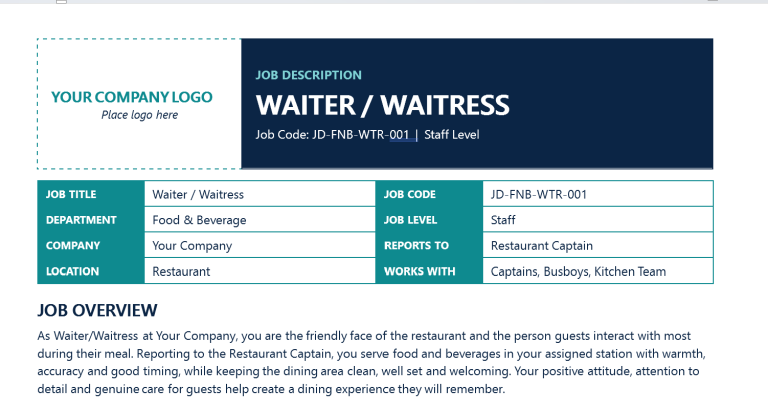
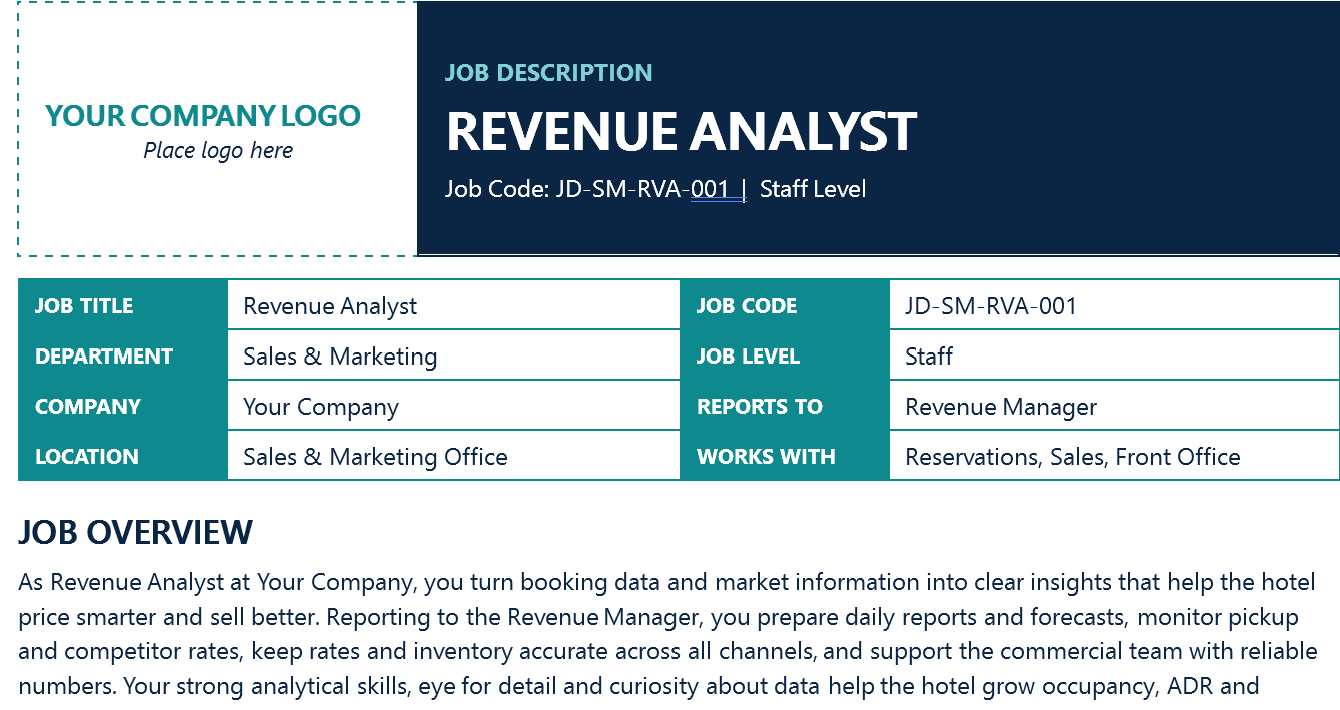
A two panel header pairing a marked logo placeholder with a dark title block carrying the document type, job title, job code, and job level, identified here as Staff.
2. Position identification table
Eight fields covering job title, job code, department, job level, company, reporting line to the Revenue Manager, location at the Sales and Marketing Office, and the teams the position works alongside, namely Reservations, Sales and Front Office.
As with the other staff level documents in your library, this one carries Works With rather than Supervises, which is the correct treatment and keeps the convention consistent across departments.
3. Job overview
A single paragraph in second person, describing the role as turning booking data and market information into clear insights that help the hotel price smarter and sell better. It names the reporting line and the four core activities, namely daily reports and forecasts, pickup and competitor monitoring, rate and inventory accuracy across channels, and supporting the commercial team with reliable numbers. It closes on analytical skill, attention to detail and curiosity about data.
Naming curiosity as a quality alongside skill and detail is a small but well judged choice, since the difference between an analyst who reports numbers and one who notices things is almost entirely curiosity.
4. Key responsibilities
Twenty eight responsibilities organised into nine titled groups:
- Data Collection and Daily Reports, four points covering the daily revenue report on occupancy, ADR, RevPAR, pickup and segment production, collection of booking, market and competitor data from the PMS, RMS and rate shopping tools, checking daily statistics against the night audit report with errors corrected, and sharing daily highlights and unusual trends with the Revenue Manager.
- Rate and Inventory Updates, three points covering loading and updating of rates, packages, promotions and restrictions in the PMS and channel manager, application of stop sells, minimum stay and closed to arrival rules as instructed, and verification that rate loading and inventory are correct after every change.
- Forecasting and Analysis, four points covering support for daily, weekly and monthly forecasts, tracking of booking pace, pickup, cancellations, no shows and group wash against forecast, competitor rate shopping with comparison reports, and analysis of segment, channel and source performance.
- Channel and Parity Monitoring, four points covering monitoring of rate parity and availability across website, OTAs, GDS and wholesale, verification of hotel content, photos and room descriptions on all channels with errors reported, follow up with OTA partners and the channel manager provider on technical or mapping issues, and tracking of channel production and commission cost.
- Systems and Data Quality, three points covering maintenance of rate codes, room types, packages and market segment codes, checking reservations for correct segment, source and rate codes with corrections made alongside Reservations, and keeping revenue reports, templates and dashboards current.
- Group and Business Evaluation, three points covering preparation of displacement analysis for group and corporate rate requests, tracking of group blocks, allotments and cut off dates with release dates reported to Reservations and Sales, and support for budget and business plan preparation with data and historical trends.
- Communication and Coordination, three points covering preparation of data and reports for weekly revenue meetings, sharing rate and availability updates with Sales, Reservations and Front Office, and helping train staff on rate codes, packages and system use.
- Reporting and Administration, three points covering weekly and monthly reports on market share, STR or benchmark data and channel production, maintaining a clear log of rate changes, restrictions and system updates, and organised storage of revenue data for easy access and audit.
- Other Duties, a single properly worded catch all point.
Three inclusions are worth drawing out. Checking daily statistics against the night audit report is the verification step that separates a reliable daily report from a plausible one, and it is routinely skipped. Verifying hotel content, photos and room descriptions across channels addresses a revenue leak most properties never examine, since an outdated room description on an OTA suppresses conversion silently. And maintaining a log of rate changes and system updates creates the audit trail that makes a parity dispute or a pricing error traceable.
5. Qualifications, performance indicators, and approval
- Qualifications and requirements, seven points covering education in Hospitality, Business, Finance, Statistics or related field, a minimum of one year in revenue, reservations or front office with fresh graduates welcomed on analytical strength, basic knowledge of pricing, distribution, segments and hotel KPIs, analytical and numerical skill with high attention to detail, advanced Excel with PMS, RMS or channel manager experience as an advantage, good English, and the ability to work to tight deadlines with large volumes of data accurately.
Listing Statistics as an acceptable field of study is a sensible widening, since this is one of the few hotel roles where a non hospitality graduate may be the stronger candidate.
- Key performance indicators, five measurable standards covering accuracy and timeliness of daily, weekly and monthly reports, rate loading accuracy and parity compliance, forecast support and PMS data quality, speed of response to channel and mapping issues, and quality of insights shared with the Revenue Manager.
The final indicator is unusual for a staff level position and is the right inclusion. It measures whether the analyst is thinking rather than only processing, and it gives a capable junior a visible path toward the Revenue Manager role.
- A scope limitation note, properly worded.
- A three column approval block with name and date fields for the Corporate General Manager, the Human Resource Manager, and the Revenue Analyst as acknowledging assignee, followed by a footer carrying the update date, revision number, and job code.
What you gain
- A daily revenue report that is accurate and on time, with a named owner.
- A Revenue Manager freed from data production to do strategy.
- Rate parity and channel content monitored continuously rather than discovered by complaint.
- Displacement analysis prepared as routine, so group business is assessed before it is accepted.
- Clean system data, which makes every downstream report trustworthy.
- An audit trail of rate and restriction changes.
- An entry point into revenue management for analytical graduates, with a visible development path.
Owner: Oka Witantra
© 2026 Oka Witantra. All rights reserved.
Website: www.okawitantra.com
This document, including its design, layout, wording, structure and documentation, is the intellectual property of Oka Witantra. The downloader is granted a single user licence to use and adapt this document for the internal operation of their own property or organisation. Reproduction, redistribution, resale, sublicensing or publication of this document, in whole or in part, is not permitted without prior written permission from the author.
All names, codes and figures shown in this document are sample data for illustration only.
Download link:
Revenue Analyst Job Description Template