
Revenue Management and Room Yield Awareness SOP
Revenue Management and Room Yield Awareness SOP
Short description
A leadership skills Standard Operating Procedure that gives Front Office Supervisors and Managers a working command of revenue management, covering seven core concepts with formulas, six shift level indicators, six rate application rules, a complete overbooking and walk procedure, upselling as a managed activity, and distribution channel economics including OTA commission. Third in the Front Office management skills series.
Purpose
Revenue management is usually treated as something that happens in an office upstairs. The Revenue Manager sets rates, the front desk applies them, and nobody at the desk is expected to understand why. The consequences are entirely predictable. Rates get discounted to settle an argument, walk in guests are quoted whatever seems reasonable, upgrades are offered only to guests who look wealthy, and an oversold night is discovered at check in with no plan.
Every one of those is a revenue loss caused by a knowledge gap rather than by negligence. This SOP closes it:
- It teaches the vocabulary with the mathematics. Occupancy, ADR, RevPAR, room yield, rack rate, BAR and ALOS are each defined with their formula, so a supervisor can calculate them rather than merely recognise them.
- It converts concepts into shift actions. Six indicators are specified for review at the start and end of each shift, each phrased as a question the supervisor should be able to answer.
- It protects rate integrity at the point of sale. Six enforcement rules cover the final moment where revenue is won or lost, namely the front desk at check in.
- It provides a complete walk procedure. Overbooking is explained as a deliberate strategy rather than an error, and the walk procedure is specified step by step including compensation and documentation.
- It makes upselling a managed activity. Daily inventory briefings, shift targets, conversion tracking, recognition and on the spot coaching replace the usual approach of telling staff to try harder.
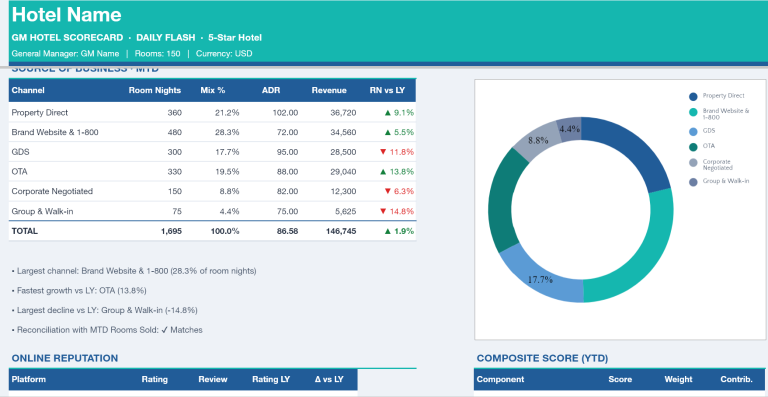
- It explains channel economics. OTA commission is stated as a range, direct booking margin is explained, and the supervisor is given a reason to care about where a booking came from.
It suits hotels where front desk rate discipline is inconsistent, properties preparing supervisors for Duty Manager or department head roles, operations with weak upsell conversion, management companies raising commercial literacy across properties, and any Front Office Manager who has had to explain for the third time why a rate was not to be discounted at the desk.
What is inside the document
A complete SOP in six numbered sections, with document control, policy statement and corrective action provisions.
1. Document control and policy
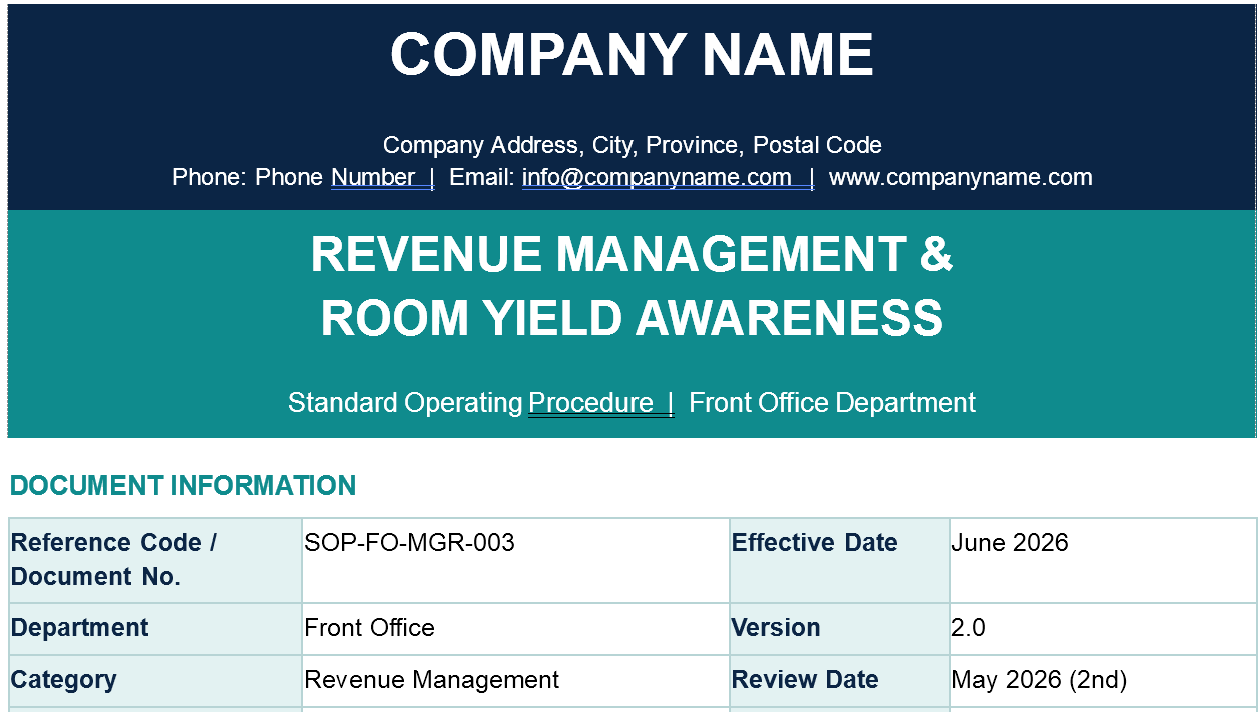
A letterhead block for company name, address, phone, email and website, followed by a five row control table recording the reference code SOP-FO-MGR-003, effective date, department, version, category identified as Revenue Management, review date, preparer, approver, distribution and classification.
Purpose and scope confirm the document applies to all Front Office Supervisors and Managers across all properties, covering revenue management concepts, the Front Office role in yield optimisation, and the practical actions supervisory staff can take.
The policy statement sets the argument the whole document rests on, stating that revenue management is not exclusive to the Revenue Manager, that every supervisor and manager plays a direct role in maximising room yield through correct rate application, upselling, occupancy management and accurate reporting, and that revenue awareness is a core supervisory competency. That last phrase is the one that justifies the training investment.
2. Section 1, Key Revenue Management Concepts
Seven concepts, each with its definition and, where applicable, its formula:
- Occupancy Rate, rooms sold divided by rooms available, multiplied by one hundred.
- Average Daily Rate, total room revenue divided by rooms sold.
- RevPAR, given both ways, as occupancy multiplied by ADR and as total room revenue divided by total available rooms, and identified as the primary indicator because it combines both.
- Room Yield, actual room revenue as a ratio of maximum possible revenue at rack rate.
- Rack Rate, the published full rate without discount.
- BAR, the lowest non restricted rate for a date, identified as the baseline for rate decisions.
- ALOS, with the operational observation that a longer average stay reduces cost per guest.
Giving RevPAR both formulas is a small teaching decision that matters, because it is the calculation supervisors most often half remember, and seeing the two forms together is what makes the relationship between occupancy and rate click.
3. Section 2, Revenue Performance Indicators
Six indicators for review at the start and end of each shift, covering current day occupancy against forecast with arrivals tracking, rooms remaining to sell and at what rate, ADR for the current day against the same day last week and last month, walk in rate against total arrivals with the observation that a high walk in ratio on a low occupancy day signals a pricing opportunity, upgrade conversion for the day, and no show rate with the note that high no shows on a sold out day call for an overbooking policy review.
Each indicator is written as a question rather than a measurement, which is what turns a report into a decision.
4. Section 3, Correct Rate Application at the Front Desk
Six enforcement rules, prefaced by the observation that the front desk is the final point of rate application and errors there directly reduce revenue:
- Always verify the rate attached to a reservation before completing check in, confirming it matches channel, segment and promotional conditions.
- Never apply a discount or complimentary rate without written or system recorded authorisation from the Front Office Manager or above.
- Quote walk in guests the current BAR unless a specific promotion or corporate rate applies.
- Where a guest challenges their rate, do not reduce it at the desk, but record the dispute and refer it to the Supervisor or Manager on duty.
- Offer upgrades consistently to all eligible guests rather than selectively to those who appear to be high spenders.
- Flag any same day arrival showing a zero or unusually low rate immediately, before check in.
The fifth rule is the one most worth having in writing. Selective upselling based on a guest’s appearance is both commercially wasteful and a fairness problem, and it is almost never addressed explicitly.
5. Section 4, Overbooking Awareness and Walk Procedure
Six points covering daily review of the overbooking level in the PMS, immediate notification to the Front Office Manager when oversold, and a complete walk procedure specifying sincere apology, confirmed accommodation at a comparable nearby property, transport cost covered and first night charge waived. It further requires that the guest be informed at the earliest opportunity rather than at the moment of check in with no alternative prepared, that every walk be documented in the PMS with reason, alternative property and all costs, and that no VIP, loyalty member or repeat guest be walked without explicit approval from the Front Office Manager or General Manager.
This section is the strongest in the document. Overbooking is explained as a deliberate strategy rather than treated as an error to be apologised for, the compensation standard is specified rather than left to the judgement of whoever is on duty at midnight, and the instruction to inform the guest early rather than at the desk is the difference between a managed inconvenience and a review that follows the hotel for years.
6. Section 5, Upselling as a Revenue Tool
Six management practices covering a daily team briefing on available upgrade inventory and premiums, a daily upsell target for the shift, tracking of conversion rate per shift with offers against acceptances and total upgrade revenue, recognition of successful staff during the debrief, on the spot coaching after a missed opportunity identifying what was said and what could have been said differently, and a cross reference to a dedicated upselling technique SOP.
The coaching instruction is specific in a way that makes it usable. Identifying what was said and what could have been said differently is a coaching method, not an exhortation, and it connects directly to the debriefing structure in SOP-FO-MGR-001.
7. Section 6, Distribution Channel Awareness, and corrective action
Six points covering direct bookings as the highest margin channel with no commission, OTA bookings with commission stated as typically fifteen to twenty five percent of room revenue, corporate and contracted rates as fixed and not adjustable at the desk, group bookings with their own billing and rooming list procedure, verification of channel and rate agreement before any adjustment where a guest disputes an OTA rate, and reporting of unusual channel patterns such as a walk in spike or a drop in direct bookings, which may indicate a booking system problem.
Stating the OTA commission range in actual numbers is what makes the direct booking argument land with a front desk team. A supervisor who knows that a third party booking costs the hotel a fifth of the room rate will promote the direct channel differently.
The document closes with a non compliance clause covering unauthorised rates, failure to monitor revenue indicators and neglect of upselling responsibilities, stating that revenue awareness and correct rate discipline are non negotiable supervisory standards, followed by a document control block.
What you gain
- Front desk teams who understand why a rate is what it is, and defend it accordingly.
- Rate integrity protected at the point of sale through six written enforcement rules.
- A complete, humane and documented walk procedure, agreed before it is needed.
- Upselling managed with targets, tracking, recognition and coaching rather than encouragement.
- Commercial literacy at supervisory level, including channel cost.
- A development path that prepares supervisors for Duty Manager and department head responsibility.
- Enforceability, through a corrective action clause.
Owner: Oka Witantra
© 2026 Oka Witantra. All rights reserved.
Website: www.okawitantra.com
This document, including its design, layout, wording, structure and documentation, is the intellectual property of Oka Witantra. The downloader is granted a single user licence to use and adapt this document for the internal operation of their own property or organisation. Reproduction, redistribution, resale, sublicensing or publication of this document, in whole or in part, is not permitted without prior written permission from the author.
All names, codes and figures shown in this document are sample data for illustration only.
Download link:
Revenue Management and Room Yield Awareness SOP