
Reference Check Form
Reference Check Form
Short description
A complete two referee reference verification form, structured to cross check what the candidate stated against what former employers confirm, rate performance across eight competencies, capture open commentary, screen for six red flags, and reach a defined recommendation. Form coded, revision controlled, with consent verification, legal boundaries stated up front, and a three party signature block.
Purpose
Reference checking is the stage most frequently skipped and most expensive to skip. By the time it happens, the hotel has already decided it wants the candidate, which creates a strong pull toward treating the call as a formality. The result is a brief conversation, a verbal confirmation that the person was fine, and no written record of anything.
This form changes that in five ways:
- It verifies rather than confirms. Section 3 places what the candidate stated beside what each referee confirms, with a match marker on every line. A discrepancy in dates, position or reason for leaving becomes visible rather than glossed over.
- It rates rather than impresses. Eight competencies are scored by each referee on the same five point scale used throughout your recruitment system, which turns a conversation into comparable data.
- It checks consent first. The form requires confirmation that the candidate consented, either by signature on the Job Application Form or by recorded verbal consent, before any referee is contacted.
- It sets legal boundaries explicitly. The instruction at the top states that only work related matters may be asked about, and names religion, marital status, health and family plans as off limits.
- It forces a documented conclusion. Average ratings, a verification status, a defined overall result, and a next step are all recorded, so the decision to proceed or stop is written down rather than assumed.
It suits hotels formalising pre offer verification, properties that have been burned by a hire whose history did not match their CV, HR departments needing a defensible record of due diligence, and any operation filling positions that handle cash, keys, guest rooms or valuables.
What is inside the document
A structured form in eight numbered sections.
1. Form header and assessor instructions
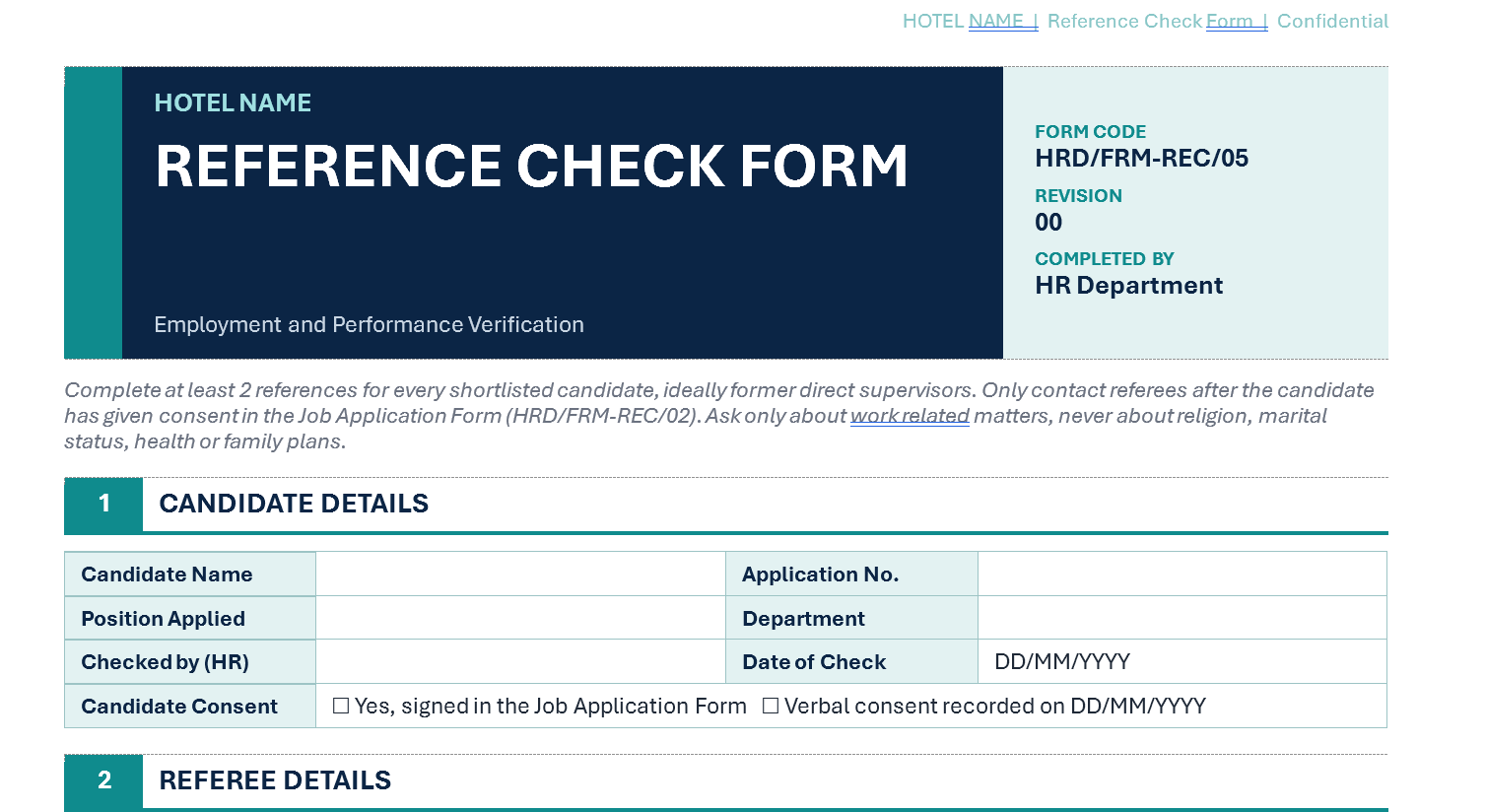
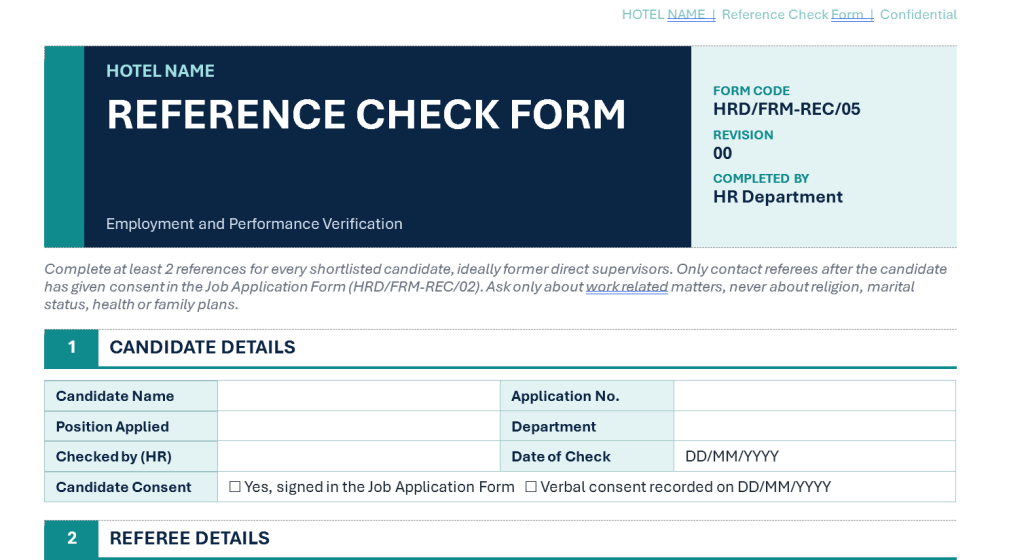
A header carrying the hotel name, form title, the purpose stated as Employment and Performance Verification, the form code HRD/FRM-REC/05, revision number, and the responsible party.
Three instructions sit at the top. At least two references are required for every shortlisted candidate, ideally former direct supervisors. Referees may only be contacted after the candidate has given consent in the Job Application Form. And only work related matters may be asked about, with religion, marital status, health and family plans named as prohibited.
That third instruction is the single most important line on the form, because reference calls are where discriminatory questions most often slip in informally, and naming the prohibited topics explicitly is far more effective than a general policy reference.
2. Section 1, Candidate Details
Seven fields covering candidate name, application number, position applied for, department, the HR officer conducting the check, the date of check, and a consent record offering two options, namely signed consent in the Job Application Form or verbal consent with the date recorded.
3. Section 2, Referee Details
A side by side structure for two referees, each recording name, company or hotel, position, relationship to the candidate across direct supervisor, HR or colleague, the period worked together, contact details, contact method across phone, email or video, and the date and time of the check.
Recording the relationship explicitly is what makes the red flag in Section 6 about friends or family members enforceable, since it has to be stated before it can be checked.
4. Section 3, Employment Verification
Five verification lines in a five column grid, comparing what the candidate stated against what each referee confirmed, with a match marker. The lines cover employment period, last position, employment status across permanent, contract and daily worker, last salary if disclosed, and reason for leaving.
An instruction beneath states that Match should only be ticked if both sources agree. This is the part of the form that does the real work, because a candidate who overstated their position or shortened a gap between jobs is identified here and nowhere else in the process.
5. Section 4, Performance Rating
Eight competencies rated by each referee on the five point scale, each phrased as an open question the HR officer can read aloud:
- Job Knowledge and Skills, asking the referee to describe the candidate’s technical skills in the role.
- Quality and Reliability, asking how consistent the quality of their work was.
- Guest Service Attitude, asking how they treated guests, especially in difficult situations.
- Teamwork, asking how they worked with colleagues and other departments.
- Attendance and Punctuality, asking about attendance and timekeeping.
- Honesty and Integrity, asking directly whether the referee ever had concerns about their honesty.
- Working Under Pressure, asking how they performed during busy periods or high occupancy.
- Supervisory Skills, for leadership positions only, asking how they led and developed the team.
An average rating row closes the section, alongside a referee comments column for each line.
Supplying the exact wording of each question is what makes this form usable by any HR officer rather than only an experienced one, and the phrasing is well constructed. Asking directly whether there were ever concerns about honesty is more effective than a softer formulation, because a referee who hesitates before answering has already told you something.
6. Section 5, Open Questions
Five open questions answered separately by each referee, covering main strengths, areas for improvement, whether any warning letter or disciplinary action was issued, whether the referee would rehire the candidate with three options of yes, with conditions, or no, and whether there is anything else the hotel should know before hiring.
The rehire question with a conditional middle option is the most informative question on the form. A referee unwilling to say no outright will often select with conditions, and that answer invites the follow up question that reveals what actually happened.
7. Section 6, Red Flag Check
Six checkable items covering a referee unable to confirm the employment, dates, position or salary not matching the candidate’s statement, a former employer who would not rehire, a disciplinary case related to theft, fraud, violence or harassment, a referee who turns out to be a friend or family member rather than a work contact, and a candidate who refuses to provide any work reference without clear reason.
A note states that any red flag must be explained in Section 7 and discussed with the HR Manager before an offer is made, which means a concern cannot be silently absorbed by an HR officer under pressure to fill a vacancy.
8. Section 7, Result and Recommendation, and Section 8, Signatures
The result block records each referee’s average rating and the overall figure, a verification status across all details confirmed, minor differences explained, or major differences, and a defined overall result with three outcomes, namely Positive at 3.5 and above with no red flags, Positive with notes at 3.0 to 3.4 or with minor issues explained, and Negative below 3.0 or on a serious red flag. It then captures the red flag explanation, HR notes, and the next step across proceeding to the Offering Letter, discussion with the Department Head and GM, requesting another reference, talent pool, or reject.
The form closes with a three column signature block for the HR Officer who conducted the check, the HR Manager as reviewer, and the Department Head as acknowledging party, beneath a confidentiality statement noting that reference information is kept in the candidate file and referee comments are not shared with the candidate.
That confidentiality statement protects the referee, which is what makes the next referee willing to speak frankly.
What you gain
- Discrepancies between claim and reality identified before an offer rather than after a hire.
- A defensible record of due diligence, signed by three parties.
- Legal protection, through consent verification and explicitly prohibited question topics.
- Comparable reference data, through the same five point scale used across your selection process.
- Serious concerns escalated rather than absorbed, through a red flag rule requiring HR Manager discussion.
- Usable by any HR officer, because every question is written out in full.
- Direct compatibility with the Effective Recruitment Procedure SOP, where this form supports Stage 09, and with the Job Application Form, which carries the consent clause this form relies on.
COPYRIGHT NOTICE
Owner: Oka Witantra
© 2026 Oka Witantra. All rights reserved.
Website: www.okawitantra.com
This document, including its design, layout, wording, structure and documentation, is the intellectual property of Oka Witantra. The downloader is granted a single user licence to use and adapt this document for the internal operation of their own property or organisation. Reproduction, redistribution, resale, sublicensing or publication of this document, in whole or in part, is not permitted without prior written permission from the author.
All names, codes and figures shown in this document are sample data for illustration only.
Download Link:
Reference Check Form