
Probation Evaluation Form
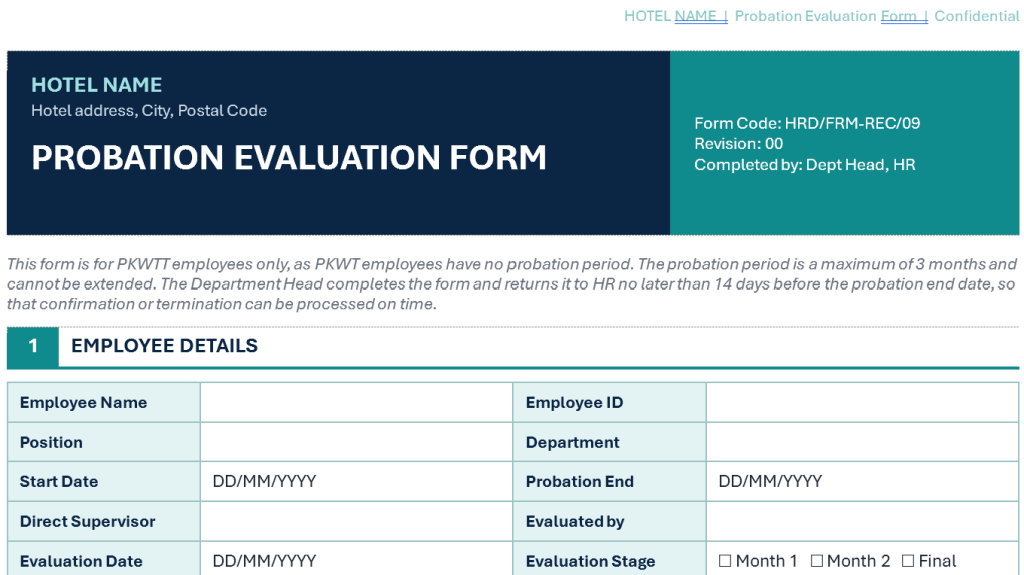
Probation Evaluation Form
Short description
A complete probation assessment form scoring new employees across ten weighted criteria totalling 100 percent, with a defined five point scale, an attendance record block drawn from the attendance system, structured comments including the employee’s own, three possible outcomes with stated thresholds, a salary review decision, and a four party signature block. Form coded, revision controlled, and written to Indonesian probation law.
Purpose
Probation is a legal window that closes whether or not anyone acts. If the evaluation is not completed before the probation period ends, the employee becomes permanent by default, and the opportunity to address a poor fit is gone. Most properties discover this the week it happens.
This form prevents that and does four further things:
- It enforces the deadline. The instruction requires the Department Head to return the completed form to HR no later than fourteen days before the probation end date, which leaves time for confirmation or termination to be processed properly.
- It states the legal position plainly. The form confirms that it applies to permanent employees only since fixed term employees have no probation, that the probation period is a maximum of three months, and that it cannot be extended.
- It assesses rather than impresses. Ten weighted criteria produce a single score out of five, with a written description for each rating level, so the decision rests on a documented assessment rather than on the supervisor’s recollection of the past three months.
- It records attendance factually. A dedicated block completed by HR from the attendance system records working days, presence, lateness, documented sick leave, unexcused absence and warning letters, which removes the most commonly disputed element of a probation decision from the realm of opinion.
- It gives the employee a voice. A comments field for the employee sits alongside the supervisor’s assessment, and the signature clause states explicitly that signing confirms the evaluation was discussed, not that the employee agrees with every point.
It suits hotels formalising probation management, properties that have had employees become permanent by administrative oversight, HR departments needing defensible records for probation terminations, and any operation where probation currently ends with a verbal conversation.
What is inside the document
A single structured form in seven numbered sections.
1. Form header and instructions
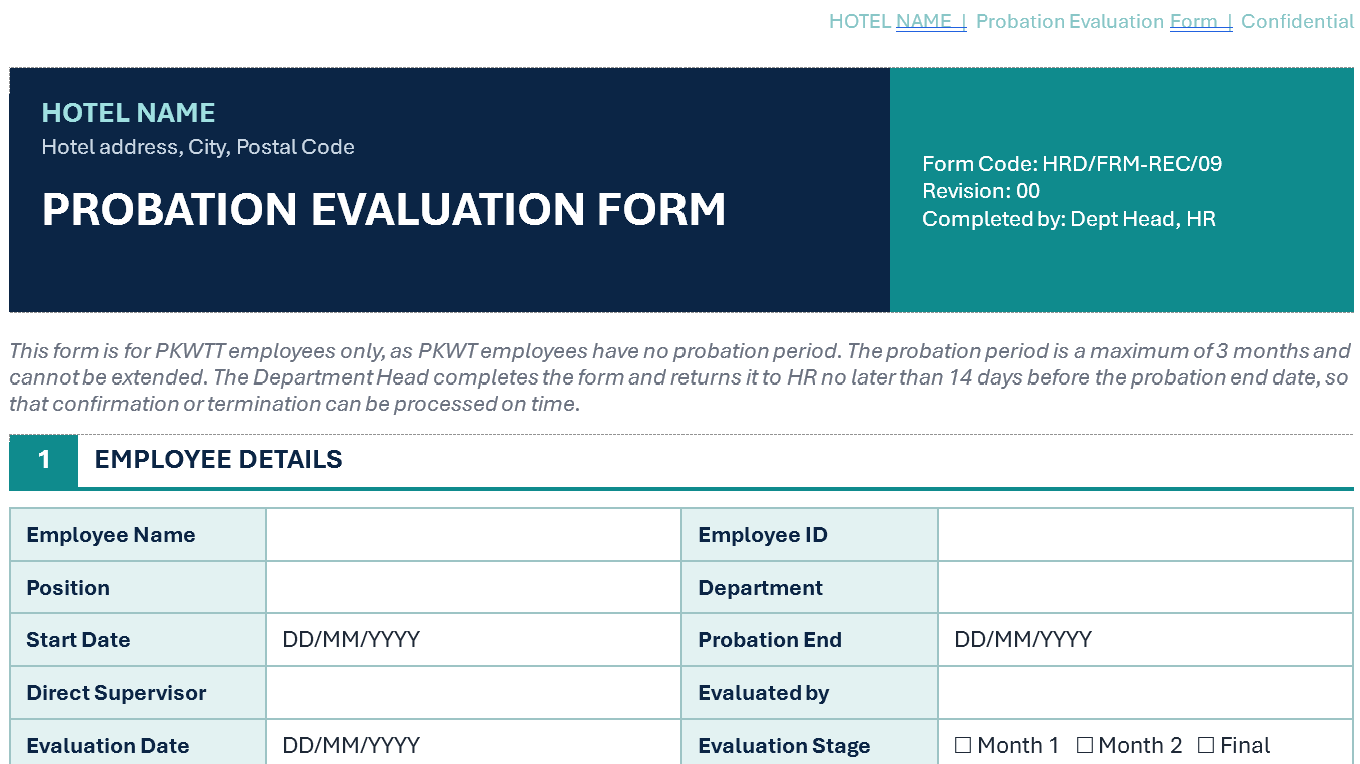
A header carrying the hotel name, address, form title, form code HRD/FRM-REC/09, revision number and the responsible parties, followed by an instruction block covering the applicability rule, the three month maximum, the no extension rule, and the fourteen day return deadline with its reason stated.
Explaining why the deadline exists, rather than simply setting one, is what gets a Department Head to meet it.
2. Section 1, Employee Details
Ten fields covering employee name, employee ID, position, department, start date, probation end date, direct supervisor, evaluator, evaluation date, and the evaluation stage across Month 1, Month 2 and Final.
The three stage structure is a significant design decision. It allows a property to run interim assessments at the end of months one and two rather than only at the end, which means a struggling employee receives feedback while there is still time to improve, and a termination at month three is never a surprise.
3. Section 2, Rating Scale
The five point scale written out with a description for each level, namely Outstanding for far exceeding the standard and serving as a role model, Above Standard for exceeding in most areas with little supervision, Meets Standard for performing tasks correctly and on time, Below Standard for not yet meeting the standard and needing regular guidance, and Unacceptable for performance far below standard or behaviour against hotel rules and values.
The distinguishing phrase at level four, namely with little supervision, is well chosen, since the amount of supervision a new employee still requires is the clearest practical indicator of whether probation has succeeded.
4. Section 3, Performance Assessment
Ten criteria in two groups, weighted to 100 percent, each with a written indicator:
A. Job Performance, 50 percent
- Job Knowledge at 15 percent, covering understanding of duties, products, SOPs and systems.
- Quality of Work at 15 percent, covering accuracy, neatness and adherence to hotel standards.
- Productivity at 10 percent, covering timely completion and handling of normal workload.
- SOP, Safety and Hygiene at 10 percent, covering SOPs, occupational safety and hygiene standards.
B. Attitude and Behaviour, 50 percent
- Service Attitude at 15 percent, covering friendliness, helpfulness and guest focus.
- Teamwork at 10 percent, covering work with colleagues and other departments.
- Attendance and Discipline at 10 percent, covering punctuality, roster adherence and hotel rules.
- Communication at 5 percent, covering clarity and politeness with guests, colleagues and supervisor.
- Grooming at 5 percent, covering neatness and full uniform standard.
- Initiative and Learning at 5 percent, covering willingness to learn, acceptance of feedback and improvement.
The fifty fifty split between performance and attitude is the right balance for hospitality, where a technically capable employee with a poor attitude is a liability and a willing employee with gaps is trainable. A worked example of the weighting calculation is supplied, which prevents the most common arithmetic error.
5. Section 4, Attendance Record
A six column block completed by HR from the attendance system before the evaluation meeting, recording working days, days present, lateness, sick leave with letter, unexcused absence, and warning letters issued.
Requiring HR to complete this from the system rather than the supervisor from memory is the single most important control on the form, because attendance is the factual basis on which a contested probation termination is most often defended.
6. Section 5, Comments, and Section 6, Result and Recommendation
Four comment blocks covering key strengths, areas for improvement, training and development needs, and employee comments.
The result block records the total weighted score, a result across three defined outcomes, namely Pass Excellent at 4.0 and above, Pass at 3.0 to below 4.0, and Not Pass below 3.0 or on a score of 1 in Service Attitude or Attendance and Discipline. It then captures the recommendation as either confirmation as a permanent employee with effective date, or ending employment at the end of the probation period with date, followed by a salary review decision and a development plan.
A note beneath restates that probation cannot be extended and requires HR to inform the employee in writing before the probation end date where the result is Not Pass, in line with applicable labour regulations.
The automatic fail on Service Attitude or Attendance and Discipline mirrors the logic of your Interview Assessment Form while correctly adjusting the second criterion for the probation context, since attendance can only be assessed once someone is employed.
7. Section 7, Signatures
A four column block for the evaluating Department Head, the acknowledging employee, the checking HR Manager, and the approving General Manager, each with name and date. The qualifying note on the employee signature, confirming discussion rather than agreement, is the correct formulation and protects the process if the employee disputes the outcome.
What you gain
- No employee becoming permanent by administrative oversight, through a deadline with a stated purpose.
- Decisions that are defensible, through weighted scoring, system sourced attendance data and four signatures.
- Fair outcomes, through optional interim assessments at months one and two.
- Legal compliance, through correct treatment of the three month maximum, the no extension rule, and written notification before the end date.
- Balanced assessment, through an equal split between performance and attitude.
- A documented development plan for employees who pass, which connects probation to the first appraisal.
- Direct compatibility with the Effective Recruitment Procedure SOP and with the Onboarding Checklist, which references this form by code twice.
Owner: Oka Witantra
© 2026 Oka Witantra. All rights reserved.
Website: www.okawitantra.com
This document, including its design, layout, wording, structure and documentation, is the intellectual property of Oka Witantra. The downloader is granted a single user licence to use and adapt this document for the internal operation of their own property or organisation. Reproduction, redistribution, resale, sublicensing or publication of this document, in whole or in part, is not permitted without prior written permission from the author.
All names, codes and figures shown in this document are sample data for illustration only.
Download Link:
Probation Evaluation Form