
Trade Test Evaluation Form
Trade Test Evaluation Form
Short description
A complete practical skill assessment form for hotel recruitment, scoring candidates out of 100 points across six weighted criteria, with written assessor instructions, sample test tasks for seven departments, a safety and knockout check, defined pass thresholds, training needs capture, and a three party acknowledgement. Form coded, revision controlled, and built to pair directly with the Interview Assessment Form.
Purpose
An interview tells you what a candidate says they can do. A trade test tells you what they can actually do. In hospitality that gap is wide, because a confident candidate who interviews well can still be unable to carry a tray, make up a bed to standard, or measure a pour accurately.
Most properties run trade tests informally. A department head watches a candidate work, forms a view, and reports back verbally. Nothing is scored, no two candidates are given the same task, and the result cannot be compared or defended. This form changes that in five ways:
- It standardises the task. The instructions require the same task and the same time limit for every candidate applying for the same position, which is the single condition that makes results comparable.
- It scores against fixed criteria. Six criteria carry fixed point allocations totalling 100, so the assessor’s judgement is distributed across technical knowledge, procedure, quality, speed, hygiene and attitude rather than resting on a general impression.
- It instructs the assessor. Six written instructions tell the department head how to run the test, including preparation, briefing, observing without helping, scoring immediately rather than at the end of the day, and stopping the test if there is a safety risk.
- It supplies the tasks. Sample test tasks are provided for seven departments, so a department head who has never designed a trade test still runs a valid one.
- It captures training needs. The form records not only whether the candidate passed but what training they would require if hired, which means the assessment feeds directly into onboarding rather than being filed and forgotten.
It suits hotels running practical selection for operational positions, properties where hiring quality varies between departments, HR departments standardising trade tests across a portfolio, and pre opening teams recruiting at volume who need a repeatable method.
What is inside the document
A structured form in seven numbered sections.
1. Form header
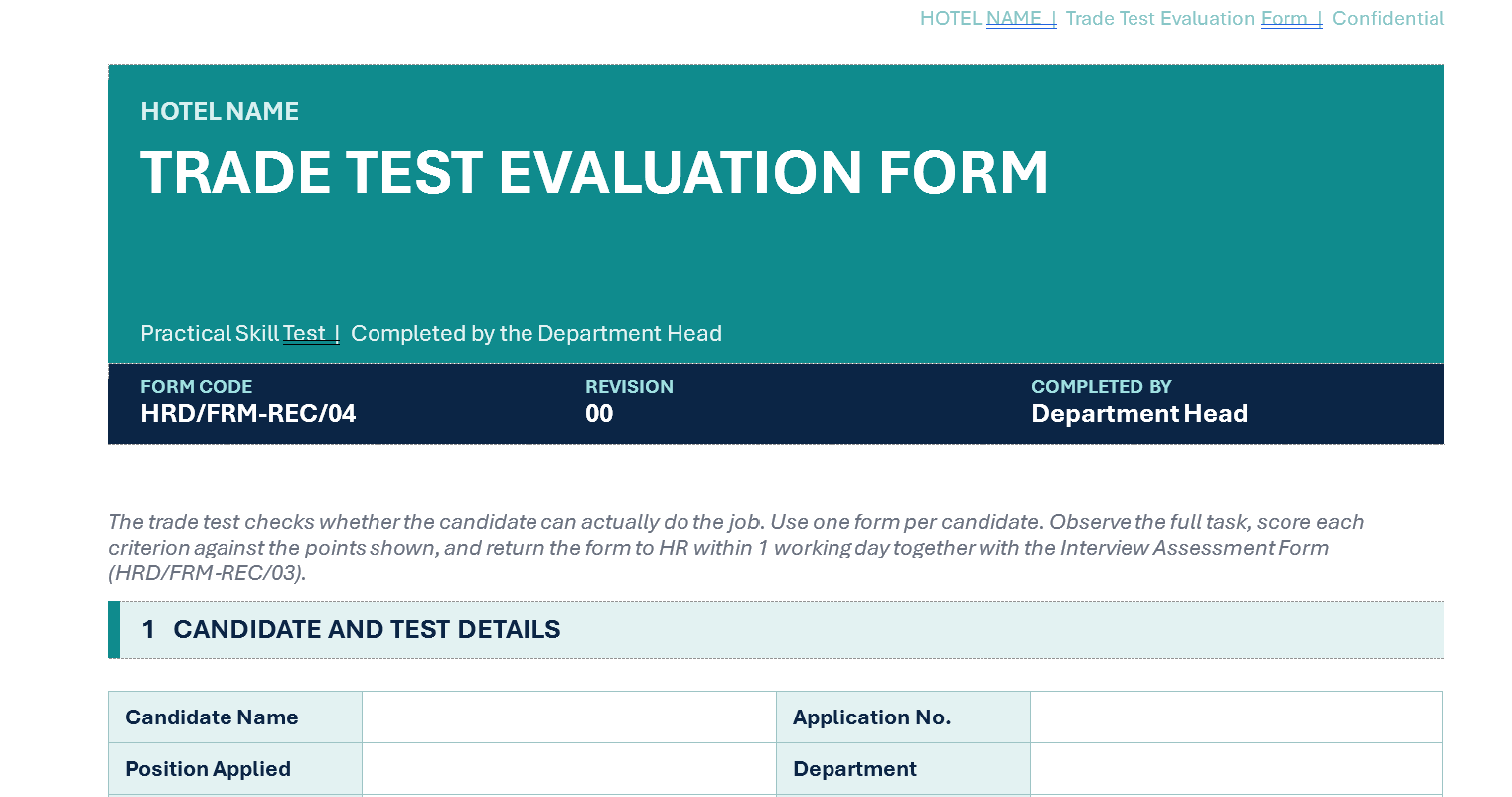
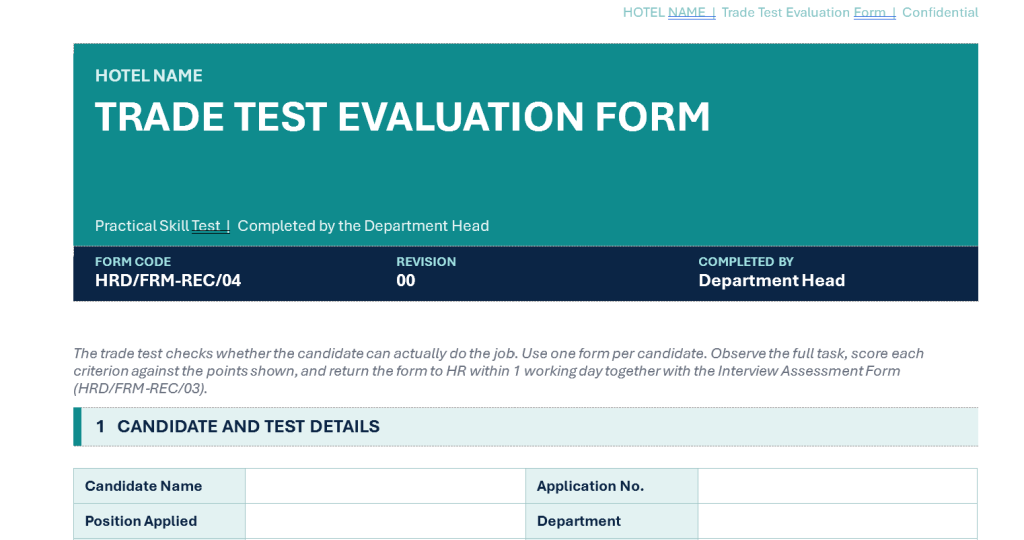
A header carrying the hotel name, form title, the method identified as Practical Skill Test completed by the Department Head, the form code HRD/FRM-REC/04, revision number, and the responsible party.
An instruction at the top states that the trade test checks whether the candidate can actually do the job, that one form is used per candidate, that the full task must be observed and each criterion scored against the points shown, and that the completed form is returned to HR within one working day together with the Interview Assessment Form. Binding the two forms together on return is sound, because a practical score separated from its interview score tells only half the story.
2. Section 1, Candidate and Test Details
Eleven fields covering candidate name, application number, position applied for, department, test date, start and finish times, test location, assessor name and position, the candidate’s interview score carried across from the Interview Assessment Form, and the test type across practical, written, role play, or practical and written combined.
Carrying the interview score onto the trade test form is a small design decision with real benefit, since it lets the assessor see immediately whether the practical result confirms or contradicts the interview impression.
3. Section 2, Test Instructions for the Assessor
Six written instructions covering agreement of the task with HR before the test day with all tools, ingredients, equipment or system access prepared; briefing the candidate on the task, time limit, safety rules and assessment criteria with the same task and time given to every candidate for the same position; provision of uniform, apron or safety equipment with the candidate required to follow hygiene and safety rules; observing without helping while noting strengths and mistakes as they happen; scoring immediately after the test rather than at the end of the day; and stopping the test at once if there is any safety risk.
A scoring guide accompanies these, defining Excellent at 90 to 100 percent of maximum points, Good at 70 to 89 percent, Fair at 50 to 69 percent and Poor below 50 percent, so the assessor has a reference for each individual criterion rather than only for the total.
This section is what makes the form usable by someone who has never been trained to assess, which is the situation in most properties.
4. Section 3, Skill Assessment Criteria
Six criteria totalling 100 points, each with a description of what to look for, a score column and an assessor notes column:
- Technical Knowledge at 20 points, covering products, tools, terms and correct methods.
- Work Procedure and SOP at 20 points, covering correct steps, sequence and equipment use.
- Quality of Result at 20 points, covering whether the final result meets hotel standard in taste, presentation, cleanliness or accuracy.
- Speed and Time Management at 15 points, covering completion within the time limit and organised working.
- Hygiene, Safety and Grooming at 15 points, covering a clean work area, food safety and occupational safety rules, and proper grooming.
- Attitude and Guest Awareness at 10 points, covering positive attitude, taking direction, clear communication and guest focus.
The weighting is well judged. Sixty of the hundred points sit with knowledge, procedure and result, which is where competence lives, while speed carries only fifteen. That balance prevents the common error of rewarding a candidate who works quickly but produces a poor result.
5. Section 4, Department Test Task
A department selector across Front Office, Housekeeping, F&B Service, Bar, Kitchen, Engineering and other, followed by a table of sample test tasks for each:
- Front Office, checking in a walk in guest, handling a room change request, explaining facilities, and using the PMS or a registration card.
- Housekeeping, making up a bed to standard, cleaning and setting up a bathroom, inspecting a room with a checklist, and using chemicals safely.
- F&B Service, setting up a table, taking an order with upselling, carrying a tray, serving a beverage, and a complaint handling role play.
- Bar, preparing three classic cocktails and one mocktail, measuring with a jigger, explaining a menu item, and setting up the bar station.
- Kitchen, mise en place, knife skills, cooking two menu dishes within a time limit, plating, and food safety with labelling.
- Engineering, finding and fixing a basic electrical or plumbing fault, reading a work order, using tools safely, and explaining preventive maintenance.
- Office Roles, a written test, Excel or system test, report or email writing, and role play for Sales, Security or Admin positions.
Beneath this sits a task recording table for up to four tasks, each with its description, time limit, and a completion marker across Yes, Partly and No.
Specifying measurement with a jigger in the bar test is the kind of detail that reveals the author’s experience, since free pouring is exactly what a bar trade test should be designed to expose.
6. Section 5, Safety and Knockout Check
Five checkable items, any one of which produces an automatic fail regardless of total score, covering unsafe use of knives, tools, chemicals or equipment, serious hygiene or food safety breach, refusing instructions or leaving the test without reason, dishonest behaviour such as copying or false claims, and arriving under the influence of alcohol or drugs.
Making these override the numerical score is correct, because a candidate who scores 85 but handles a knife dangerously is not a candidate worth hiring.
7. Section 6, Test Result and Recommendation, and Section 7, Signatures
The result block records the total score out of 100 with three defined outcomes, namely Pass at 70 and above, Borderline at 60 to 69 where HR and the Department Head discuss and one retest is permitted, and Fail below 60 or on any knockout item. It then captures the skill level observed across ready to work with normal orientation, needs basic training in some tasks, or not suitable for this position, followed by key strengths, areas for improvement, training needs if hired, knockout explanation, and the next step across final interview, reference check, retest with a date, talent pool or reject.
The form closes with a three column acknowledgement block signed by the Candidate, the Assessor or Department Head, and the HR Manager, beneath a statement confirming the test was explained clearly and conducted under fair conditions, and noting that the result is confidential and not shared with the candidate in detail.
The candidate signature is the element most trade test forms omit and the one that matters most if a rejected candidate later disputes the process.
What you gain
- Hiring decisions based on demonstrated ability rather than interview performance.
- Candidates genuinely comparable, through identical tasks and time limits.
- A valid test run by a department head with no assessment training, because the instructions and tasks are supplied.
- A defensible record, through written scores, assessor notes and a candidate signature.
- Safety protected during assessment, through a stop rule and five knockout conditions.
- Onboarding that starts informed, through training needs captured at the point of assessment.
- Direct compatibility with the Effective Recruitment Procedure SOP, where this form supports Stage 07, and with the Interview Assessment Form, which carries a field for this result.
COPYRIGHT NOTICE
Owner: Oka Witantra
© 2026 Oka Witantra. All rights reserved.
Website: www.okawitantra.com
This document, including its design, layout, wording, structure and documentation, is the intellectual property of Oka Witantra. The downloader is granted a single user licence to use and adapt this document for the internal operation of their own property or organisation. Reproduction, redistribution, resale, sublicensing or publication of this document, in whole or in part, is not permitted without prior written permission from the author.
All names, codes and figures shown in this document are sample data for illustration only.
Download link :
Trade Test Evaluation Form