
PMS Advanced Operation: Analysis and Reporting SOP
PMS Advanced Operation: Analysis and Reporting SOP
Short description
A leadership skills Standard Operating Procedure that teaches Front Office Supervisors and Managers to use the Property Management System as an analytical tool rather than a booking terminal, covering eleven daily reports with their management purpose, occupancy interpretation, rate monitoring, guest profile management, audit trail surveillance, and a defined reporting calendar. Second in the Front Office management skills series.
Purpose
Every hotel has a PMS and almost every hotel underuses it. Front desk staff learn the five screens needed to check a guest in, supervisors learn the same five, and the system’s reporting capability sits unopened while management decisions are made on impression. The system holds the answer to why occupancy dipped last Tuesday, which guest is accumulating an unexplained balance, and who voided eleven charges on the night shift, but only if somebody knows where to look.
This SOP closes that gap:
- It names the reports and their purpose. Eleven daily reports are listed by name, grouped by when they should be reviewed, each with a stated management reason rather than a description.
- It teaches interpretation, not navigation. Pulling an occupancy history report is a system skill. Comparing it against the same week last year and last month, and flagging the pattern for rate and staffing decisions, is a management skill, and that is what the document develops.
- It establishes control through the audit trail. An entire section covers monitoring overrides, voids, deletions and unusual user activity, which is where PMS based fraud and error are actually detected.
- It protects rate integrity at operational level. Rate strategy stays with management, but the supervisor is given a clear role in applying, monitoring and reporting on it, with a stated prohibition on unauthorised overrides.
- It sets a reporting calendar. Daily, weekly and monthly reports are specified by name and deadline, which turns reporting from an occasional request into a routine.
It suits hotels where PMS reporting capability is underused, management companies developing supervisory analytical skill across properties, operations tightening control over rate overrides and voids, properties preparing supervisors for Duty Manager or department head promotion, and any Front Office Manager who suspects the system knows more than the team is extracting from it.
What is inside the document
A complete SOP in six numbered sections, with document control, policy statement and corrective action provisions.
1. Document control and policy
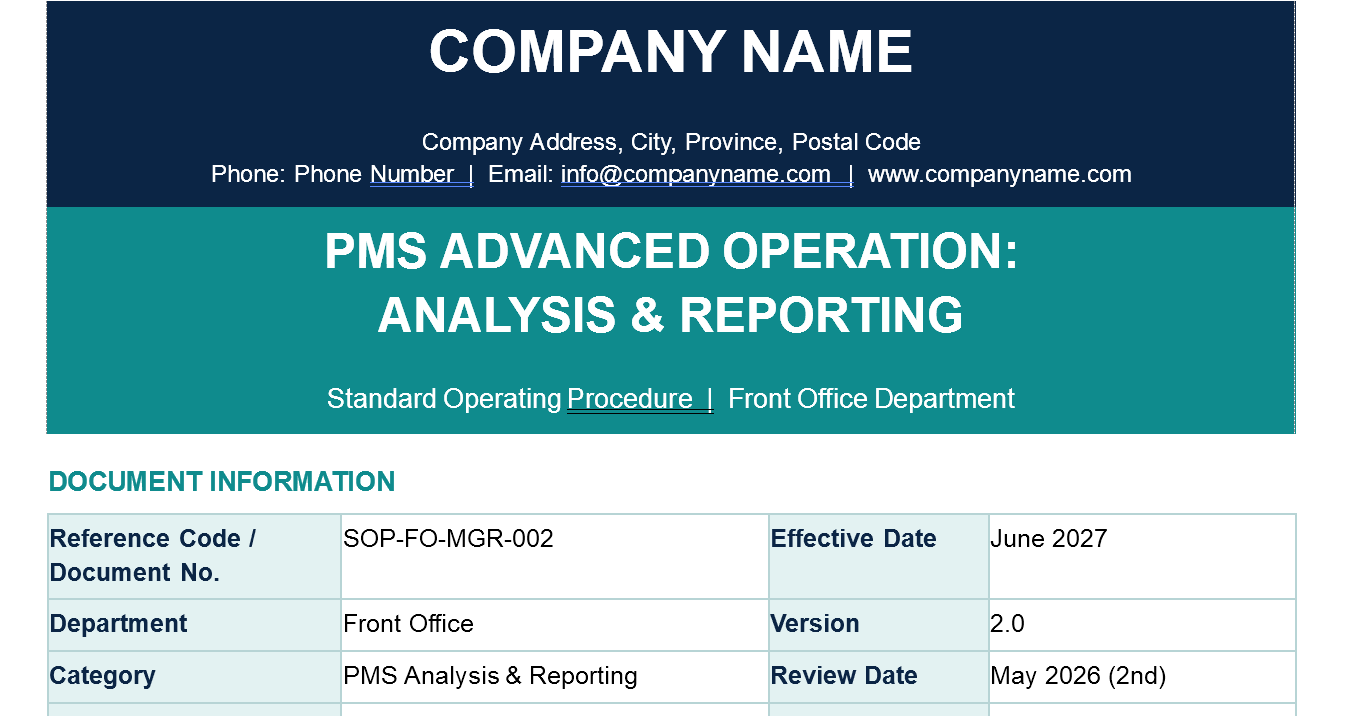
A letterhead block for company name, address, phone, email and website, followed by a five row control table recording the reference code SOP-FO-MGR-002, effective date, department, version, category identified as PMS Analysis and Reporting, review date, preparer, approver, distribution and classification.
Purpose and scope confirm that the SOP applies to all Front Office Supervisors and Managers across all properties, covering report generation, occupancy analysis, rate management inputs, guest history review and audit trail monitoring.
The policy statement is again the sharpest writing in the document, stating that data is a management tool rather than an administrative task, that supervisors and managers are expected to review PMS reports daily, identify patterns and anomalies and take informed action, and that reliance on guesswork in a system supported environment is not acceptable. That final sentence is the standard the whole document enforces.
2. Section 1, Daily PMS Reports
Eleven reports grouped by timing, each with its management purpose stated:
- Start of day, four reports covering the Arrivals Report for expected check ins, room assignments and special requests, the Departures Report for check out confirmation, late check out flagging and billing verification, the Occupancy Snapshot for current occupancy, rooms available and out of order rooms, and the VIP In House Report to confirm VIP flagging and requirement actioning.
- Mid shift, three reports covering the Housekeeping Status Report verified against PMS to prevent check in delays, the Guest In House Report to identify long stay guests and repeat visitors, and the Open Balance Report to flag unusually high balances for proactive billing review.
- End of day, four reports covering the Night Audit Summary for revenue totals, room charges and system discrepancies, the Revenue Report comparing actual against forecast and budget, the No Show Report with charge procedures initiated, and the Cancellation Report reviewed for revenue recovery opportunities.
The instruction that each report must be acted upon and not just filed is the sentence that distinguishes this from a list of report names.
3. Section 2, Occupancy Analysis and Interpretation
Six analytical practices covering weekly review of the Occupancy History Report for day of week trends and seasonal patterns, comparison against the same week in the prior month and prior year, identification of peak and low periods flagged for rate and staffing decisions, monitoring of walk in conversion rates with the observation that high walk ins may indicate an opportunity to reduce OTA dependency, tracking Average Length of Stay by leisure, corporate and group segment, and reviewing pickup pace against the same date last week to assess demand momentum.
The walk in observation is the most commercially intelligent line in the document. It takes an operational data point most supervisors ignore and connects it to a distribution cost decision, which is precisely the kind of thinking the SOP is trying to develop.
4. Section 3, Rate Management Inputs
Six practices that define the supervisor’s role in rate control without encroaching on strategy, covering daily review of the Rate Variance Report with any room sold below approved minimum flagged, monitoring of upgrade and downgrade transactions for authorisation and reason coding, application of rate restrictions including minimum stay, closed to arrival and stop sell as directed, immediate reporting of rate anomalies with a room sold at zero or an incorrect VIP rate named as billing risks, an explicit prohibition on overriding approved rates without written or system recorded approval, and documentation of all manual adjustments with a clear reason note.
The boundary is drawn cleanly. The supervisor applies and monitors, the Front Office Manager decides, and the prohibition is stated rather than implied.
5. Section 4, Guest History and Profile Management
Six practices covering weekly review of the Returning Guest Report for repeat visitors arriving within seven days, ensuring preferences from prior stays are actioned in the current reservation, flagging incomplete or duplicate profiles for cleanup with the one guest one master profile rule stated, updating profiles after each stay with room preferences, complaints, compliments and upgrade history, using history to personalise the welcome by acknowledging returning guests by name and prior stay, and reviewing VIP profile notes before arrival to confirm room setup matches recorded preferences.
Framing guest profiles as a strategic asset rather than a data entry obligation is the right argument, and the duplicate profile rule addresses the single most common cause of a returning guest being treated as a stranger.
6. Section 5, PMS Audit Trail and System Monitoring
Six control practices covering review of the Audit Trail Report at the start of each shift for unusual overnight transactions, checking for manual rate overrides, voided charges or deleted postings from the previous shift, verifying that no reservation was modified or cancelled without a reason code or user note, identifying user accounts performing an unusually high volume of corrections or voids, reporting suspicious entries to the Front Office Manager without attempting to reverse them, and ensuring staff log out at shift end and never share credentials.
This is the most valuable section in the document commercially. Shared logins and unmonitored voids are where front office losses occur, and the instruction not to reverse a suspicious entry without authorisation is exactly right, since reversing it destroys the evidence.
7. Section 6, Reporting to Management, and corrective action
Eight reports across three frequencies with submission deadlines:
- Daily, by end of shift, the Shift Summary Report covering occupancy, arrivals, departures, revenue and notable incidents, and the Open Complaint or Pending Request Log with status and responsible owner.
- Weekly, every Monday morning, the Occupancy Trend Summary with seven day rolling occupancy and ADR against the prior week, the Guest Profile Audit recording incomplete or duplicate profiles identified and resolved, and the Rate Variance Summary with authorisation notes.
- Monthly, by the third of each month, the Month to Date Occupancy and Revenue Report against budget and prior year, the Top Guest Segments Report by room nights and revenue, and the System Discrepancy Log summarising anomalies, voids and corrections.
The document closes with a non compliance clause stating that failure to review required reports, submit on schedule or act on identified discrepancies is subject to corrective action under HR policy, followed by a document control block.
What you gain
- A PMS used at the level it was purchased for rather than at the level it was taught.
- Supervisors who interpret data rather than only retrieve it.
- Control over rate overrides, voids and deletions, through audit trail monitoring written into the shift routine.
- Early detection of billing risk, through open balance and rate anomaly review.
- Guest personalisation driven by recorded history rather than by memory.
- Management reporting on a fixed calendar with named reports and deadlines.
- A development path that prepares supervisors for Duty Manager and department head responsibility.
- Enforceability, through a corrective action clause.
Owner: Oka Witantra
© 2026 Oka Witantra. All rights reserved.
Website: www.okawitantra.com
This document, including its design, layout, wording, structure and documentation, is the intellectual property of Oka Witantra. The downloader is granted a single user licence to use and adapt this document for the internal operation of their own property or organisation. Reproduction, redistribution, resale, sublicensing or publication of this document, in whole or in part, is not permitted without prior written permission from the author.
All names, codes and figures shown in this document are sample data for illustration only.
Download link:
PMS Advanced Operation: Analysis and Reporting SOP