
Interview Assessment Form
Interview Assessment Form
Short description
A complete competency based interview scoring form built on the STAR method, covering candidate details, a defined five point rating scale, six weighted competencies with sample questions supplied, a knockout and red flag check, interviewer summary, overall recommendation, a panel consolidation block, and four signatures. Form coded, revision controlled, and built to sit directly alongside the Effective Recruitment Procedure SOP as its assessment instrument.
Purpose
Interviews are the least reliable part of most recruitment processes, not because interviewers lack judgement but because nothing forces that judgement to be recorded consistently. Three managers interview the same candidate, each forms an impression, and the hiring decision is settled by whoever argues most confidently afterwards. Nothing is written down that could be compared, challenged, or revisited.
This form fixes that in five ways:
- It scores against defined standards rather than impressions. A five point scale is written out with a description for each level, so a score of 3 means the same thing to the HR manager and the Executive Chef.
- It requires evidence, not opinion. The instruction at the top of the form states explicitly that ratings must be based on evidence from the candidate’s real past experience. Each competency carries an evidence column where the interviewer records what the candidate actually said.
- It supplies the questions. Five competency based STAR questions are printed on the form itself, which means a department head who has never been trained in interviewing still conducts a structured one.
- It weights what matters. Six competencies carry fixed weights totalling 100 percent, so service attitude and technical competency together account for half the decision, which is the correct balance for hospitality.
- It consolidates the panel. A dedicated block brings all three interview stages together with an average score and a single hire, hold or reject decision, so the final call is made on combined evidence rather than on the most recent conversation.
It suits hotels standardising interviews across departments, properties where hiring quality varies by interviewer, HR departments training line managers to interview, management companies requiring documented selection evidence, and any operation that needs a defensible record of why a candidate was or was not selected.
What is inside the document
A structured form in eight lettered sections.
1. Form header
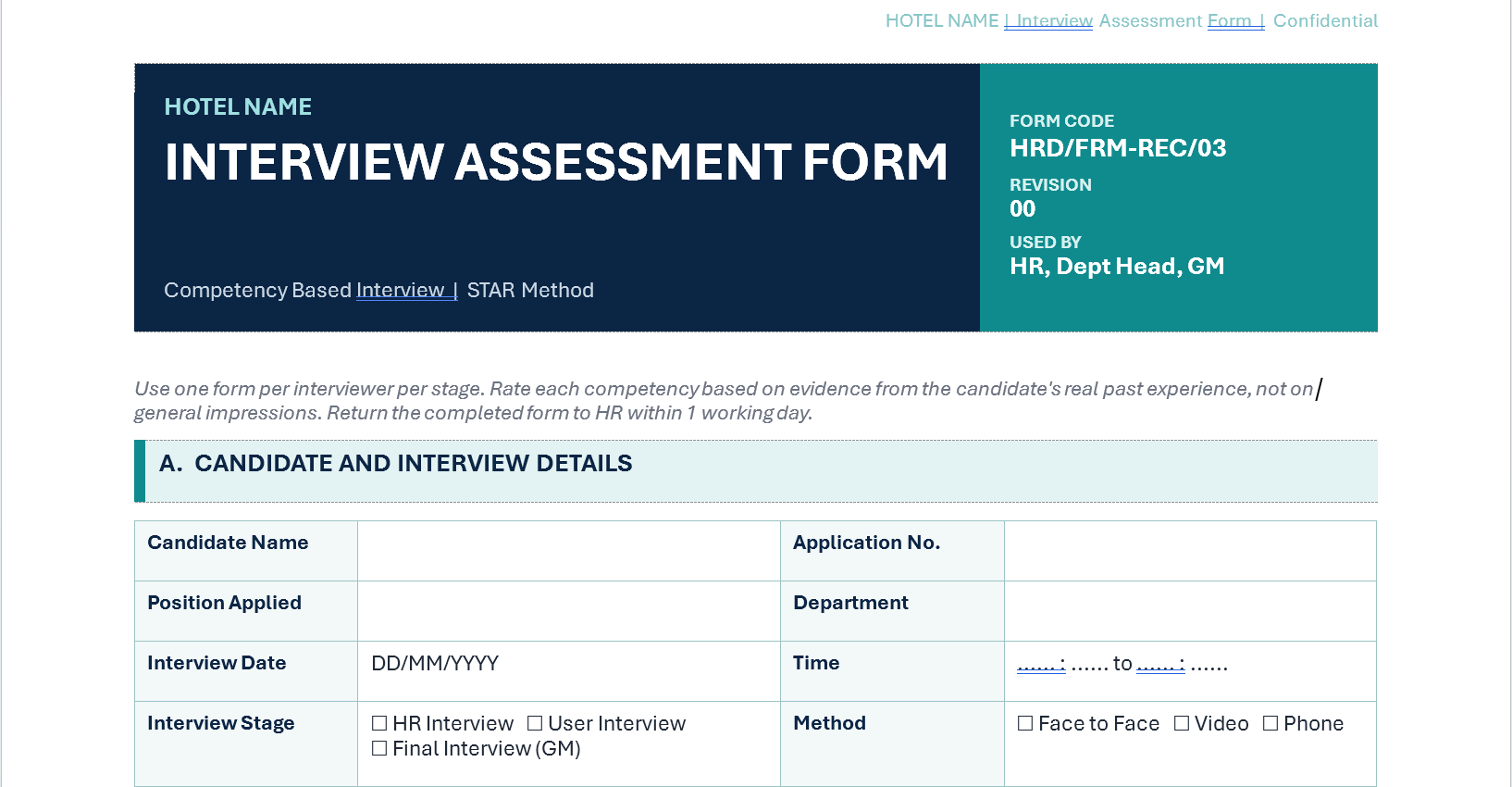
A header carrying the hotel name, form title, the method identified as Competency Based Interview using the STAR method, the form code HRD/FRM-REC/03, revision number, and the users, namely HR, Department Head and GM.
A completion instruction sits at the top stating that one form is used per interviewer per stage, that ratings must be based on evidence from real past experience rather than general impressions, and that the completed form is returned to HR within one working day. That last requirement is what keeps a process moving, since assessment forms left on desks are the most common cause of delay between stages.
2. Section A, Candidate and Interview Details
Fourteen fields covering candidate name, application number, position applied for, department, interview date, start and end time, interview stage across HR, User and Final, method across face to face, video and phone, interviewer name and position, current or last salary, expected salary, notice period, and available start date.
Recording the interview duration is a small discipline with real value, since a twenty minute final interview and a ninety minute one carry very different weight when a decision is later reviewed.
3. Section B, Rating Scale
The five point scale written out in full, with each level given both a label and a description, namely Outstanding for far exceeding the standard with strong specific evidence in every answer, Above Standard for exceeding in most areas with clear examples and good results, Meets Standard for meeting the minimum with relevant examples and acceptable results, Below Standard for gaps needing intensive training with vague or incomplete examples, and Unacceptable for failing the standard or showing behaviour against hotel values.
Each description ties the score to the quality of evidence rather than to the interviewer’s feeling, which is the distinction that makes scores comparable across interviewers.
4. Section C, Competency Assessment
Six weighted competencies in a five column grid capturing the score, the weighted result, and written evidence:
- Service Attitude and Hospitality at 25 percent, with indicators covering friendliness, empathy, initiative and composure with complaints.
- Technical Competency at 25 percent, covering product and SOP knowledge, trade test result and relevant experience.
- Communication and Language at 15 percent, covering clarity, politeness and English level suited to the position.
- Grooming and Appearance at 10 percent, assessed by observation throughout the interview rather than by question.
- Teamwork and Integrity at 15 percent, covering cross departmental working, honesty, accountability and discipline.
- Motivation and Culture Fit at 10 percent, covering reasons for applying, career plan and willingness to work shifts and holidays.
Five of the six carry a printed sample question. The integrity question in particular, asking whether the candidate has ever seen a colleague break an SOP and what they did, is a well constructed behavioural question, because there is no safe generic answer and the response reveals both values and judgement.
The totals row includes a worked example of the weighting calculation, which prevents the most common arithmetic error on forms of this kind.
5. Section D, Knockout and Red Flag Check
Six checkable red flags presented in two columns, covering an automatic fail score of 1 in Service Attitude or Teamwork and Integrity, inconsistent or false information in the CV or answers, lateness without notice or unprofessional behaviour, negative remarks about former employers or colleagues, unwillingness to work shifts, weekends or public holidays, and salary expectation far outside the approved range.
A note beneath states that any checked flag must be explained in Section E and that a knockout item means the candidate does not proceed. Making these explicit rather than leaving them to interviewer discretion means a serious concern is recorded in writing rather than mentioned verbally and forgotten.
6. Section E, Interviewer Summary
Four blocks covering key strengths, areas for development, trade test result with the test name, score out of 100, pass or fail marker and assessor name, and an explanation field for any red flag checked.
Including the trade test result on the same form as the interview assessment is sound design, since it keeps the practical and the behavioural evidence together in one document rather than in two separate files.
7. Section F, Overall Recommendation
Three decision fields covering the total weighted score out of 5.00 with the decision thresholds printed directly beside it, namely Highly Recommended at 4.0 and above, Recommended at 3.0 to 3.9, and Not Recommended below 3.0; the next step across trade test, user interview, final interview, reference check, talent pool and reject; and a question asking whether the candidate is suitable for another position.
That last field is more valuable than it appears. A capable candidate who is wrong for one vacancy is frequently right for another, and without a prompt on the form that observation is almost never recorded.
8. Section G, Panel Summary, and Section H, Signatures
A panel consolidation block recording the interviewer, date, weighted score and recommendation for each of the three stages, with an average score row and a final decision across Hire, Hold and Reject. The form closes with a four column signature block for the Interviewer, HR Manager, Department Head and General Manager, each with name and date fields.
The panel block is what turns three separate assessments into one defensible decision, and it is the element most commonly missing from interview forms in use at properties.
What you gain
- Candidates compared on the same basis regardless of who interviewed them.
- Line managers conducting structured interviews without prior training, because the questions are printed on the form.
- Written evidence behind every hiring decision, which matters when a decision is later questioned.
- Serious concerns recorded rather than mentioned, through an explicit red flag check.
- A values floor that cannot be overridden by a strong total score, through the automatic fail rule.
- A single consolidated panel decision instead of three competing impressions.
- Direct compatibility with the Effective Recruitment Procedure SOP, where this form supports Stages 06 and 08, using the identical competency weights and decision thresholds.
COPYRIGHT NOTICE
Owner: Oka Witantra
© 2026 Oka Witantra. All rights reserved.
Website: www.okawitantra.com
This document, including its design, layout, wording, structure and documentation, is the intellectual property of Oka Witantra. The downloader is granted a single user licence to use and adapt this document for the internal operation of their own property or organisation. Reproduction, redistribution, resale, sublicensing or publication of this document, in whole or in part, is not permitted without prior written permission from the author.
All names, codes and figures shown in this document are sample data for illustration only.
Download Link:
Interview Assessment Form