
Effective Recruitment Procedure SOP
Effective Recruitment Procedure SOP
Short description
A complete, ready to adopt Standard Operating Procedure for hotel recruitment, covering the full process from manpower requisition through to the end of probation. It defines 13 process stages with named owners and service level agreements, a weighted interview scoring matrix, selection depth by job level, seven recruitment KPIs, and three ready to use appendix forms. Written for Indonesian hotel operations and scaled for properties from under 100 rooms to over 300 rooms.
Purpose
Most hotels recruit by habit rather than by procedure. A department head mentions a vacancy, HR posts something, interviews happen when people are free, and the decision rests on whoever spoke most persuasively in the room. The costs are invisible but real, namely slow hiring during peak season, inconsistent quality between departments, new hires who leave within three months, and no defensible record when a hiring decision is later questioned.
This SOP replaces that with a documented process:
- It sets a flow with time limits. Every stage names who is responsible and how many working days it should take, so a vacancy cannot sit idle without someone being accountable for the delay.
- It makes selection objective and comparable. A single weighted scoring matrix is used by every interviewer, which means a candidate assessed by Housekeeping is scored on the same basis as one assessed by Front Office.
- It scales selection depth to the job level. A Daily Worker is not put through a psychometric test, and an Executive Committee appointment is not made on a single interview.
- It protects the hotel legally and ethically. Non discrimination, the prohibition on charging candidates, conflict of interest declarations, candidate data protection, and labour law compliance are written as explicit rules rather than assumed.
- It makes recruitment measurable. Seven KPIs with stated targets are reported monthly to the General Manager, which converts recruitment from an administrative function into a managed one.
It suits hotels establishing or rewriting their HR procedures, management companies standardising recruitment across a portfolio, properties preparing for brand or ownership audit, HR managers newly appointed into an undocumented department, and pre opening teams building an HR system from nothing.
What is inside the document
A full SOP in twelve sections with three appendix forms, built around 19 structured tables.
1. Document control
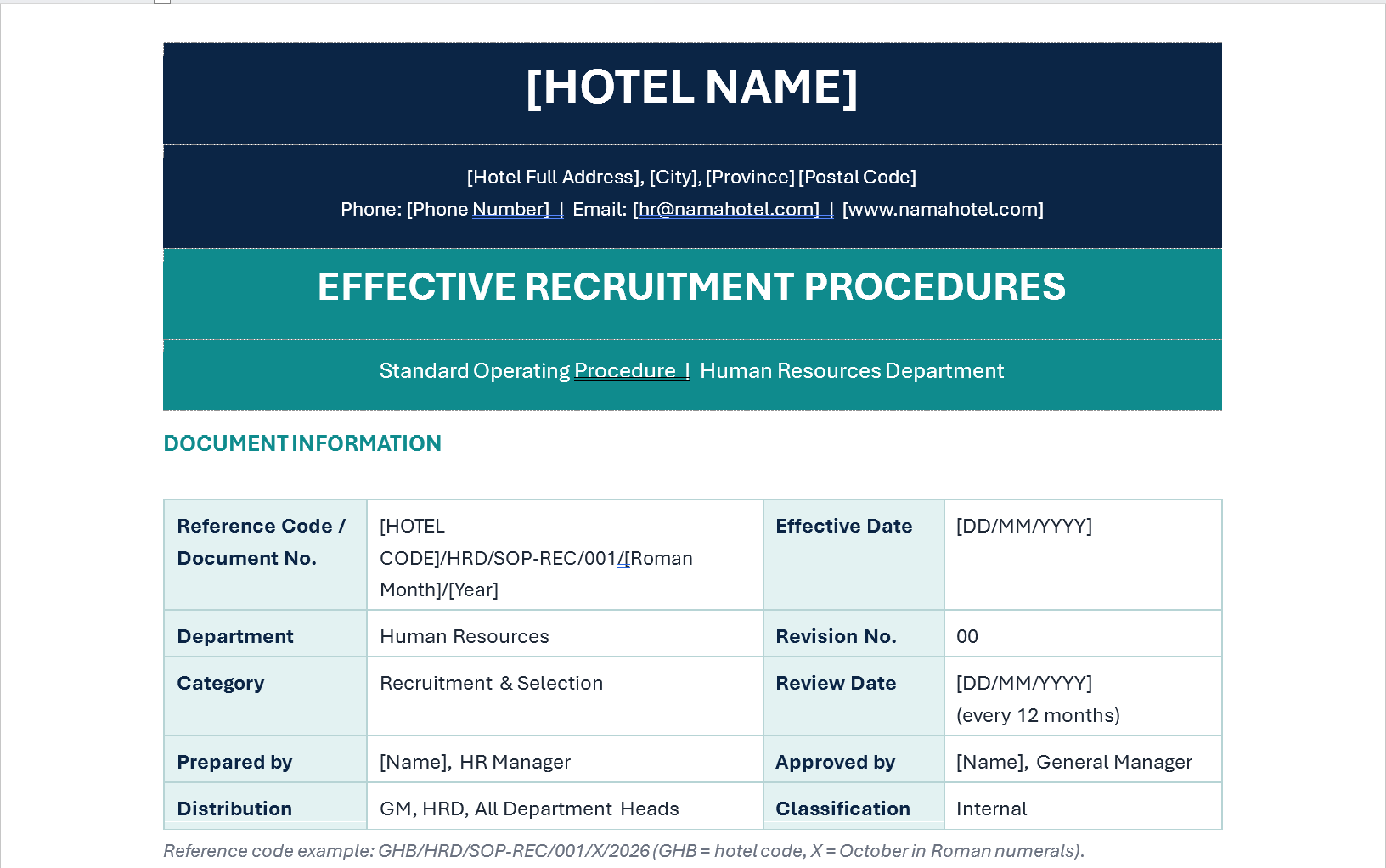
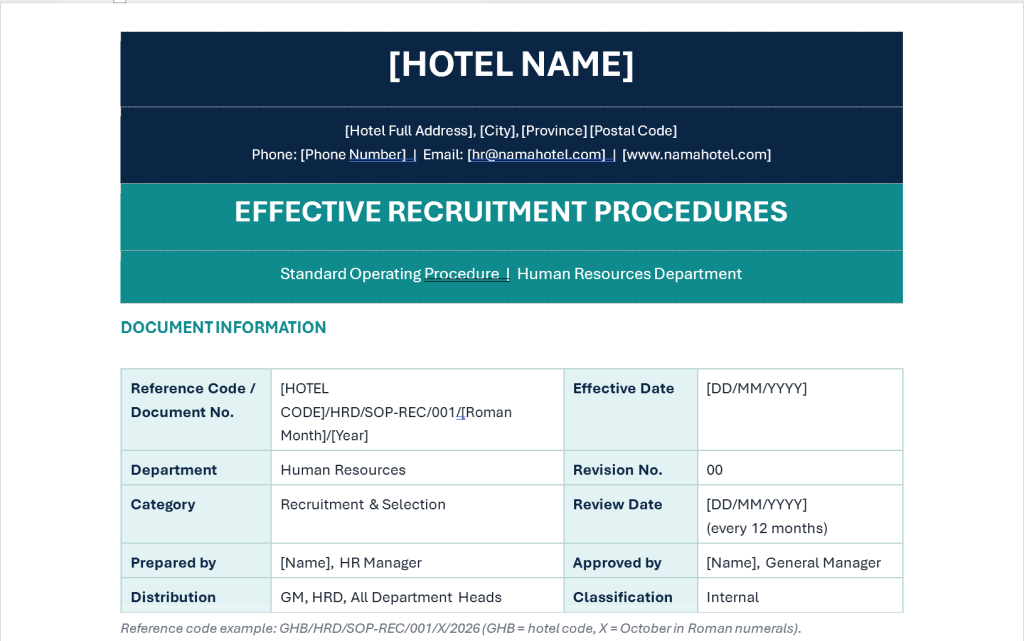
A letterhead block for hotel name, address, phone, email, and website, followed by a five row control table covering the reference code, effective date, department, revision number, category, review date set at twelve months, preparer, approver, distribution list, and classification. A worked example of the reference code numbering is included, showing how the hotel code, document type, sequence, Roman numeral month, and year combine.
2. Purpose and scope
Four stated objectives covering process clarity with SLAs, fair and compliant selection, reduced cost per hire and time to fill, and lower new hire turnover. The scope then defines coverage explicitly across all six job levels, all four employment types including PKWTT, PKWT, Daily Worker and Trainee, all hotel departments, both internal and external recruitment, and all three hotel size bands.
3. Definitions
Twelve terms defined precisely, covering Manpower Planning, Manpower Requisition Form, Job Description, Job Specification, Sourcing, Shortlist, Trade Test, Competency Based Interview, Offering Letter, Talent Pool, Time to Fill, and Onboarding. This section does more work than it appears to, because most recruitment disputes between HR and department heads come down to the two parties using the same word differently.
4. Responsibilities
Six parties with defined roles, covering the Owner or Management Company, the General Manager, the HR Manager as process owner, the Department Head as user, Finance or Cost Control, and the Candidate. Including the candidate as a party with responsibilities is a sound touch, since it establishes the obligation to provide accurate information.
5. Process flowchart
A full visual flowchart of 17 nodes, comprising 13 numbered process steps, four decision points, and marked start and end states, with the responsible party and the output document labelled at every step. Colour coded so that process, decision, and terminal nodes are distinguishable at a glance. Each decision point names both branches, for example a failed HR interview routes the candidate to the Talent Pool rather than simply ending the process.
6. Detailed procedure by stage
Thirteen stages set out in full, each with its activities and standards, the person in charge, and a service level agreement in working days. The detail is operational rather than theoretical. The MRF must be submitted 30 days before the position is needed. Internal posting runs for three working days with priority to internal candidates meeting stated criteria. Screening must produce at least three shortlisted candidates. Trade tests are specified by position, including a cooking test for cooks, table setup and service sequence for waiters, make up room for room attendants, and check in role play for front desk agents. Reference checks require at least two previous direct supervisors. Police clearance is required for security, cashier, finance and cash handling positions. Candidates have three working days to respond to an offer. Fixed term contracts may not include probation, while permanent contracts may include up to three months.
7. Selection methods by job level
A matrix across five job levels from Daily Worker through to Executive Committee, specifying the mandatory selection stages, the required interviewers, and a target time to fill ranging from 7 to 14 days at the lowest level up to 60 to 90 days at the highest. This single table prevents both over engineering junior recruitment and under assessing senior appointments.
8. Interview assessment matrix
Six weighted competencies totalling 100 percent, namely Service Attitude and Hospitality at 25 percent, Technical Competency at 25 percent, Communication and Language at 15 percent, Grooming and Appearance at 10 percent, Teamwork and Integrity at 15 percent, and Motivation and Culture Fit at 10 percent, each with written behavioural indicators. A five point rating scale is defined with plain descriptions, and the decision thresholds are stated, with 4.0 and above highly recommended, 3.0 to 3.9 recommended, and below 3.0 not recommended. A score of 1 in Service Attitude or Integrity is an automatic fail regardless of the weighted total, which is the correct safeguard for a hospitality business. Five sample STAR interview questions are supplied covering service attitude, teamwork, integrity, problem solving, and leadership.
9. Adjustments by hotel size
A comparison across small, medium, and large properties covering six aspects, namely HR structure, MRF approval chain, main sourcing channels, selection stages, tools, and talent pool depth. This section is what makes the SOP genuinely usable by a 40 room boutique property as well as a 400 room resort, because it states which simplifications are acceptable and which are not.
10. Key performance indicators
Seven KPIs with calculation methods and targets, covering Time to Fill, Offer Acceptance Rate at a minimum of 85 percent, Quality of Hire at a minimum of 90 percent passing probation, 90 day New Hire Turnover at a maximum of 10 percent, Internal Fill Rate at a minimum of 30 percent for supervisory level and above, Cost per Hire within budget, and Hiring Manager Satisfaction at a minimum of 4.0.
11. Principles and prohibitions
Seven rules covering non discrimination, the absolute prohibition on charging candidates any fee, conflict of interest declaration and recusal, candidate data confidentiality under personal data protection rules, legal compliance including minimum working age and fixed term contract rules, a candidate experience commitment to respond within seven working days, and the rule that no employee begins work before the contract is signed and the medical check result is clear.
12. Related forms and three appendix forms
A register of ten coded recruitment forms from the Manpower Requisition Form through to the Monthly Recruitment Report, followed by three complete ready to use forms:
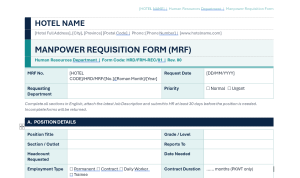
- Appendix A, Manpower Requisition Form, with fields for department, position, grade, headcount, dates, employment type, reporting line, reason for the request, budget confirmation, key qualifications and salary range, closing with a four signature approval block.
- Appendix B, Interview Assessment Form, carrying the candidate and interview details, the full weighted scoring grid with a column for STAR evidence, and a recommendation selection including a Talent Pool option.
- Appendix C, Reference Check Form, with referee identification, the relationship to the candidate, and six structured questions closing with the decisive one, namely whether the referee would rehire the candidate.
The document concludes with a revision history table and a three signature approval block.
What you gain
- A complete HR procedure you can adopt in a day, needing only the hotel name, codes and signatures.
- Faster and more predictable hiring, through stated SLAs that make delay visible and attributable.
- Comparable, defensible hiring decisions, through one scoring matrix used by every interviewer.
- Legal and ethical protection, through explicit written rules on discrimination, candidate fees, conflicts of interest, and data handling.
- Measurable recruitment performance, through seven KPIs reported monthly to the General Manager.
- Three working forms included, so the procedure can be executed immediately rather than requiring supporting documents to be built first.
- Suitability across property sizes, through a dedicated section stating which adjustments are acceptable.
COPYRIGHT NOTICE
Owner: Oka Witantra
© 2026 Oka Witantra. All rights reserved.
Website: www.okawitantra.com
This document, including its design, layout, wording, structure and documentation, is the intellectual property of Oka Witantra. The purchaser is granted a single user licence to use and adapt this document for the internal operation of their own property or organisation. Reproduction, redistribution, resale, sublicensing or publication of this document, in whole or in part, is not permitted without prior written permission from the author.
All names, codes and figures shown in this document are sample data for illustration only.
Download Link:
Effective Recruitment Procedure SOP